
Water Softener Vs Filter Terms Explained: A Plain-English Glossary
If you are pricing water treatment for a Minneapolis home, the quotes come loaded with jargon: grains, regeneration, media, micron ratings. This water softener vs filter glossary breaks those terms down in plain English so you can read a quote line by line, ask sharper questions, and spot when a proposal does not match your problem. Every entry starts with a short, standalone definition, then explains what the term means for your home and your budget. No sales pitch, just the words of the trade explained the way a neighbor would.
- Hard Water: water loaded with calcium and magnesium
- Water Softener: removes hardness minerals with resin and salt
- Water Filter System: strains or absorbs contaminants, not hardness
- Whole-House Filter: treats all water at the point it enters
- Ion Exchange: the swap that makes soft water possible
- Resin Tank: where the actual softening happens
- Brine Tank: the salt tank that recharges the resin
- Regeneration: the softener's self-cleaning cycle
- Grain Capacity: how much hardness a softener holds between cycles
- Grains Per Gallon (GPG): the unit hardness is measured in
- Scale Buildup: the crusty mineral deposit hard water leaves behind
- Iron Filter: removes the iron that stains fixtures orange
- Salt-Free Conditioner: changes scale behavior without removing minerals
- Bypass Valve: lets water skip the softener for service
- Micron Rating: how fine a filter's screening is
- Dual-Tank Softener: two resin tanks for nonstop soft water
- Softener Sizing: matching capacity to your household and water
- Point of Entry vs Point of Use: whole house versus one faucet
The Problem: Hard Water and What It Leaves Behind
Before the equipment terms make sense, you need the words for the problem itself. This part of the water softener vs filter glossary covers what is actually in Minneapolis water and why it wrecks fixtures and appliances.
Hard Water
Hard water is water that carries dissolved calcium and magnesium picked up from rock and soil. Most municipal and well water across the Twin Cities metro is hard, so this is not a rare problem here. Hardness is not a health issue, but it is a plumbing and appliance issue. It causes scale buildup, spotted glassware, stiff laundry, and shortened water heater life. If a provider tests your water first, that is a good sign they will size equipment to the real number.
Grains Per Gallon (GPG)
Grains per gallon is the standard unit for measuring water hardness, where one grain equals about 17.1 milligrams of hardness minerals per liter of water. Your GPG number drives everything else: what size softener you need and how often it will regenerate. A quote that never mentions your GPG was written without testing your water. Ask for the number before you sign anything.
Scale Buildup
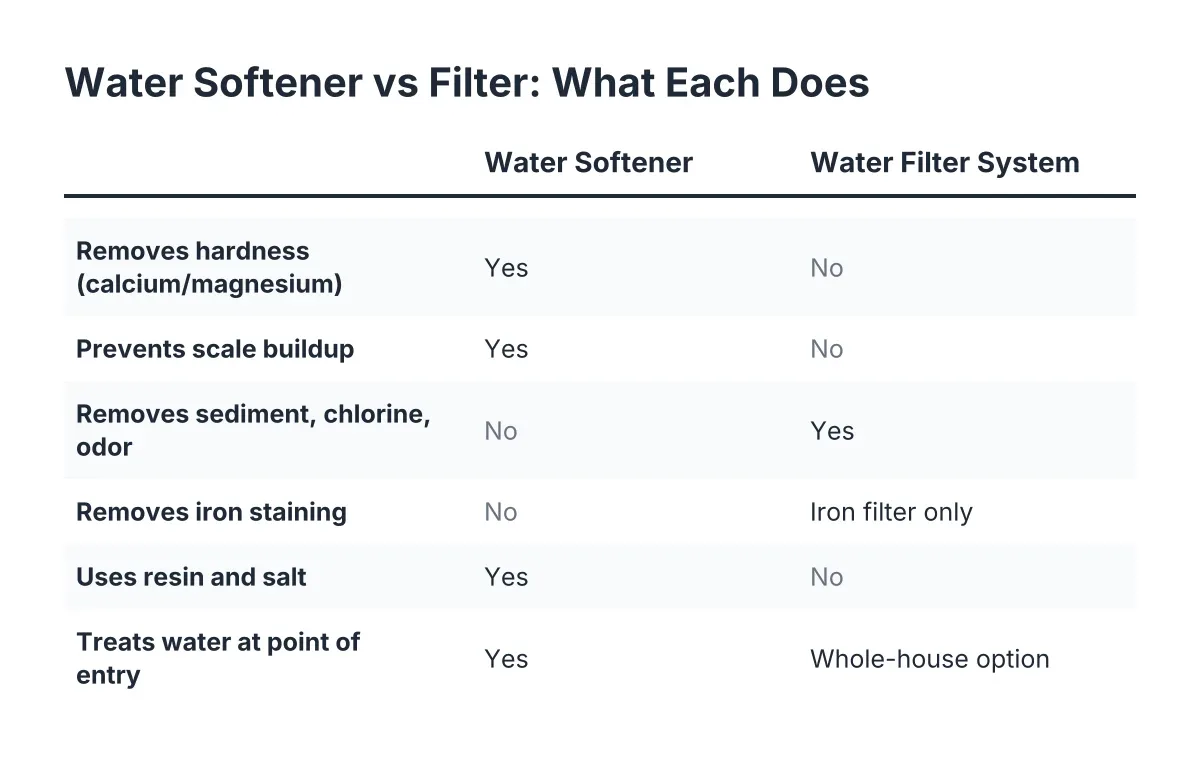
Scale buildup is the hard, chalky mineral crust that forms when hard water is heated or evaporates. You see it as white deposits on faucets and showerheads, but the damage you cannot see is worse. Scale coats water heater elements and dishwasher parts, making them work harder and fail sooner. Removing hardness with a water softener stops new scale from forming; a standard water filter system does not.
Hard Water Stains
Hard water stains are the mineral spots and streaks left behind when hard water dries on glass, fixtures, and tubs. White or cloudy stains point to calcium and magnesium, which a softener fixes. Orange, brown, or black stains point to iron or manganese, common in Twin Cities suburbs, which need filtration instead. The color of the stain tells you which piece of equipment you actually need.
The Equipment: Understanding Water Softener and Filter Functions in Your Glossary
These are the machines and parts a quote will name. Knowing which box does which job is the heart of the water softener vs filter question, because the two solve different problems and one cannot substitute for the other. That distinction is covered in depth in our guide to how a softener removes hardness and a filter does not.
Water Softener
A water softener is a device that removes calcium and magnesium from your water by trading them for sodium as the water passes through a resin tank. It is the only common residential fix for hardness itself. A softener protects your water heater, dishwasher, and fixtures from scale, and it makes soap and detergent work better. It does not remove chlorine taste, sediment, or most contaminants; that is filter territory.
Water Filter System
A water filter system is equipment that removes contaminants like sediment, chlorine, iron, or odor by trapping or absorbing them as water passes through a filter media. Filters improve taste, smell, and clarity, but a standard filter does not remove dissolved hardness minerals. If your main complaint is scale and stains from hardness, a filter alone will not fix it. Many Minnesota homes end up needing both, and this article on combining a softener and filter explains when that makes sense.
Whole-House Filter
A whole-house filter is a filter system installed where the water line enters your home, so every tap, shower, and appliance gets treated water. Compare that to a small under-sink or pitcher filter that treats one faucet. A whole-house filter matters when the problem, like iron staining or sediment, affects laundry, showers, and appliances, not just drinking water. Installation happens at the main line, so it is a real install, not a DIY cartridge swap.
Iron Filter
An iron filter is a whole-house filter built to remove dissolved iron and often manganese before they reach your fixtures. Iron is the usual culprit behind orange stains in toilets, tubs, and laundry, and it is common in suburban Twin Cities well water. Small amounts of iron can pass through a softener, but heavy iron will foul softener resin and shorten its life. If your water test shows meaningful iron, a provider who quotes an iron filter ahead of the softener is protecting your investment.
Salt-Free Conditioner
A salt-free conditioner is a device that changes how hardness minerals behave so they are less likely to stick as scale, without actually removing them from the water. It is often marketed as a "salt-free softener," but that name is misleading because the water stays hard. A conditioner needs no salt and no drain line, which appeals to some homeowners. But it will not give you the slick soft-water feel, better soap performance, or spot-free results a true softener does. Ask any provider pitching one to say plainly what it will and will not fix.
Dual-Tank Softener
A dual-tank softener is a system with two resin tanks, so one can regenerate while the other keeps supplying soft water. A single-tank unit sends hard water through the house during its regeneration cycle, usually scheduled overnight. Dual-tank systems suit large households, homes with high hardness, or anyone who uses water around the clock. They cost more up front, so expect that trade-off to show up in the quote.
The Parts and Processes: Water Softener and Filter Terms Explained in Your Glossary
Quotes and service calls throw around component names as if you already know them. Here is what the moving parts do.
Ion Exchange
Ion exchange is the chemical swap inside a softener where hardness minerals stick to resin beads and a small amount of sodium is released in their place. This is the process that makes softening possible, and it is why softeners need salt while filters do not. The sodium added to your water is small in typical conditions. When a spec sheet says "ion exchange softener," it means a standard salt-based unit, not something exotic.
Resin Tank
A resin tank is the tall tank in a softener filled with tiny plastic beads that grab hardness minerals as water flows through. The resin is the working heart of the system. Resin wears out over years, and heavy iron or chlorine speeds that up. If your softener runs but the water tests hard, tired resin is a common cause, and resin tank service or replacement may cost less than a whole new unit.
Brine Tank
A brine tank is the shorter tank that holds softener salt and mixes it with water to make the strong salt solution used during regeneration. This is the tank you refill with salt bags every month or two, depending on use. A crusty "salt bridge" inside the brine tank can stop the system from recharging even though the tank looks full. Checking salt level and breaking up bridges is basic softener maintenance you can do yourself.
Regeneration
Regeneration is the softener's automatic cleaning cycle, where salty water from the brine tank flushes the collected hardness minerals off the resin and down the drain. It usually runs overnight and takes an hour or two. How often it runs depends on your water hardness, your water use, and the unit's capacity. A softener that regenerates too often wastes salt and water; one that regenerates too rarely lets hard water slip through. Both point to a sizing or settings problem worth a service call.
Grain Capacity
Grain capacity is the total amount of hardness, measured in grains, a softener can remove before it must regenerate. Residential units commonly range from around 24,000 to 64,000 grains. The right capacity depends on your GPG and how many people live in the house. Bigger is not automatically better; an oversized unit regenerates so rarely the resin can degrade, and an undersized one runs constantly.
Bypass Valve
A bypass valve is the valve on a softener or filter that lets water flow around the equipment instead of through it. It matters for repairs, vacations, and outdoor watering, since there is no reason to soften water for the lawn. A stuck or leaking bypass valve is a common repair on older units. If a technician mentions it, they are talking about a specific part, not a full system replacement.
Micron Rating
A micron rating is a number that tells you how small a particle a filter can trap, with smaller numbers meaning finer filtration. A 25-micron sediment filter catches sand and grit; a 1-micron filter catches much finer particles. Finer filters clog faster and can slow your water pressure if chosen wrong. When a quote lists cartridge sizes and micron ratings, this is what those numbers mean.
Sizing, Scope, and What You Are Paying For
These terms show up when a provider turns your water test into a specific proposal.
Softener Sizing
Softener sizing is the process of matching a softener's capacity to your household size, water use, and tested hardness. Good sizing starts with a water test and a few questions about your home, not a one-size-fits-all model. Correct sizing keeps salt use, water use, and regeneration frequency in balance. A provider who quotes a size without asking about your hardness or household is guessing, and guesses cost you money either now or later. Sizing also affects price, which is broken down in this cost guide for softeners and filters.
Point of Entry vs Point of Use
Point of entry means treatment installed where water enters the house, so the whole home benefits; point of use means treatment at a single fixture, like an under-sink filter. Softeners and whole-house filters are point-of-entry equipment. Drinking-water filters are usually point of use. Knowing which one a quote describes tells you the scope of the install: main-line plumbing work versus a small fixture-level job.
Using These Terms
You now have what this water softener vs filter glossary set out to give you: the vocabulary to read a quote line by line and know whether it matches the stains, scale, or taste problem you actually have. When a provider says regeneration, grain capacity, or micron rating, you can follow the conversation instead of nodding along. Ask for your hardness number, ask what each piece of equipment removes, and let the answers tell you who knows their trade.
If you need water softener installation, Twin Cities Water Softening can help.
Prefer to talk it through? Call +16512171659 — a quick call is usually the fastest way to get a straight answer for your situation.