
When You Need Both: Combining a Water Softener and Filter for Complete Treatment
If your water leaves scale on the water heater and chlorine taste in your glass, one piece of equipment will not fix both. Sometimes you need both. Combining a water softener with a whole-house filter is how you handle hard water and water quality problems at the same time. This guide explains what each unit actually does, how they work together on one supply line, and how to set the pair up so it runs for years without trouble. It comes from the installer side of the counter, where we sell and service both types of equipment and have no reason to push one over the other.
Softening and Filtering Are Two Different Jobs
Start with the basic split, because most of the confusion online comes from blurring it.
A water softener removes dissolved hardness minerals, mostly calcium and magnesium. Inside the resin tank, ion exchange resin swaps those minerals out of the water. Salt in the brine tank recharges the resin so it can keep working. According to North Dakota State University Extension, water softeners rely on salt to regenerate the resin bed, and that regeneration is what keeps hardness minerals out of your water. In a loose sense, a softener is a filter for dissolved minerals; it turns hard water into soft water.
A whole-house filter removes different things. Depending on the media inside, it targets chlorine and chloramine, sediment, bad taste and odor, or iron and manganese. It does not remove hardness. You can run every drop of your water through a carbon filter and still get scale buildup on your fixtures and white crust on your dishes.
Here is the misconception that costs people money: softening and filtering are separate processes done by separate equipment, not two settings on one device. Soft water alone will not fix chlorine taste or chemical smell. A filter alone will not stop hard water stains or protect your water heater from scale. When your water has both problems, you need both. Combining the two systems on one main line is the standard fix, and it is a routine install for any competent water treatment company.
Why Minneapolis Water Often Means You Need Both
Minneapolis-area homes draw mineral-heavy water. According to HomeWater 101, the Twin Cities metro pulls water from the Mississippi River, producing hardness levels of 15 or more grains per gallon for Minneapolis-area homes. That is firmly in the very hard range. Statewide, the picture is similar; according to USGS Water Science School data across 49 measured Minnesota cities, the median hardness is 162.0 mg/L, or 9.5 grains per gallon, and 61 percent of those cities fall in the hard or very hard bands.
Hardness is only half the story here. Municipal water in the metro carries chlorine or chloramine for disinfection. That is what you taste and smell at the tap. Out in the suburbs on well water, iron and manganese are common, and they leave orange and brown staining on tubs, toilets, and laundry.
So a typical metro home faces two or three separate water problems at once:
- Scale buildup on the water heater, dishwasher, and fixtures from hardness
- Chlorine taste and smell from municipal treatment
- Iron and manganese staining, especially on suburban well water
- Sediment or cloudiness on some private wells
No single tank handles that whole list well. This is exactly the situation where combining a softener for the hardness with a filter matched to the other problem gives you complete treatment instead of a partial fix.
How Combining a Softener and Filter Works Together on One Line
When a softener and a whole-house filter share a supply line, order matters. The standard layout puts the filter first and the softener second on the main line, before the treated water branches to the rest of the house. An outdoor hose bib can tee off before treatment so you are not softening water for the lawn.
On municipal water, there is a specific reason for that order. Chlorine is hard on softener resin over time. Placing a backwashing carbon filter ahead of the softener strips chlorine and other chemicals before the water reaches the resin bed. The filter protects the softener, and the softener protects everything downstream. Each unit does its own job, and each one helps the other last longer.
On iron-heavy well water, the pairing shifts. Ion exchange softeners can help reduce small amounts of iron in well water in addition to softening, according to Penn State Extension. However, small amounts is the key phrase. When iron runs higher, the resin fouls and staining continues. In that case the right pair is a dedicated iron filter first, then the softener. This decision depends on a water test, not a guess, and it is one place where a professional assessment pays for itself.
A proper install also includes a bypass valve setup. That lets you turn a valve and route water around the softener and filter entirely, which matters during service, repairs, or a leak. Softener units also typically have their own inlet and outlet valves separate from the main house shutoff, according to InspectAPedia, so the unit can be isolated without cutting water to the whole house. If you have ever mopped up around a leaking resin tank at ten at night, you already know why those valves matter.
What the Combined Setup Looks Like in a Real Basement
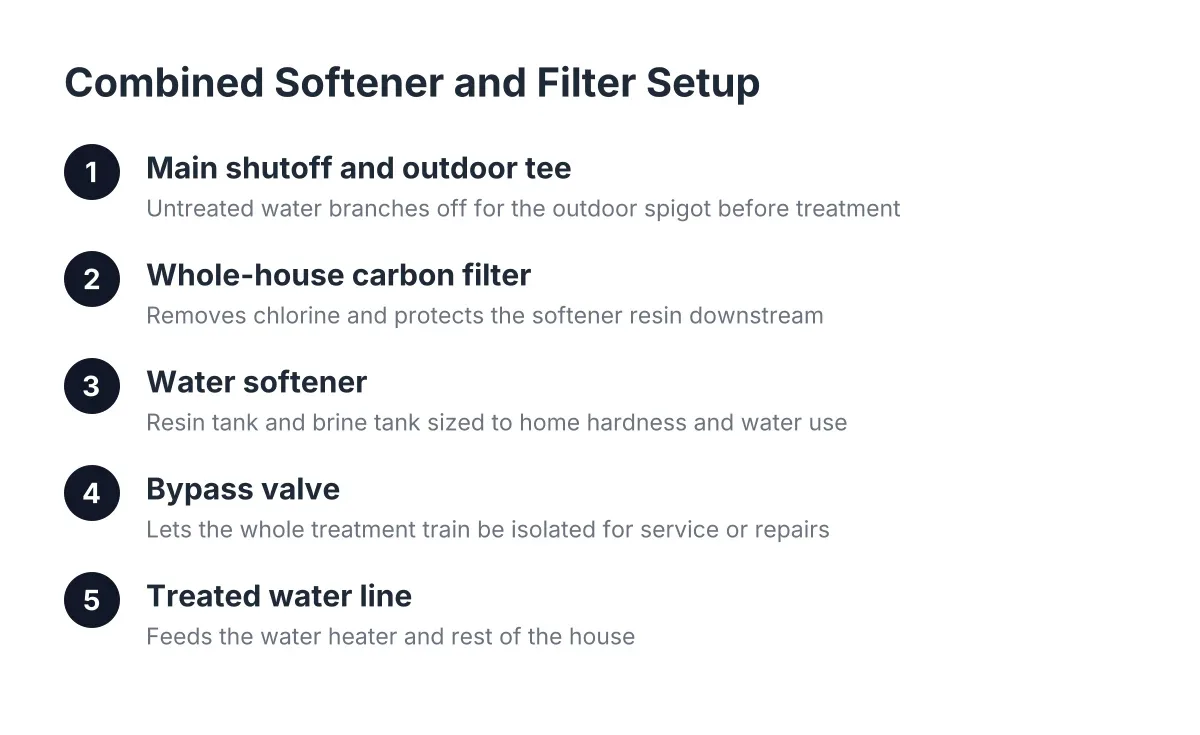
Suppose you own a 1960s rambler in a Minneapolis suburb on city water. The water heater is scaling up, the shower glass never comes clean, and the kitchen tap tastes like a pool. A typical crew would set the system up in this order on the main line after the meter:
- Main shutoff and a tee for an untreated outdoor spigot
- Whole-house carbon filter to remove chlorine and protect the resin
- Water softener with resin tank and brine tank, sized to the home's hardness and water use
- Bypass valve so the whole treatment train can be isolated
- Treated water line feeding the water heater and the rest of the house
In that scenario, the softener stops new scale buildup, the carbon filter fixes the taste and smell, and the water heater stops collecting mineral sediment. Neither unit alone gets that result. The homeowner who installs only a softener still tastes chlorine. The homeowner who installs only a water filter still fights hard water stains and appliance damage.
Now change one detail. Say the same house sits on a private well with visible orange staining in the toilet tanks. The carbon filter comes out of the plan and an iron filter goes in its place, ahead of the softener. Same logic, different media, because the problem in the water is different. That is why the equipment decision starts with a water test rather than a product brochure.
How to Size Equipment When Combining Softener and Filter
The point of pairing systems is complete treatment, not maximum equipment. A few decisions keep the setup right-sized.
Match the filter media to the actual problem
Test the water first. Carbon media handles chlorine, taste, and odor on city water. Iron filters handle iron and manganese on wells. Sediment filters handle grit and cloudiness. Buying a filter that targets a problem you do not have wastes money and floor space. This is also where the water softener vs filter question gets settled honestly; the test results tell you which problems exist, and the equipment list follows from that.
Size the softener to hardness and household use
A softener sized for 10 grains per gallon will struggle at Minneapolis levels of 15 or more. Sizing uses your measured hardness, the number of people in the home, and daily water use. Undersized units regenerate constantly and burn through water softener salt. Oversized units regenerate too rarely, which is hard on the resin.
Consider single-tank vs. dual-tank
A single-tank softener regenerates on a schedule, usually overnight, and during regeneration the house gets untreated water if anyone runs a tap. A dual-tank setup keeps one tank softening while the other regenerates or stands ready, so there is no window of hard water breakthrough. For a large household, or for a property manager running multi-unit buildings where water demand never fully stops, dual-tank is often worth the added cost.
Pick the right control valve
Softener control valves come in automatic and manual regeneration types. For nearly all homes and rental units, automatic is the right call. High-efficiency softeners can be programmed to use less salt, water, and energy than standard units, according to Culligan, which matters when you are buying salt for one home or for twenty units across a portfolio.
Salt, Chloride, and Doing This Responsibly in Minnesota
Running a softener in Minnesota comes with a real environmental question, and it is worth facing directly. Softener regeneration discharges chloride, and chloride does not break down. According to the Minnesota Pollution Control Agency, 75 percent of Minnesotans rely on groundwater for drinking water, and that groundwater is vulnerable to chloride contamination linked partly to softener discharge.
The fix is not to skip softening in a 15-plus grain city; it is to soften efficiently. The state has seen what optimization can do. A Minnesota Pollution Control Agency program in Marshall enrolled nearly 300 homeowners and businesses and cut salt use by up to 320,000 pounds per year, with some households reducing salt use by as much as 86 percent. The same program offered $500 to $700 rebates for replacing old timer-based softeners. The lesson for a Minneapolis homeowner in 2026 is simple: a modern demand-based softener, sized correctly, uses a fraction of the salt an old timer unit dumps down the drain.
Two more salt notes worth knowing. Most control valves can be set for either standard sodium chloride or potassium chloride as the regenerant, according to NSF International, depending on which salt you load. And per Cargill, softener salt contains insoluble material that settles at the bottom of the brine tank over time, so the tank needs a periodic cleanout. Skipping that cleanout is one of the quiet causes of salt bridging and the "salt not going down" complaint that leads to a service call.
Keeping the Combined System Running
A paired softener and filter is low-maintenance, not no-maintenance. If your last system failed on you, this checklist is how you keep the new one from doing the same.
- Check the brine tank monthly. Typical households refill water softener salt about every two to four months, according to Culligan, though hardness, family size, and tank size shift that.
- Break up any salt bridge. A hard crust above the water line means the softener runs but no brine forms, so the water goes hard even with a full-looking tank.
- Change or backwash filter media on schedule. Carbon and sediment cartridges have a service life; a spent filter passes chlorine straight to your resin.
- Watch for slow warning signs. Returning hard water spots, salt that never drops, or a bypass valve that is stiff or dripping all point to a problem worth catching early.
- Sanitize when conditions call for it. According to Kinetico, a softener should be sanitized after a boil-water order, after bad taste or odor shows up, or after the system sits unused during an extended absence.
For a property manager standardizing equipment across 20 or more units, this maintenance list is also the argument for consistency. Identical softener and filter pairs across a portfolio mean one salt schedule, one filter spec, and predictable service visits instead of a different fix at every building.
One honest limitation: not every home needs both systems. A house on low-chlorine municipal water with no taste complaints may only need a softener. A home with soft source water but bad taste may only need a filter. Additionally, a water test and an honest read of your symptoms should drive the decision, and when the answer is unclear, a local water treatment specialist can test on site before you buy anything.
The Bottom Line on Pairing Softener and Filter
Hard water and poor water quality are separate problems that show up together in most Minneapolis homes. A softener stops scale buildup and hard water stains. A whole-house filter handles chlorine, iron, sediment, and taste. When your water has both problems, and at 15-plus grains with treated city water it usually does, the complete fix is one treatment train: filter first, softener second, bypass valve on the whole thing.
Get the water tested, size the softener to real hardness numbers, match the filter media to what the test finds, and keep up with salt and filter changes. Do that, and the combined system fades into the background, which is exactly what good water treatment should do.
If you need water softener installation, Twin Cities Water Softening can help.
Prefer to talk it through? Call +16512171659 — a quick call is usually the fastest way to get a straight answer for your situation.