
Reverse Osmosis Whole House vs. Water Softener: What Minneapolis Water Needs
You've noticed the white crust on your faucets. Maybe an appliance tech told you hard water killed your dishwasher. Now you're researching fixes, and you keep running into a term that sounds like the ultimate answer: the reverse osmosis whole house system. It filters everything, right? So why would you need a water softener at all? Here's the straight answer from someone who installs both: for most Minneapolis homes, a whole-house reverse osmosis setup is the wrong tool, and a water softener plus targeted filtration is the right one. A whole-house RO system sounds like the ultimate solution, but it's rarely the right fit for Twin Cities homes. This article explains why, side by side, without the marketing fog.
The Real Problem in Minneapolis Water Is Hardness, Not Contamination
Before comparing equipment, name the actual problem. In the Twin Cities, that problem is almost always hardness minerals: dissolved calcium and magnesium.
Minneapolis draws mineral-heavy water from the Mississippi River, and hardness levels run 15 or more grains per gallon for Minneapolis-area homes, according to HomeWater 101. Statewide, the picture is similar. Across 49 measured Minnesota cities, the median hardness is 162.0 mg/L, or 9.5 grains per gallon, and 61% of cities fall in the hard or very hard bands, according to USGS Water Science School.
Hardness is what causes the problems you're seeing:
- White scale buildup on faucets, showerheads, and shower doors
- Cloudy glasses out of the dishwasher
- Water heaters and dishwashers dying years early
- Soap that won't lather and laundry that feels stiff
Here's the part the filter ads skip: hardness minerals are dissolved in the water. A standard whole-house filter cannot catch them, no matter how fine the cartridge. Only two things remove or neutralize dissolved hardness at whole-house scale: ion exchange (a water softener) or reverse osmosis. That's why this comparison matters.
What a Reverse Osmosis Whole House System Actually Does
A reverse osmosis whole house system pushes every gallon entering your home through a semipermeable membrane. The membrane strips out nearly everything dissolved in the water: hardness minerals, sodium, lead, arsenic, and most other contaminants. Reverse osmosis is considered the most effective method available for producing purified drinking water. On paper, it solves hardness and everything else at once.
In practice, whole-house RO is a specialty tool. It exists mainly for water sources that are hard to treat any other way: problem wells with contamination that standard filtration can't handle. For a Minneapolis home on treated municipal water, it's overkill, and expensive overkill at that.
Why Whole-House RO Rarely Fits a Twin Cities Home
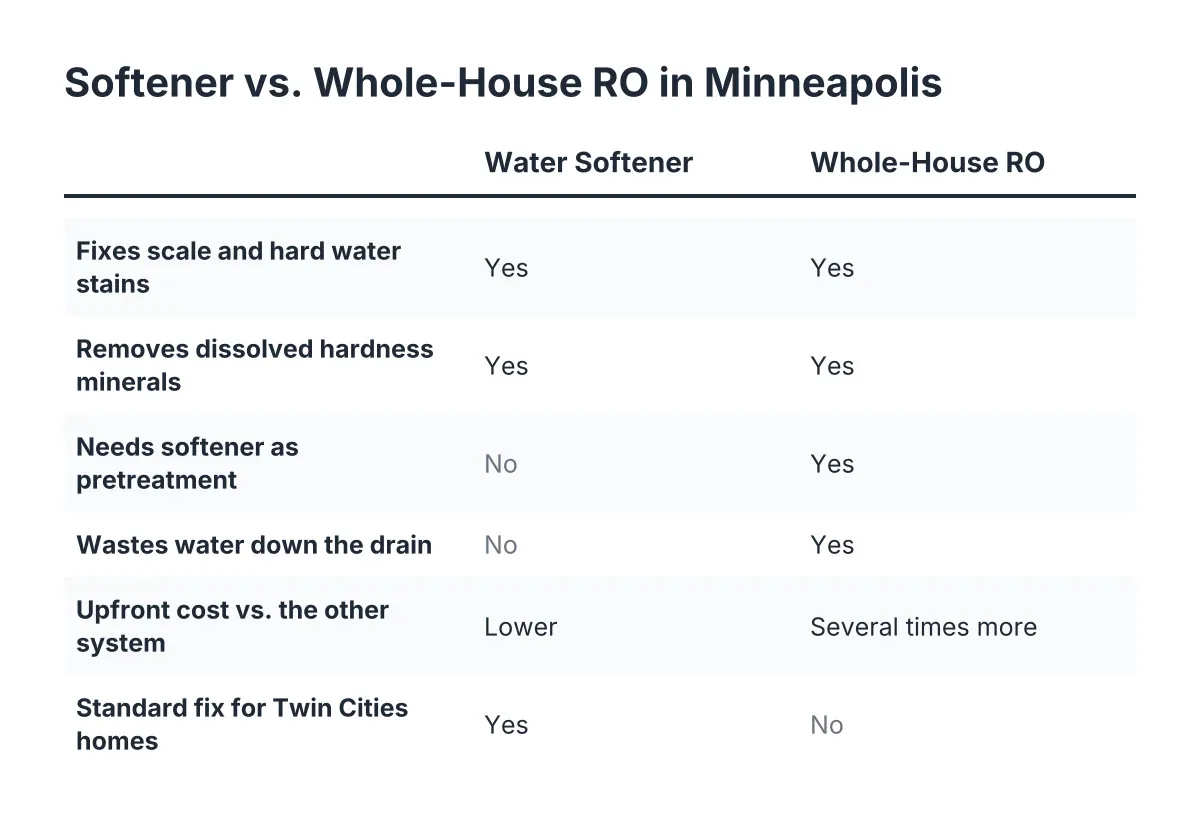
Reverse osmosis for the whole house rarely fits a Minneapolis home for three reasons: it wastes water, it costs several times more than a softener, and it needs pretreatment anyway. RO membranes send a portion of every gallon down the drain as reject water. Multiply that across every shower, toilet flush, and load of laundry, and the waste adds up fast.
Cost is the second problem. A whole-house RO system needs a large membrane array, a storage tank, a repressurization pump, and pretreatment equipment. As an illustrative estimate, that package often runs several times the price of a quality water softener installation, before you count membrane replacements.
Third, and this is the detail most homeowners miss: hard water destroys RO membranes. Scale buildup fouls the membrane the same way it fouls your water heater. On 15-plus grain Minneapolis water, a whole-house RO system needs a water softener installed in front of it just to survive. So the softener isn't an alternative to whole-house RO; it's a prerequisite. Some whole-house RO designs add recycle and blending features to cut wastewater and shape the final water quality, but that adds complexity and cost, not less.
There are cases where whole-house RO earns its keep. Certain private wells in outlying areas have water so difficult to treat that a secondary RO stage after standard filtration is the only workable fix. If a water test shows serious contamination, that's a conversation for a water treatment professional, not a checkout page.
What a Water Softener Does, and Why It's the Standard Fix Here
A water softener removes dissolved calcium and magnesium through ion exchange. Hard water passes through a resin tank, the resin grabs the hardness minerals, and soft water flows on to your whole house. The softener relies on salt to regenerate that resin bed, which is what keeps removing hardness minerals over time, according to North Dakota State University Extension.
For the problems that brought you here, this is the direct fix:
- Scale buildup stops forming on fixtures and inside your water heater
- Hard water stains on shower doors and glasses fade with normal cleaning
- Appliances last closer to their rated lifespan
- Soap and detergent work the way they're supposed to
A softener has other practical advantages in an older Minneapolis home. Ion exchange softeners can also reduce small amounts of iron, according to Penn State Extension, which helps with the orange staining common in suburban well water. Units typically have their own inlet and outlet valves separate from the main shutoff, so a tech can service the softener without cutting water to the whole house, according to InspectAPedia. That matters when your home's original plumbing dates to the 1960s and you'd rather not stress old shutoff valves.
The Honest Trade-Offs of a Softener
A water softener is not free to run. You'll refill salt on average every two to four months, depending on water hardness, family size, and brine tank size, according to Culligan. In a 15-grain city like Minneapolis, plan for the shorter end of that range.
Salt discharge is a real environmental consideration in Minnesota. Seventy-five percent of Minnesotans rely on groundwater for drinking water, and that groundwater is vulnerable to chloride contamination linked partly to softener discharge, according to Minnesota Pollution Control Agency. The fix is not skipping the softener; it's choosing an efficient one. High-efficiency softeners can be programmed to use less salt, water, and energy than standard units, according to Culligan. A Minnesota optimization program in Marshall cut salt use by up to 320,000 pounds per year, with some households reducing salt use by as much as 86%, according to Minnesota Pollution Control Agency. Sizing and programming matter that much.
One more caveat: a softener removes hardness, not everything. It won't fix chlorine taste, sediment, or most contaminants. That's where targeted filtration comes in.
Side by Side: Softener, Whole-House Filter, and Whole-House RO
Here's how the three options compare on what a first-time hard water sufferer in a pre-1980 Minneapolis home actually cares about.
Fixes Scale and Hard Water Stains
A water softener fixes scale directly; a whole-house filter does not; whole-house RO does, but at a much higher price and only with a softener protecting it anyway. This is the core of the water softener vs filter question, and it trips up nearly every first-time buyer. A carbon or sediment whole-house filter improves taste, smell, and clarity, but hardness minerals pass straight through it. If white crust and cloudy glasses are your complaint, a filter alone changes nothing.
Upfront and Ongoing Cost
As rough illustrative estimates for 2026: a properly sized water softener installation in the Twin Cities typically lands in the low-to-mid four figures. A whole-house carbon or sediment filter adds less than that. A reverse osmosis whole house system, with its membranes, storage tank, pump, and required pretreatment, often costs several times a softener, plus higher ongoing costs for membranes and reject water. Reverse osmosis whole house cost is the single biggest reason installers steer municipal-water homes away from it.
Water Waste
A softener uses some water during regeneration, but an efficient, correctly programmed unit keeps that modest. A standard whole-house filter wastes none. Whole-house RO sends reject water down the drain continuously, on every gallon your household uses.
Drinking Water Quality
Here RO wins, but you don't need it at every tap. A compact under-sink RO unit gives you purified water where you drink and cook, at a fraction of whole-house cost. That's the reverse osmosis whole house vs under sink question in one line: purify the one tap you drink from, soften the whole house. When choosing an under-sink unit, look for a nonproprietary design with inexpensive, easy-to-find replacement filters and minimal water sent to the drain.
The Setup That Actually Works for Minneapolis Homes
For most homes here, the right answer is a sequence, not a single box. A typical whole-house layout installs treatment in order on the main supply line:
- A sediment pre-filter first, which catches rust and grit before it reaches anything downstream. In a pre-1980 home with original galvanized or aging copper lines, this protects the softener, your fixtures, and your toilets.
- The water softener second, removing hardness before water branches to the house.
- Optional targeted filtration after that: a carbon whole-house filter for chlorine taste, a water filter system for the sink with an RO membrane for drinking water, or a filtered shower head if chlorine bothers your skin.
Suppose a homeowner in a 1962 Richfield rambler just replaced a water heater that scaled up and died at year seven. In that scenario, a sized water softener with a sediment pre-filter solves the scale, the stains, and the appliance damage. An under-sink RO unit handles drinking water. Total cost lands in the typical $1,200 to $3,500 install range most homeowners budget for this work, as an estimate. A whole-house RO system for that same home would cost far more and still need the softener installed first.
Look for NSF/ANSI 44 certification when comparing softeners; it means independent testing verified the unit removes calcium along with radium-226 and radium-228, according to NSF International. If salt concerns you, most modern units also let you switch the regenerant setting between standard sodium chloride and potassium chloride, according to NSF International.
How to Choose
Match the equipment to the problem you can see and the water you actually have.
- Scale, stains, cloudy glasses, dead appliances: you need a water softener. This describes most Minneapolis and inner-ring suburb homes.
- Bad taste or chlorine smell on top of hardness: softener plus a carbon whole-house filter, or an under-sink RO for drinking water.
- Iron or orange staining on a suburban well: softener sized for iron, sometimes with dedicated iron filtration ahead of it.
- Confirmed serious contamination on a private well: this is the rare case where a reverse osmosis whole house system belongs in the conversation, and it still needs softening as pretreatment.
Start with a water test, not a purchase. Hardness in grains per gallon, plus iron and manganese numbers, tells you exactly what to install and what size. A local installer who handles both softeners and filtration can size the system to your household instead of selling you the biggest box on the truck. Get the diagnosis right, and the equipment decision makes itself.
If you need water softener installation, Twin Cities Water Softening can help.
Prefer to talk it through? Call +16512171659 — a quick call is usually the fastest way to get a straight answer for your situation.