
Single Tank vs Dual Tank Water Softener: Which Handles Twin Cities Hard Water?
If your old softener just died and you are staring at a wet basement floor, the single tank versus dual tank water softener question lands fast. Every quote you get seems to push a different setup, and every sales page claims its design is the answer. Here is the honest version from an installer who puts in both: neither one is "better" across the board. Each design wins in specific situations, and Minneapolis hard water makes the choice matter more than it would in a soft-water city.
This comparison walks through how each system works, where each one struggles, and how to pick based on your actual household or rental property, not marketing copy.
Why the Tank Question Matters More in Minneapolis
Twin Cities water is hard enough that a softener is not optional equipment for most homes. According to HomeWater 101, the metro area draws mineral-heavy water from the Mississippi River, producing hardness levels of 15 or more grains per gallon for Minneapolis-area homes. Statewide, the picture is similar. USGS Water Quality Portal data shows 65 of Minnesota's 87 counties have very hard water above 180 mg/L.
At those hardness levels, your softener works hard and regenerates often. That is exactly the condition where the difference between a single tank and a dual tank design shows up. In a soft-water region, the choice barely matters. Here, it affects whether you ever run hard water through your pipes at all.
One quick note on terms. This article covers softener tank configurations, not the water softener vs filter question. A softener removes hardness minerals through ion exchange; a whole-house filter or reverse osmosis water filter handles taste, sediment, and contaminants. If iron staining or bad taste is your main complaint, a water filter system for home use may belong in the conversation too, often installed ahead of the softener on the main line.
How a Single Tank Softener Works
A single tank softener is the standard setup you see in most Minneapolis basements: one resin tank paired with a brine tank that holds the salt. Water flows through the resin, hardness minerals stick to the resin beads, and softened water goes to the house. When the resin fills up, the system regenerates. Salt brine flushes the beads clean, and the cycle starts over.
Modern single tank units are metered. They track how much water you use and regenerate only when needed, usually at 2 a.m. when nobody is running taps. That timing matters, because during regeneration the softener is offline. Any water you use in that window bypasses treatment and arrives hard.
Where a Single Tank Softener Wins
For most households, the single tank design earns its popularity honestly:
- Lower upfront cost. One resin tank, one control valve, simpler installation.
- Smaller footprint. Tight utility rooms and rental basements have room for it.
- Easier service. Parts are common, and most local techs know the platforms well.
- Metered efficiency. A properly sized, high-efficiency unit regenerates only on demand. According to Culligan, high-efficiency softeners can be programmed to use less salt, water, and energy than standard units.
For a small landlord turning over a unit, this combination is hard to argue with. The equipment cost stays modest, tenants get soft water, and any competent local service call can handle repairs down the road.
Where a Single Tank Falls Short
The weakness is that offline window. If your household runs the dishwasher at midnight or a tenant showers at 2:30 a.m., that water skips treatment during regeneration. With 15-plus grain water, even short breakthroughs feed scale buildup in the water heater over time.
Sizing also matters more with one tank. An undersized unit for a family of four in hard-water territory lets water pass through the resin too fast to soften fully, especially during heavy-use stretches like Sunday mornings or holidays. A single tank that is too small does not just run out; it half-works during peak demand, and you see hard water stains return without an obvious failure.
There is also a regeneration timing quirk. Metered single tank units often regenerate before the resin is fully exhausted, because they cannot risk running out mid-day. That means some salt gets used cleaning resin that still had capacity left.
How a Dual Tank Water Softener Works
A dual tank water softener uses two resin tanks and one control valve. One tank softens while the other sits regenerated and ready. When the working tank exhausts, the valve switches over to the fresh tank instantly, then regenerates the spent one in the background.
The result is soft water 24 hours a day, with no offline window. The system can also let each resin bed run to full exhaustion before regenerating, since the second tank is always standing by. That improves salt efficiency, because no capacity gets wasted by early regeneration.
Better twin-tank designs add another advantage. They make brine from already-softened water and use the fresh tank's clean water to flush the tank being regenerated. Rinsing resin with soft water cleans it more thoroughly than rinsing with hard water, which is what a single tank has to do.
Where a Dual Tank System Wins
- No hard water breakthrough, ever. Regeneration happens off to the side while the other tank carries the load.
- Better salt efficiency. Full resin exhaustion before regeneration means less wasted salt per year.
- Handles irregular schedules. Night-shift households, big families, and multi-unit buildings with unpredictable water use never catch the system offline.
- Well water flexibility. Homes on wells in the outer suburbs often run iron along with hardness, and continuous treatment keeps iron staining in check. According to Penn State Extension, ion exchange softeners can also reduce small amounts of iron in well water.
Salt efficiency is not a small thing in Minnesota. Chloride from softener discharge is a real water-quality concern here. The Minnesota Pollution Control Agency reported that a softener rebate and optimization program in Marshall cut salt use by up to 320,000 pounds per year, with some households reducing salt use by as much as 86 percent. An efficient, right-sized system is part of that picture, whatever the tank count.
Where a Dual Tank Falls Short
Cost is the obvious one. Two resin tanks and a more complex valve mean a higher price at water softener installation, and the unit takes up more floor space. For a rental property where the budget per unit is tight, that premium is hard to justify unless the water use pattern demands it.
There is a less obvious trade-off too. Some dual tank systems split a given resin capacity across two smaller tanks. Each tank individually holds less resin than one equivalent single tank, which can lower peak flow softening during a high-demand moment, like two showers and a laundry load at once. A dual tank system needs to be sized as carefully as any other softener, not just bought for the feature list.
Service is the last consideration. Dual tank valves are more complex, and not every tech stocks parts for every platform. If your current unit is leaking and you need it fixed this week, a common single tank platform is often the faster path back to working water.
Single Tank vs Dual Tank Water Softener Comparison
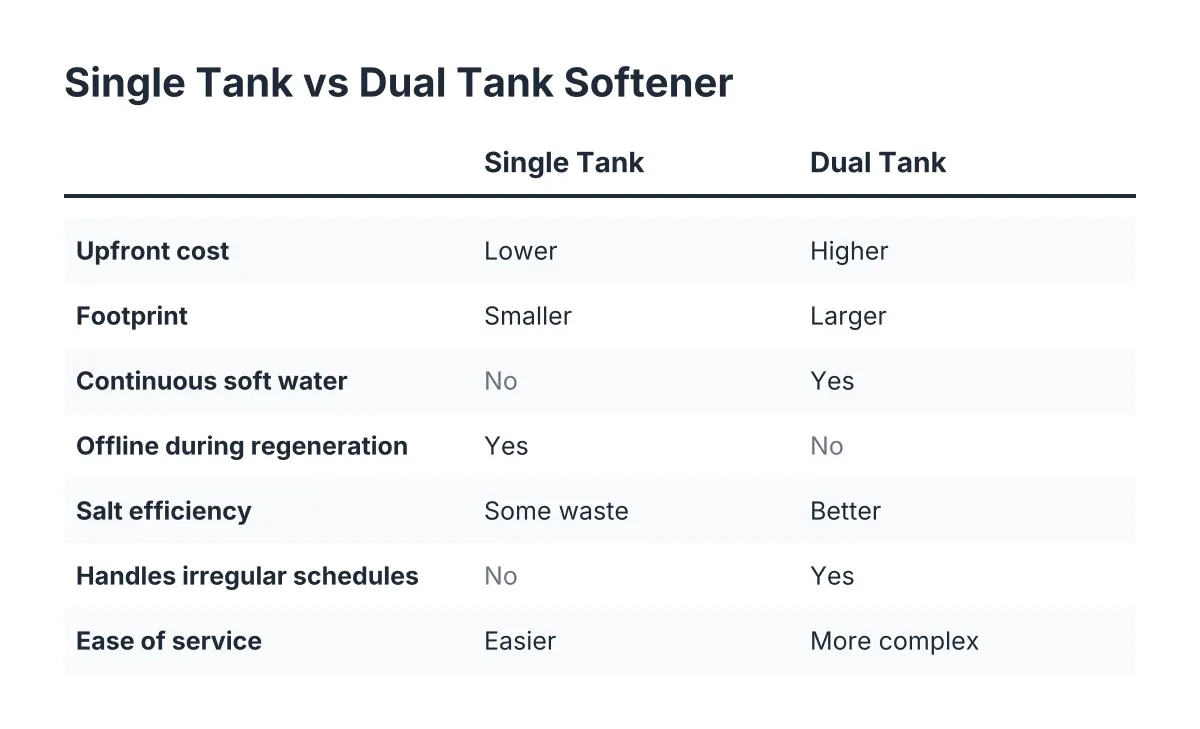
Here is the short version of the single tank versus dual tank decision, criterion by criterion.
Upfront cost. Single tank wins. Fewer components, simpler install, lower price.
Soft water availability. Dual tank wins. No offline window during regeneration, no hard water breakthrough at 2 a.m.
Salt efficiency. Dual tank has the edge. Full resin exhaustion and soft-water rinsing waste less salt per regeneration. However, a well-programmed high-efficiency single tank narrows the gap.
Footprint. Single tank wins. Two resin tanks plus a brine tank need room that many utility closets do not have.
Repair speed and parts. Single tank wins for most homeowners. Common platforms mean faster softener repair and easier parts sourcing on a service call.
Peak flow. Depends on sizing. A generously sized single tank can outperform a dual tank system whose individual tanks are small. Sizing beats configuration every time.
Heavy or unpredictable use. Dual tank wins. Large families, home businesses, and multi-unit rentals with staggered schedules benefit most.
A Realistic Scenario: The Landlord With a Failed Softener
Suppose you own a duplex in south Minneapolis. The softener quit two weeks ago, a tenant is complaining about spotted dishes and dry skin, and you found water pooling near the resin tank during an inspection. You want it fixed before the next turnover, and you want the lowest-hassle option that will not fail again in three years.
In that scenario, a right-sized single tank unit is usually the practical call. Illustratively, the premium for a dual tank system might run several hundred to over a thousand dollars more, and a duplex with two small households rarely uses water in a pattern that catches a metered single tank offline. Put the budget into correct sizing for combined hardness and usage instead.
Now flip the scenario. Say the property is a fourplex on a suburban well with 20-plus grain hardness and iron, and tenants shower around the clock. There, the dual tank design earns its cost. Continuous soft water protects four water heaters, and full-exhaustion regeneration keeps salt refills manageable. According to Culligan, typical households refill softener salt every two to four months, but a hard-water fourplex on an inefficient unit will burn through it faster than anyone wants to haul bags downstairs.
How to Choose Between Single Tank and Dual Tank
Start with three questions, in order.
- When do you use water? If your household sleeps through the 2 a.m. regeneration window, a single tank never leaves you with hard water in practice. If someone is always up, or tenants keep unpredictable hours, dual tank removes the risk.
- How hard is your water, and how much do you use? Get your water tested. At Minneapolis hardness levels of 15-plus grains per gallon, a family of four or a multi-unit building pushes a softener hard. High volume plus high hardness is the strongest case for a dual tank system.
- What does your budget and space allow? A tight utility room and a per-unit repair budget point to a quality single tank. Room to spare and a long ownership horizon point toward dual tank.
Two honest caveats. First, sizing matters more than tank count; the best water softener system for home use is the one matched to your hardness, iron level, and household size, not the one with the most tanks. Second, if you are not sure whether the puddle in your basement is a softener leak or a plumbing failure upstream, have a professional look before you buy anything. Replacing equipment that was not the problem is the most expensive mistake in this trade.
For most Minneapolis homes, a properly sized, metered single tank softener does the job well in 2026. For big families, well water with iron, round-the-clock water use, or small rental buildings with steady demand, the dual tank premium buys real performance, not just a spec-sheet bragging point. Match the system to how your building actually uses water, and either design will keep the scale off your water heater for years.
If you need water softener installation, Twin Cities Water Softening can help.
Prefer to talk it through? Call +16512171659 — a quick call is usually the fastest way to get a straight answer for your situation.