
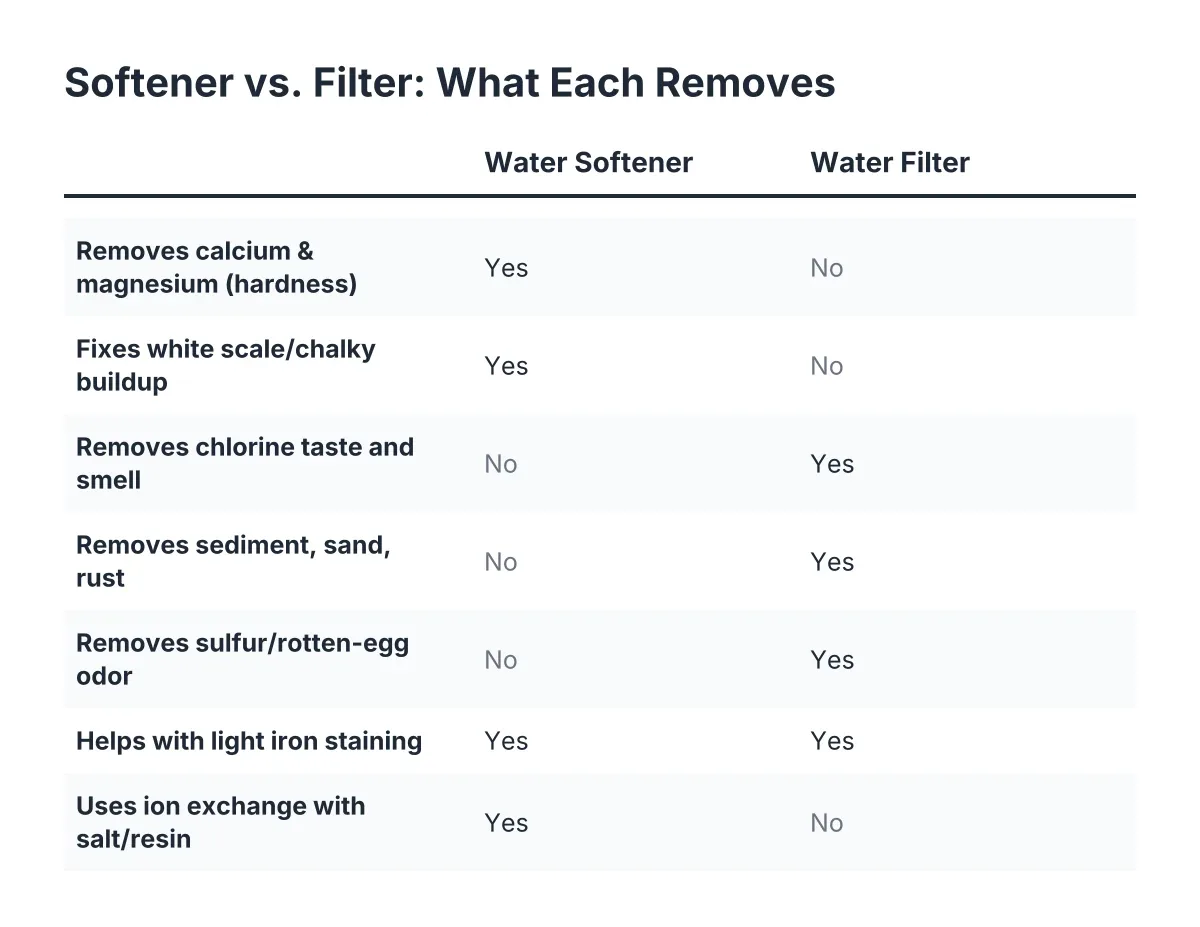
Water Softener vs. Filter: A Softener Removes Hardness, a Filter Does Not
If you moved to Minneapolis from a soft-water state, or your old system just quit, you have probably heard both terms thrown around like they mean the same thing. They do not. Here is the plain version from someone who installs both: a water softener removes hardness minerals, calcium and magnesium, from your water. A filter removes other stuff, like sediment, chlorine taste, and in some cases bacteria. Understanding the difference between a softener vs filter difference is essential because neither one does the other's job. Salespeople blur that line all the time, and it costs homeowners real money. This guide draws the line back where it belongs.
Why This Confusion Costs Minneapolis Homeowners Money
The confusion is not your fault. Marketing language works hard to blur it. Some products call themselves "salt-free softeners" when they soften nothing. Some whole-house filter packages promise to fix "water quality," which sounds like it covers hardness. It usually does not.
Here is why the distinction matters in this city specifically. The Twin Cities metro draws mineral-heavy water from the Mississippi River, and Minneapolis-area homes commonly see hardness of 15 or more grains per gallon, according to HomeWater 101. Statewide, the average hardness is 278.3 PPM, which the USGS Water Quality Portal classifies as very hard. Across 49 measured Minnesota cities, the median is 9.5 grains per gallon, and 61% of cities land in the hard or very hard bands, according to USGS Water Science School.
In other words, hard water is not a maybe here. It is the default. If you buy a filter to fix a hardness problem, you will spend real money and still have white crust on your faucets six months later. If you buy a softener to fix a rotten-egg smell or a chlorine taste, you will be disappointed the other direction.
So before you spend anything, get clear on which problem you actually have. That is what the rest of this guide is for.
What a Water Softener Removes: Hardness, Full Stop
A water softener removes hardness minerals, specifically dissolved calcium and magnesium, through a process called ion exchange. Water flows through a tank of resin beads that grab the calcium and magnesium and swap them for sodium ions. The salt in your brine tank is not softening the water directly; it regenerates the resin bed so it can keep trading, which North Dakota State University Extension confirms is what actually removes the hardness minerals.
That is the whole job. It is a narrow job, and it is the right tool for these symptoms:
- White, chalky scale buildup on faucets, showerheads, and around drains
- Cloudy spots and film on dishes and glassware, even fresh out of the dishwasher
- Soap that will not lather, and skin or hair that feels dry and tight after showers
- A water heater that rumbles, pops, or has lost efficiency from scale on its elements
- Stiff, dingy laundry no matter what detergent you use
Every one of those is a hardness symptom, and no filter on the market will fix them. Only ion exchange pulls those dissolved minerals out of the water before they can bake onto your pipes, water heater, and dishwasher.
One useful bonus: ion exchange softeners can also reduce small amounts of iron, which Penn State Extension notes is helpful on well water. In the Minneapolis suburbs, where iron and manganese staining shows up as orange or black streaks in toilets and tubs, that matters. Heavy iron still needs dedicated iron filtration, but a properly sized softener handles the light cases.
How Much Hardness a Softener Actually Takes Out
A correctly sized and maintained water softener removes hardness down to near zero grains per gallon at the tap. It does not just reduce hardness a little; it takes the calcium and magnesium out of the water almost entirely, as long as the unit is sized for your household and regenerating on schedule.
Sizing is where this goes wrong. A softener rated for 10 grains per gallon serving a Minneapolis home with 15-plus grains will run out of capacity between regenerations. You get soft water Monday and hard water Thursday, and homeowners often blame the unit when the real issue is the math. Capacity has to match your actual hardness, your household size, and your daily water use. That is a measurement and a calculation, not a guess off a box label.
If you want a benchmark for legitimacy, look for NSF/ANSI 44 certification. According to NSF International, that certification means the unit passed independent testing verifying it removes calcium, plus radium-226 and radium-228, from water. If a product cannot claim that standard, be skeptical of any softening claim it makes.
What a Filter Removes: Sediment, Taste, Smell, and Contaminants
A whole-house filter does a completely different job. Depending on the media inside, a water filter system removes things like:
- Sediment, sand, and rust particles that cloud water or clog fixtures
- Chlorine and chloramine taste and smell from municipal treatment
- Sulfur odors, the rotten-egg smell common on some wells
- Certain chemicals and organic compounds, depending on the filter type
- Heavy iron and manganese, with dedicated iron filtration media
Notice what is missing from that list: calcium and magnesium. A standard carbon or sediment filter does not touch dissolved hardness minerals. They pass straight through, because they are dissolved in the water, not floating in it. The key softener vs filter difference lies in this fact: filtering hard water through a whole-house water filter gives you hard water that tastes better. The scale buildup on your water heater continues exactly as before.
This works the other way too. Soft water alone does not remove chlorine taste or a chemical smell. If your water is both hard and tastes like a swimming pool, which is common on Minneapolis municipal water, you need both technologies working together. That is not an upsell; it is two different problems needing two different tools.
Softener and Filter Function: Where the "Best Filtration System" Advice Goes Wrong
Search for the best water filtration system for home use and you will find rankings that never ask the first question: what is in your water? A filter that wins awards for chlorine removal is the wrong purchase if your actual problem is 16 grains of hardness eating your water heater. There is no best system in the abstract. There is only the right equipment for the water coming into your specific house, and in this metro, hardness treatment is usually the foundation everything else builds on.
The Water Conditioner Trap: Why "Salt-Free Softener" Is Not a Softener
Salt-free water conditioners do not remove hardness minerals from water. This is the most common point of confusion in the water softener vs filter conversation, and it deserves its own section because the marketing is aggressive.
A conditioner changes how hardness minerals behave. The idea is that treated minerals are less likely to stick to pipes as scale. What a conditioner does not do is take calcium and magnesium out of the water. Test the water leaving a conditioner and the hardness reading is unchanged. So does a water conditioner remove hardness? No. The minerals are all still there.
That means conditioned water still leaves spots on dishes. Soap still struggles to lather. Your skin still feels the minerals. For a relocator arriving from a soft-water region, a conditioner will not give you the water you are used to. Only ion exchange, the process where a water softener removes hardness through resin and salt regeneration, actually changes what is dissolved in the water.
Conditioners have a legitimate place. Some homeowners want reduced scale without adding salt, and some cities are pushing that direction; the Minnesota Pollution Control Agency reports that a program in Marshall, Minnesota offered $500 to $700 rebates for replacing timer-based softeners, partly to cut chloride pollution. Salt discharge is a real environmental concern in Minnesota. But choose a conditioner with clear eyes about the trade-off: less scale sticking, zero hardness removed. If softness is what you want, a conditioner will disappoint you.
Modern equipment softens the environmental edge of that trade-off. High-efficiency softeners can be programmed to use less salt, water, and energy than standard units, according to Culligan. And NSF International notes many units can run on potassium chloride instead of standard sodium chloride, which some households prefer. In Marshall's program, some households cut salt use by as much as 86% just by optimizing their equipment, per the Minnesota Pollution Control Agency. Efficient softening exists; you do not have to choose between soft water and responsibility.
When Your Old System Fails: Diagnosing Softener vs. Filter Problems
Suppose your basement softener has been humming along for twelve years, and this week you notice water pooling near the resin tank and fresh hard water spots on the shower door. Now you are firefighting, and the first question is what actually failed. The symptom tells you which system to look at.
First, if hardness symptoms came back, the softener side failed. Spots on dishes, scale creeping back on fixtures, and soap suddenly not lathering all point to the softener not regenerating. Check the brine tank. If the salt level has not gone down in weeks, the unit is not drawing brine. Sometimes it is a salt bridge, a hard crust over a hollow pocket, which you can break up with a broom handle. Sometimes it is a failed valve or a fouled resin bed, which is a service call.
Second, if the problem is taste, smell, or cloudy water, look at the filtration side, or realize you never had filtration and need it. A softener that is working perfectly will not fix a chlorine taste.
Third, if the unit is leaking, isolate it before you diagnose anything. Softeners typically have their own inlet and outlet valves separate from the main house shutoff, according to InspectAPedia, so you can bypass the unit without cutting water to the whole house. Put the unit in bypass, mop up, and then figure out whether it is the bypass valve itself, a tank fitting, or a cracked brine line. Bypass valve repair and leak repair are common, fixable jobs; a leak does not automatically mean the softener is dead.
A quick note on maintenance while you are down there: salt contains insoluble material that settles at the bottom of the brine tank over time and needs periodic cleanout, according to Cargill. A sludgy brine tank is a slow, quiet way for a softener to stop removing hardness while looking fine from the outside. And per Kinetico, a softener should be sanitized after a boil-water order, after sitting unused during an extended absence, or when well water develops a bad taste or odor.
Repair, Replace, or Rethink the Whole Setup
The failure moment is also a decision moment. A reasonable rule of thumb: a unit under roughly ten years old with a single failed part, like a bypass valve or brine line, usually deserves a repair. A unit past twelve to fifteen years with fouled resin, repeated failures, or an outdated timer-based control is usually a replacement candidate, because you would be putting new parts on a machine near the end of its life.
There is a third option worth naming. If your old setup never fully solved your water, say you softened but still fought iron stains or chlorine taste, a failure is the natural time to rethink the whole system rather than clone the old one. Water softener and filter combo systems exist for exactly this: a softener handling hardness and a whole-house filter handling taste, sediment, or iron, plumbed in sequence.
Resin condition is a judgment call that benefits from someone who services these units regularly; chlorinated city water degrades resin over years, and no checklist replaces a hands-on assessment. If you are unsure whether a leak is the softener or the house plumbing, that is also worth a professional look before you replace anything.
A Simple Decision Path for 2026
If you are staring at equipment options in 2026, whether you are replacing a dead unit or setting up a home you just bought, this order of operations keeps you from buying the wrong box:
- Test the water first. Get a hardness number in grains per gallon, plus iron and manganese if you are on a well or in a suburb known for staining. You cannot size or select equipment without it.
- Match the symptom to the technology. Scale, spots, dry skin, and stiff laundry mean hardness, and only a softener removes hardness. Taste, odor, sediment, and staining point to filtration.
- Size the softener to your actual numbers. Hardness level, household size, and daily use set the capacity. Metro homes at 15-plus grains need meaningfully more capacity than a generic big-box unit assumes.
- Add filtration only for the problems you confirmed. Carbon for chlorine taste, sediment filtration for particles, iron media for heavy staining. Do not pay for media that treats a problem you do not have.
- Skip anything that calls itself a softener but removes nothing. If the product cannot show hardness leaving the water, it is a conditioner, whatever the label says.
For the relocator who just closed on a house with no softener at all, this path usually ends with a softener installed first, since hardness is near-universal here, and filtration added only if the test or your own nose says so. For the homeowner with a failed unit, it usually ends with a repair-or-replace call informed by the unit's age and what actually broke.
The One-Sentence Version to Remember
A water softener removes hardness minerals so scale stops attacking your water heater, dishwasher, pipes, and skin. A filter removes sediment, tastes, odors, and contaminants that a softener ignores. Additionally, a conditioner removes nothing and only discourages scale from sticking. In Minneapolis water, which runs hard to very hard nearly everywhere, most homes need softening as the foundation, some need filtration on top of it, and nobody should pay for one expecting the results of the other.
Get a hardness number, match the equipment to the problem, and the confusing water treatment aisle turns into a short, clear shopping list.
If you need water softener installation, Twin Cities Water Softening can help.
Prefer to talk it through? Call +16512171659 — a quick call is usually the fastest way to get a straight answer for your situation.