
Water Softener for Iron and Manganese Stains: What Works in Minneapolis Suburbs
Orange rings in the toilet. Rust streaks in the tub. Black flecks around the faucet aerator. If you just moved into a home in the Minneapolis suburbs and you are seeing stains like these, you are probably wondering whether a water softener handles iron and manganese, or whether you need a filter instead. Water softener iron stains are one of the most common concerns we address with new homeowners. It is a fair question, and the marketing around it is confusing on purpose. This guide gives you the plain answer from an installer's point of view: a water softener can remove iron and manganese, but only up to a point, and knowing where that point sits for your water is the whole decision.
We install softeners, iron filters, and whole-house filter systems. We do not have a horse in the race between them. What follows is the same walkthrough you would get standing next to your utility sink.
Why Minneapolis Water Stains Fixtures in the First Place
Start with what is in the water, because the equipment decision flows from it. The Twin Cities metro draws mineral-heavy water from the Mississippi River, and Minneapolis-area homes see hardness levels of 15 or more grains per gallon, according to HomeWater 101. That is firmly in the "very hard" range. Hardness is calcium and magnesium, and it causes the white, crusty scale buildup on faucets, shower doors, and inside your water heater.
Iron and manganese are a different problem. They show up most in suburbs on well water, and in some municipal systems too. Iron leaves orange and rust-colored stains. Manganese leaves brown or black stains and can put dark flecks in your water. Neither one is scale. That matters, because a lot of homeowners see stains, buy the wrong equipment, and keep the stains.
This is not a small local quirk. According to the USGS Water Quality Portal, 65 of Minnesota's 87 counties have very hard water above 180 mg/L, and only 5 counties have soft water. Across 49 measured Minnesota cities, the median hardness is 162.0 mg/L, or 9.5 grains per gallon, with 61 percent of cities landing in the hard or very hard bands, according to the USGS Water Science School. If you relocated here from a soft-water region, your instincts about "normal" water do not apply. The scale and the stains are real, and they will not clean themselves away.
How Water Softener Iron Stains Are Removed
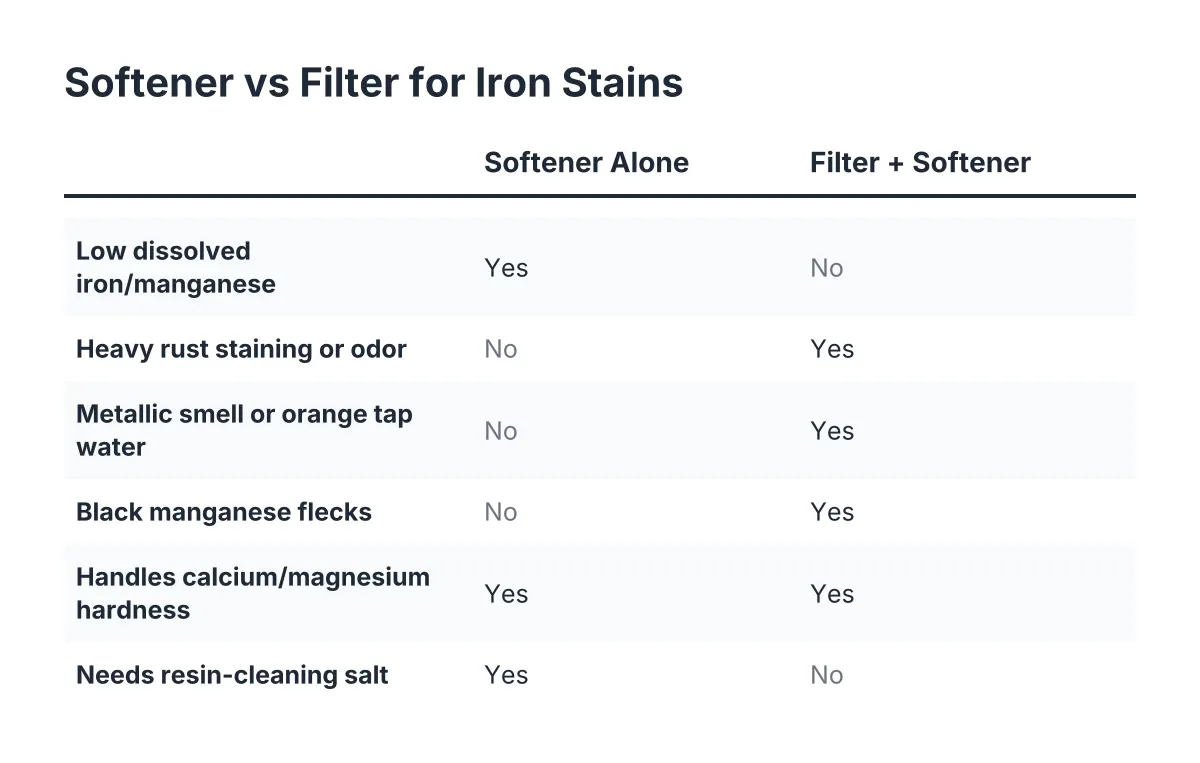
Yes, a water softener can remove iron and manganese, but only at low concentrations and only when the metals are dissolved in the water rather than already oxidized. Ion exchange softeners can help reduce small amounts of iron in well water in addition to removing hardness minerals, according to Penn State Extension. Above that low threshold, a softener alone will not stop the staining.
Here is why. A softener works by ion exchange. Water passes through a resin bed, hardness minerals stick to the resin, and sodium goes into the water in their place. Dissolved iron and manganese carry a similar charge, so the resin grabs some of them too. The softener then uses salt to regenerate the resin bed and flush the captured minerals down the drain, as North Dakota State University Extension explains.
The catch is capacity and form. If your iron or manganese level is more than trace amounts, the resin cannot keep up. Worse, if the metals have already turned to rust particles, red water, or black specks you can see, the resin cannot exchange them at all. Particles need a filter, not a softener. A softener asked to do heavy iron duty will foul its resin bed, lose softening capacity, and need repair or replacement years early.
When a Softener Alone Handles the Stains
Suppose you are on Minneapolis city water, or a suburb with low iron in the supply, and your main complaints are white scale buildup, cloudy dishwasher glasses, and a faint orange tint in the toilet tank. In that case, a properly sized water softener usually fixes all of it. The iron level is low enough that the resin catches it while doing its main job on calcium and magnesium.
There is one maintenance note if your softener is pulling iron duty without a dedicated iron filter. Use a resin-cleaning salt, often sold in green bags, instead of plain salt. It helps keep iron from coating the resin bed. Plan on cleaning out the brine tank periodically too; softener salt contains insoluble material that settles at the bottom over time and needs cleanout, according to Cargill. A softener removing iron simply needs more attention than one handling hardness alone.
When You Need an Iron and Manganese Filter Too
If your water leaves heavy rust staining, smells metallic, runs orange after the tap sits overnight, or shows black manganese flecks, a softener alone is the wrong tool. You need a dedicated iron and manganese filter, and often a softener behind it, because iron-heavy suburban well water usually carries hardness as well. The filter oxidizes the metals and traps them; the softener then handles the calcium and magnesium. Water softener iron stains paired with heavy contamination require professional treatment to prevent ongoing damage.
Order matters here. On well water, the iron filter goes upstream of the softener, so the resin never sees the heavy metal load. On municipal water with chlorine, any backwashing carbon filter also goes ahead of the softener, so chlorine does not chew up the resin. Getting this sequence wrong is one of the most common problems we find on service calls for softeners that failed early.
How to Tell Which Problem You Actually Have
You do not have to guess. The stains themselves tell you most of the story, and a water test tells you the rest. Before anyone quotes you equipment, get the numbers: hardness in grains per gallon, iron in mg/L, manganese in mg/L, and pH. On a private well, test every one of those. On city water, your municipality publishes hardness, but iron can still enter from old galvanized pipes in the house.
Use this quick read on your symptoms:
- White, chalky crust on faucets and shower doors: hardness. A water softener fixes this.
- Cloudy glasses out of the dishwasher: hardness. Softener.
- Orange or rust stains in toilets, tubs, and laundry: iron. Softener if trace levels; iron filter if heavy.
- Brown or black stains and dark specks: manganese. Usually needs a dedicated filter.
- Rotten egg smell: sulfur. Needs an iron and sulfur filter, not a softener.
- Chlorine taste or smell on city water: carbon filtration, not softening.
Notice the pattern. Softeners fix hardness. Filters fix everything else. The gray zone is low-level dissolved iron and manganese, where a softener does double duty. That gray zone is exactly where the water softener iron and manganese question gets decided, and it gets decided by a test number, not a sales pitch.
Softener vs. Filter for Iron: An Installer's Honest Comparison
The water softener vs filter debate is mostly a false choice created by companies that only sell one of them. A softener and a whole-house filter do different jobs. A softener removes hardness by ion exchange so scale-forming minerals never reach your pipes, water heater, dishwasher, or washing machine. Additionally, a whole-house filter system traps particles, removes chlorine, or oxidizes and captures iron and manganese, depending on the media inside it.
A filter does not soften. No carbon filter, sediment filter, or under-sink water filter for the sink will touch your 15-grain hardness or stop scale buildup in the water heater. Likewise, a softener is not a filter. It will not remove sediment, chlorine, taste, or odor, and it will not handle heavy iron. Anyone who tells you one box does everything for Minneapolis suburban well water is selling you the box they stock.
The same goes for shortcuts. A shower stick water softener, the small inline cartridge sold for showerheads, is really a filter, and it cannot perform true ion exchange at shower flow rates. It will not fix hard water stains on your glass door. Salt-free "water conditioners" change how scale forms but remove nothing; they do not touch iron or manganese at all, and they do not make water soft. For real iron and manganese staining, the honest answers are a softener, an iron filter, or both, chosen by your test results.
Sizing a Water Softener When Iron and Manganese Are Present
Sizing a water softener around iron and manganese takes four numbers: your hardness in grains per gallon, your iron level, your manganese level, and the number of people in the home. Iron and manganese consume softening capacity, so installers add compensation grains for each, which usually means a larger unit than hardness alone would suggest.
For example, a family of four on 20-grain suburban well water with modest dissolved iron needs a noticeably bigger resin tank than the same family on Minneapolis city water. Undersize it and the unit regenerates constantly, burning salt and water. Oversize it badly and the resin sits too long between regenerations, which invites iron fouling. Sizing is where a specialist earns their fee, and it is also where getting oversold happens most, so ask the installer to show you the math against your actual test numbers.
Two more spec-sheet items worth checking in 2026. First, look for NSF/ANSI 44 certification; it means the softener passed independent testing verifying it removes calcium along with radium-226 and radium-228, according to NSF International. Second, high-efficiency softeners can be programmed to use less salt, water, and energy than standard units, according to Culligan. That matters in Minnesota, where chloride from softener salt is a watershed concern. A rebate program in Marshall, Minnesota paid $500 to $700 for replacing old timer-based softeners, according to the Minnesota Pollution Control Agency, and the same program cut salt use by up to 320,000 pounds per year across nearly 300 participants, with some households cutting salt use by as much as 86 percent. If your new home came with an aging timer-based softener, replacing it with a metered unit saves salt every single week.
What Installation Looks Like and What to Budget
A straightforward water softener installation in a Minneapolis home takes a few hours. The installer sets the softener near where the main water line enters, usually by the utility area, cuts into the line, adds a bypass valve, and runs a drain line for regeneration discharge. The unit gets its own inlet and outlet valves separate from the main house shutoff, so it can be isolated for service without cutting water to the whole house, as InspectAPedia notes. Then the installer programs the unit to your tested hardness and iron levels, loads salt, and runs a regeneration to confirm everything drains and seals correctly.
Adding an iron and manganese filter extends the job, since it means a second tank plumbed upstream of the softener with its own drain line. Expect a full day for a combined system rather than a half day for a softener alone.
On budget, as an illustrative range rather than a quote, most Minneapolis homeowners should plan on roughly $1,500 to $4,000 installed for quality softening equipment, with combined softener and iron filter setups landing at the upper end or above it. Ongoing costs are salt, typically a few bags a month depending on household size and water use, plus periodic maintenance. Potassium chloride works as an alternative regenerant on most units; the salt type setting can usually be switched between sodium chloride and potassium chloride, according to NSF International, though potassium costs more per bag.
Here is a hypothetical that mirrors what we see constantly. Say a couple relocates from Denver, closes on a 1990s house in a western suburb, and finds rust rings in both toilets within three weeks. The inspection flagged no softener. A water test shows 22 grains of hardness, moderate dissolved iron, and a trace of manganese. In that scenario, the right answer is an iron filter feeding a properly sized softener, installed in one visit, with resin-cleaning salt as cheap insurance. A softener alone would have helped for a year or two, then fouled. A filter alone would have left the scale destroying the new dishwasher. The test numbers made the decision, not a brochure.
Living With the System: Maintenance for Iron-Duty Softeners
A softener that handles iron and manganese needs more care than one on clean city water. That is the honest trade-off, and homes on private wells with meaningful iron should expect it going in. Budget for these habits:
- Check salt monthly and keep the brine tank at least a third full.
- Use resin-cleaning salt if the softener removes iron without a dedicated iron filter ahead of it.
- Clean out the brine tank when insoluble sludge builds at the bottom.
- Sanitize the system after a boil-water order, after bad taste or odor shows up on a well, or after the house sits empty for an extended stretch, per Kinetico's guidance.
- Watch for the early failure signs: spots returning on glasses, stains creeping back, or the unit regenerating far more often than programmed.
If stains return even though the salt is full and the settings are right, the resin bed may be iron-fouled, or your well's iron level may have climbed. That is the point to bring in a local water treatment professional rather than keep buying cleaning products; resin tank service or a media change is a diagnosis job, not a DIY guess. The same goes for any well showing sulfur odor or sudden color changes, which can signal a shift in the well itself.
The Bottom Line for Minneapolis, MN Homeowners
If your problem is white scale and cloudy glasses, a water softener fixes it, full stop. If your problem is orange or black staining, get the water tested first. Trace dissolved iron and manganese, a well-sized softener with resin-cleaning salt handles it. Heavier levels, pair a dedicated iron filter upstream with a softener behind it, and both problems end for good.
The equipment decision for iron, manganese, and hardness comes down to three test numbers and an honest installer willing to sell you the smaller system when that is what the numbers say. In a metro where 15-plus grain water is normal and iron staining runs through the suburbs, the homes that stay stain-free are the ones where somebody tested first and sized second. Do those two things in that order, and the rust rings, black flecks, and crusty faucets stop being part of owning a home in Minneapolis, MN.
If you need water softener installation, Twin Cities Water Softening can help.
Prefer to talk it through? Call +16512171659 — a quick call is usually the fastest way to get a straight answer for your situation.