
Water Softener vs Filter: Which One Fixes Minnesota Hard Water Problems?
If you own an older home in Minneapolis, you have probably stood at a sink covered in white crust and wondered whether you need a water softener or a filter. The two get sold side by side, and the marketing blurs together. But they solve different problems. As installers who put in both, we can tell you the honest answer up front: for most Minnesota hard water problems, the softener does the heavy lifting, and a filter earns its keep only when something specific is in your water that a softener cannot handle.
This guide walks through what each system actually does, which Minnesota problems each one fixes, and how to decide when your current equipment is failing and you need to pick a replacement fast.
Why Minnesota Water Wrecks Equipment in the First Place
Minneapolis and its suburbs sit on some of the hardest water in the country. According to the USGS Water Quality Portal, Minnesota's average statewide water hardness is 278.3 PPM, which lands in the "very hard" category. The same data shows 65 of Minnesota's 87 counties have very hard water above 180 mg/L. Only 5 counties in the whole state have soft water.
The Twin Cities are not the exception. According to HomeWater 101, the metro draws mineral-heavy water from the Mississippi River, and hardness for Minneapolis-area homes can run 15 or more grains per gallon. On the USGS scale, anything over 10.5 grains is very hard. So the water coming into your house carries a heavy load of dissolved calcium and magnesium every single day.
Those minerals do not stay dissolved. Heat them in a water heater or let them dry on a shower door, and they turn into scale. In a pre-1980 house with original plumbing, decades of that scale narrows pipes, coats water heater elements, and clogs faucet aerators. That is why hard water shortens appliance life; the scale buildup forces water heaters and dishwashers to work harder until they fail early.
Add iron to the picture in many suburbs, especially on well water, and you get the orange-brown staining in toilets, tubs, and around drains. Hard water stains and iron stains often show up together, but they are two different problems, and that matters for choosing equipment.
What a Water Softener Actually Does
A water softener removes the dissolved calcium and magnesium that make water hard. It runs your water through a tank of ion exchange resin, which swaps out the hardness minerals before they reach your pipes, water heater, and fixtures. Then the system uses salt to regenerate that resin bed so it can keep working, a process confirmed by North Dakota State University Extension.
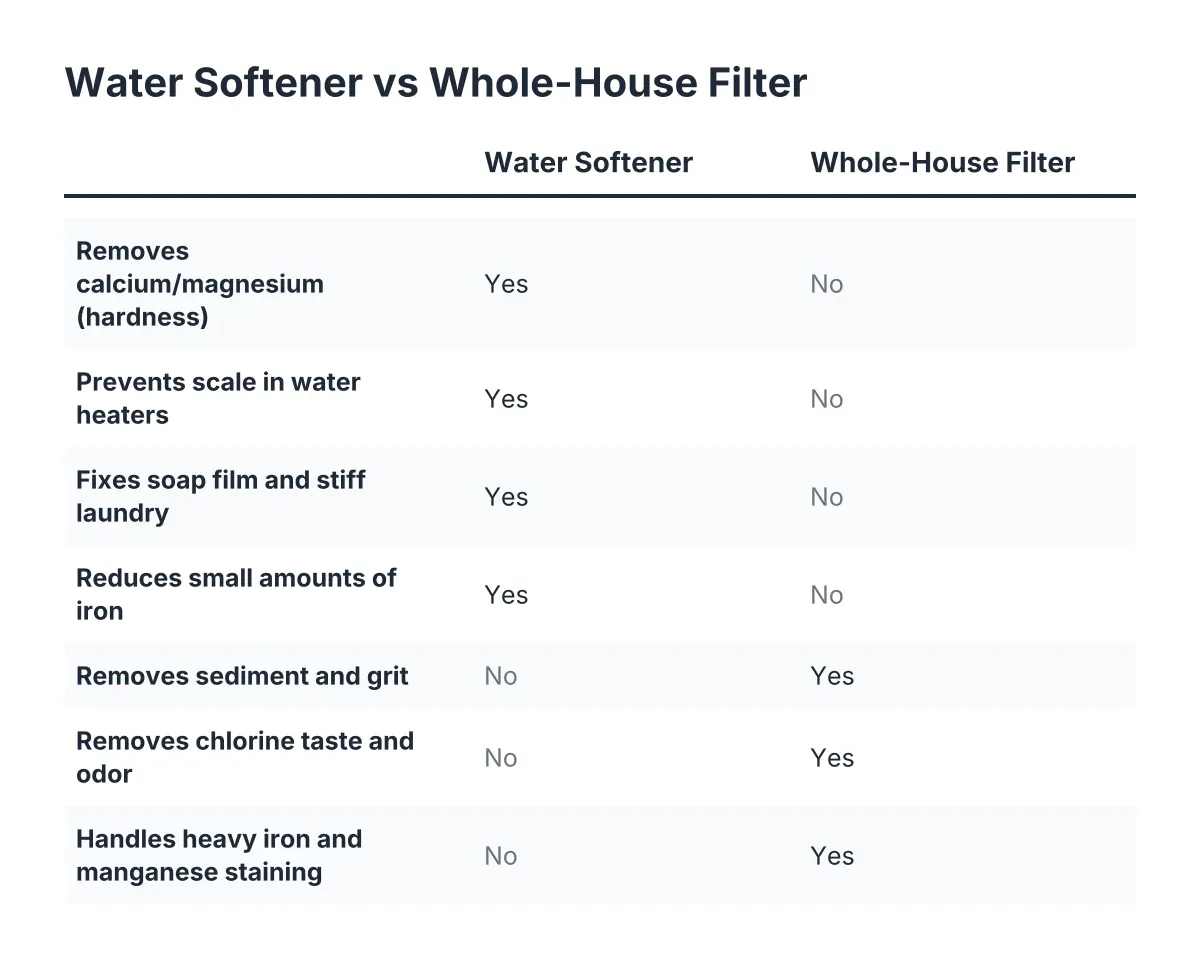
Think of it this way: a softener is the only common residential system that pulls hardness minerals out of every gallon entering the house. In that sense, a softener is itself a kind of filter for dissolved minerals. Once those minerals are gone, they cannot form scale in your water heater, spot your dishes, or crust over your showerhead.
What a softener fixes:
- Scale buildup inside water heaters, dishwashers, and washing machines
- White crust on faucets, showerheads, and shower doors
- Soap that will not lather, and the film it leaves on skin and hair
- Stiff, dingy laundry
- Yellow-red staining in toilets and around drains, which slows way down once hardness and small amounts of iron are removed
That last point deserves a note. According to Penn State Extension, ion exchange softeners can also reduce small amounts of iron in well water in addition to hardness. In practice, a softener handling iron needs more frequent service than one handling hardness alone, and heavy iron levels call for a dedicated iron filter alongside the softener. More on that below.
One more benefit for older homes: a new water softener installed in a house with existing scale can gradually help clean up some of that old buildup over time. It will not restore a 40-year-old pipe to new, but it stops the damage from getting worse and slowly improves what is there.
What a Whole-House Filter Does, and Does Not Do
A whole-house filter removes particles, sediment, chlorine taste and odor, or specific contaminants like iron and manganese, depending on the media inside it. What it does not do, in almost every case, is remove hardness. Calcium and magnesium are dissolved in the water at a molecular level. A standard water filter system lets them pass right through.
This is the single biggest point of confusion we run into on service calls. A homeowner installs a whole-house filter expecting the white scale on the shower door to go away, and six months later nothing has changed. The filter was doing its job; scale was never its job.
Where a whole-house filter earns its place in a Minnesota home:
- Sediment and grit, common with older wells and aging municipal mains
- Chlorine taste and smell from city water
- Iron and manganese above the level a softener can handle, which cause the rust-orange staining common in suburbs on well water
- Taste and odor problems that make water unpleasant to drink
So when someone searches "whole house water filter vs softener," the real answer is that they are not competitors. They target different things in the water. A whole house water filtration system polishes the water; a softener stops the mineral damage. The question is not which one is better. The question is which problem you actually have.
Water Softener vs Filter: Match the Equipment to the Symptom
Here is the plain-language version of the water softener vs filter decision, based on what you can see and smell in your own house. Skip the sales pitch and go by symptoms.
- White or gray crust on fixtures, spotted dishes, scale in the water heater, soap that will not lather. That is hardness. You need a water softener. A filter will not touch it.
- Orange, brown, or rust-colored stains in toilets, tubs, and sinks. That is iron, and often manganese with it. Light iron on a well can be handled by a softener; heavy iron needs a dedicated iron filter, usually paired with a softener because iron and hardness travel together in Minnesota well water.
- Water smells or tastes like chlorine, or looks cloudy with sediment. That is a filtration problem. A whole-house filter or a water filter system at the point of entry is the right tool.
- All of the above. Common in older suburban homes on wells. That is a combo setup: softener plus filtration, sized and sequenced correctly so each unit protects the other.
The order of equipment matters more than most homeowners realize. Heavy iron reaching a softener fouls the resin bed and shortens its life. Untreated iron-heavy water will even discolor the inside of the supply pipe on the inlet side of a system while the outlet side stays clean. Put the iron filter first, and the softener behind it lasts longer and works better. This is where a proper water test before installation pays for itself; guessing at equipment based on a store display is how people end up with the wrong tank in the basement.
What About a Water Conditioner or Salt-Free System?
A salt-free water conditioner does not remove hardness minerals; it changes how they behave so they form less scale on surfaces. The minerals stay in the water. That means no salt to haul and no brine discharge, but also no truly soft water. Soap behavior, spotting, and film do not improve the way they do with a real softener.
With Minneapolis-area hardness running 15+ grains per gallon, conditioners are a hard sell for this metro. They can make sense in mildly hard regions. Here, the mineral load is heavy enough that most homeowners who try a conditioner end up calling later about the same scale and stains. If your goal is protecting a water heater and old plumbing from very hard water, a salt-based water softener system is the proven fix.
There is one honest trade-off worth knowing. According to the Minnesota Pollution Control Agency, 75 percent of Minnesotans rely on groundwater for drinking water, and that groundwater is vulnerable to chloride contamination linked partly to softener discharge. The practical response is not to skip softening; it is to install a high-efficiency unit. Culligan notes that high-efficiency softeners can be programmed to use less salt, water, and energy than standard units. Right-sizing the system and setting regeneration correctly cuts salt use for the life of the equipment. Some homeowners also run potassium chloride instead of standard sodium chloride; NSF International confirms most units can switch between the two salt types with a settings change.
When Your Old Softener Fails: Repair, Replace, or Rethink?
A failing water softener forces a decision on repair versus replacement, and the age of the unit usually decides it. A unit under 10 years old with a stuck bypass valve, a bad seal, or a control head problem is often worth a softener repair. Additionally, a unit past 15 years with fouled resin or a cracked tank is usually a replacement, because you would be putting new parts on equipment near the end of its life either way.
Many homeowners find this article the week their old unit quits. The salt stops going down, water pools near the resin tank, or hard water spots suddenly return after years of soft water. If that is you, here is how to think it through without panic.
First, deal with the water on the floor. Most softeners have their own inlet and outlet valves separate from the main house shutoff, a standard setup noted by InspectAPedia. Put the unit in bypass or close those valves, and you stop the leak without cutting water to the whole house. You will have hard water at the taps, but you will not have a flooded basement while you decide.
Next, read the symptoms:
- Salt not going down usually means a salt bridge, a hard crust suspended above the water in the brine tank. Break it up with a broom handle. This is a maintenance fix, not a dead unit. Cargill notes that softener salt also contains insoluble material that settles at the bottom of the brine tank over time, so a periodic cleanout keeps the brine system honest.
- Sudden hard water after years of soft water can mean the bypass valve got bumped, the unit lost its regeneration schedule after a power blip, or the resin bed is worn out. The first two are cheap fixes. Worn resin on an old tank pushes you toward replacement or a resin tank service.
- Leaks at connections are often fittings and seals, a repair. A crack in the tank body itself is not worth fixing on an aging unit.
Suppose a homeowner in a 1962 Richfield rambler wakes up to water around a softener that came with the house when they bought it 12 years ago. The salt has not moved in a month, and the shower doors are spotting again. In that scenario, the unit is likely 20-plus years old, the resin is probably spent, and money spent on repairs is money spent on borrowed time. Replacement is the honest recommendation, and it is also the chance to fix the original sin: many older installs were never sized for the household or the actual hardness at the tap.
A fair warning about the upsell fear. It is reasonable to worry that whoever shows up will push a full replacement no matter what. A straightforward way to protect yourself: ask the tech to explain what failed, why, and what the same failure would cost to fix again in two years. A salt bridge or a bypass valve repair should be presented as exactly that. Age, resin condition, and tank integrity are the things that legitimately justify replacement, and a good installer will show you the evidence rather than just quote a number.
Sizing and Setup: Where Older Minneapolis Homes Trip Up
Sizing a water softener correctly means matching grain capacity to your actual hardness, iron level, and household water use, not picking a box off a shelf. An undersized unit regenerates constantly, burns through salt, and still lets hardness slip through. An oversized one wastes money and can sit too long between regenerations.
For a Minneapolis home at 15 grains per gallon with three or four people, the math is different than for the same house in a soft-water state. Iron in the water raises the effective hardness the softener has to handle, which is another reason a test matters before you buy. If you want independent assurance on equipment, look for NSF/ANSI 44 certification; per NSF International, it means the unit was independently tested to verify it removes calcium along with radium-226 and radium-228.
Pre-1980 houses add a few wrinkles worth planning for during water softener installation:
- Galvanized supply lines may be partially scaled shut already, which affects flow and where the tie-in should happen
- Floor drains near the old utility area may or may not be positioned well for the regeneration discharge line
- Original softener loops, where they exist, were often plumbed for smaller households and may bypass outdoor spigots incorrectly, or not at all
- Tight mechanical rooms can dictate single-tank versus dual-tank choices as much as water use does
None of these are dealbreakers. They are the difference between an install that works on paper and one that works in your basement. A dual-tank setup, for example, makes sense for larger households that cannot afford a soft-water gap during regeneration, but it needs the floor space to match.
One maintenance note for the long haul: Kinetico advises sanitizing a softener after a boil-water order, after an extended absence, or when taste or odor turns off, especially on private wells. It is a small service item that keeps a good system trustworthy for years.
The Bottom Line for a Minneapolis Homeowner
Match the equipment to the problem in your water, not to the loudest marketing. For the scale, spotting, and appliance damage that define Minnesota hard water, a properly sized water softener is the fix, and according to USGS Water Science School data, 61 percent of measured Minnesota cities fall in the hard or very hard bands, so most metro homes need one. Add a whole-house filter when iron, sediment, chlorine, or taste problems are also in the mix, and put the filtration in the right order so each unit protects the other.
If your current unit is leaking or has quit, isolate it at its own valves first, then judge repair versus replacement by age, resin condition, and tank integrity rather than by whoever talks fastest. And when the water chemistry is complicated, high iron on a well, staining that will not quit, or a combo system to sequence, get a water test and a local professional's read before you buy anything. As of 2026, the equipment options are better and more efficient than what came with your house; the only mistake left to make is buying the wrong type for the problem you actually have.
If you need water softener installation, Twin Cities Water Softening can help.
Prefer to talk it through? Call +16512171659 — a quick call is usually the fastest way to get a straight answer for your situation.