
Slow Water Softener Leak? How to Stop Hidden Basement Damage in Minneapolis, MN
It is 9pm. You went downstairs for a tote of winter gear and found a wet ring around the softener. A slow water softener leak is sneaky that way; it does not flood the basement in an hour, it soaks it over weeks. The good news is that most slow leaks give you time to act, and you can usually tell tonight whether this can wait until morning. This guide walks you through finding the source, stopping the water, and deciding what the fix should cost, written for homeowners and small landlords in Minneapolis, MN.
Quick answer first: if the water is a trickle and not a stream, shut the softener's bypass valve, put a towel and a pan under the drip, and it can almost always wait until a normal service call tomorrow. If water is actively running and the bypass will not budge, shut off the main and treat it as urgent.
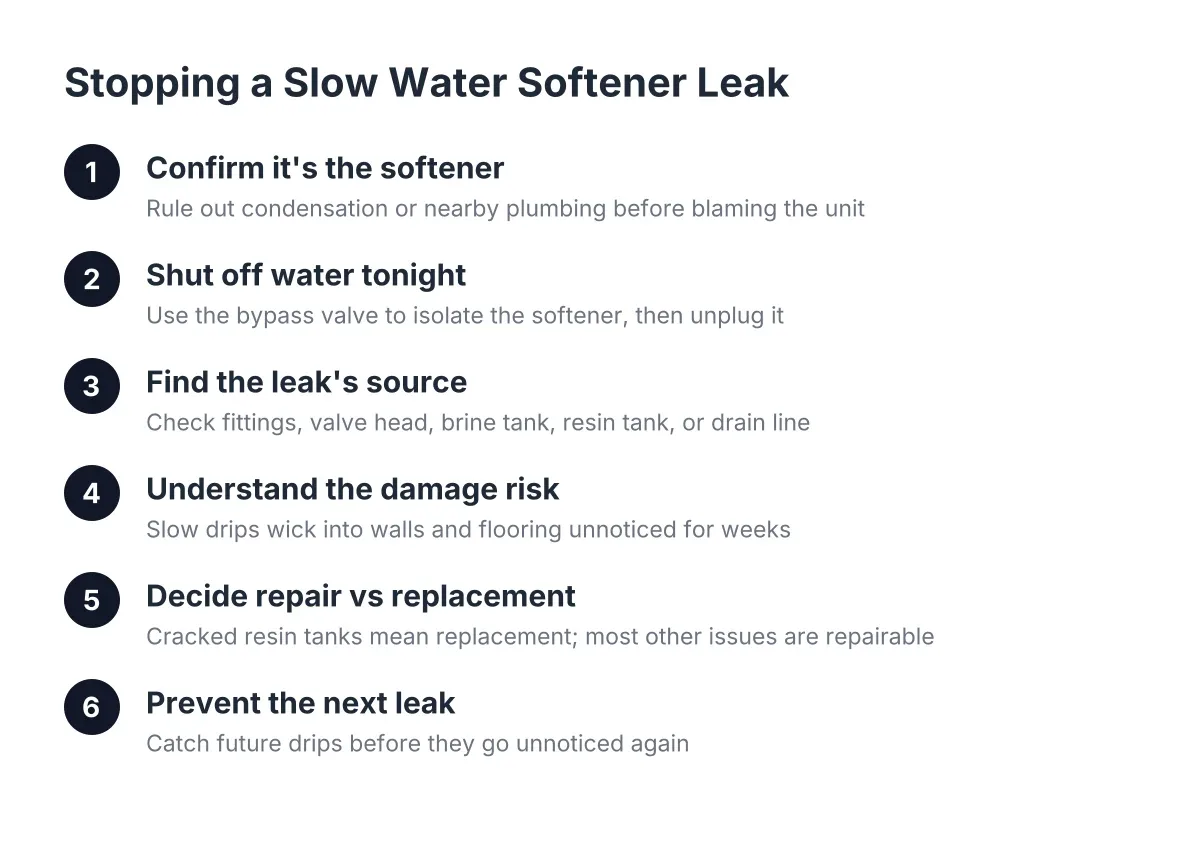
Step 1: Confirm the Leak Is Actually the Softener
Before you blame the softener, rule out the look-alikes. The most common "leak" on a softener tank is not a leak at all. It is condensation. Cold Minneapolis water flowing through an uninsulated tank in a warm basement makes the tank sweat, and that sweat pools on the floor.
Here is a fast way to tell the difference:
- Wipe the tank and all fittings dry with a towel.
- Lay dry paper towels or newspaper under the tank, the valve head, and each connection.
- Wait 30 to 60 minutes with no one running water.
- A wet spot directly under a fitting means a leak. Even dampness across the whole tank surface means condensation.
Also check the equipment nearby. Floor drains back up, water heaters weep from relief valves, and a toilet overflow upstairs can send water down along a pipe chase and pool near the softener. If the paper under the softener stays dry but the floor is still getting wet, your problem is plumbing, not the softener, and you want a plumber instead of a softener tech. Calling the right trade the first time saves you a wasted service call.
Step 2: Shut Off Water to the Softener Tonight
You do not need to kill water to the whole house. According to InspectAPedia, water softeners typically have dedicated inlet and outlet valves separate from the main house shutoff, so you can isolate the unit and still shower in the morning. On most units that means the bypass valve on the back of the control head.
Depending on your unit, the bypass is one of these:
- A single lever or knob you push or turn to "Bypass."
- Two separate handles, one on the inlet and one on the outlet; turn both a quarter turn.
- Three valves in a loop: close the two going to the softener, open the middle one.
Turn it gently. A bypass that has not moved in ten years can be stiff from scale buildup, and forcing it can crack the housing. If it will not move with firm hand pressure, stop and close the main house shutoff instead. A stuck or dripping bypass valve is a repairable part, and bypass valve repair is a standard softener service item, not a reason to replace the whole system.
Once the unit is bypassed, unplug it so it does not try to regenerate against closed valves overnight.
Step 3: Find Where Your Slow Water Softener Leak Originates
With the water off, trace the drip to its source. Slow leaks almost always come from one of five places, and each one points to a different fix.
Fittings and Connections
Check where the supply lines meet the bypass and where the bypass meets the valve head. O-rings dry out and compression fittings loosen over years of vibration. A leak here is usually a cheap seal replacement.
The Control Valve Head
Water seeping from the valve body or dripping steadily into the drain line points to worn internal seals. A worn or torn piston seal inside the control valve often causes a drain line that never stops running. Techs fix this by replacing the piston and seal pack, not the whole softener.
The Brine Tank
The salt tank rarely cracks, but the small brine line running to the valve head can split or pull loose. In addition, salt contains insoluble material that builds up at the bottom of the brine tank over time, according to Cargill, and that sludge can clog the brine system and cause overflow. A brine tank that stays full while the floor gets wet is a classic sign of a clogged injector that is not drawing brine.
The Resin Tank
Water weeping from the body of the tall tank itself is the bad one. A cracked resin tank cannot be patched reliably under pressure. If your water softener is leaking from the bottom of the resin tank and the fiberglass shell is split, you are shopping for a softener replacement, not a repair.
The Drain Line
Follow the thin drain tube to the floor drain or standpipe. A loose clamp or a line that slipped out of the drain during regeneration can dump a surprising amount of water and look like a tank leak.
One more diagnostic clue: note whether the leak is constant or comes and goes. A puddle that only appears every few days usually means the leak happens during the regeneration cycle, which points to the valve, the drain line, or the brine system rather than the tanks.
Step 4: Understand Why a Slow Leak Wrecks Minneapolis Basements
A slow water softener leak does more damage per gallon than a burst pipe, because nobody sees it. Most Twin Cities softeners sit in a finished or semi-finished basement, often on concrete near carpet, drywall, or stored boxes. A cup a day for two months is enough to wick into a wall plate, swell laminate, and start mold behind a baseboard.
Minneapolis water makes softeners work hard, which shortens seal life. According to HomeWater 101, the Twin Cities metro draws mineral-heavy water from the Mississippi River, with hardness of 15 or more grains per gallon for Minneapolis-area homes. That hardness means frequent regeneration cycles, and every cycle flexes seals, pistons, and O-rings. A ten-year-old unit on Minneapolis water has run thousands of cycles, so slow seepage at the valve is wear, not bad luck.
For landlords, the stakes are higher because nobody checks the mechanical room weekly. Suppose you own a rental in Nokomis and the tenant mentions a musty smell during a maintenance visit. You find a slow water softener leak that has been wetting the slab behind the unit for a season. In that scenario, the softener repair might run a few hundred dollars as an estimate, but the drywall, trim, and mold remediation can cost several times that. The leak was never the expensive part; the waiting was.
Step 5: Decide Between Repair and Replacement
Use the source of the leak, plus the age of the unit, to make this call. Here is the honest breakdown a good local tech will walk you through.
Repair usually makes sense when:
- The leak is at a fitting, O-ring, bypass valve, or brine line.
- The control valve needs a seal pack or piston and the unit is under 10 years old.
- The brine tank needs a cleanout or a new injector.
Replacement usually makes sense when:
- The resin tank itself is cracked or the water softener tank is bulging.
- The unit is 12 to 15 years old and the valve needs major parts; on Minneapolis hard water, the resin bed is likely near the end of its life too.
- You are also seeing hard water stains, spotty dishes, or falling salt use, which means the resin has stopped making soft water even when nothing leaks.
As a rough illustrative range, seal and fitting repairs often land in the low hundreds, valve rebuilds in the mid hundreds, and a full softener replacement with installation runs into the low thousands depending on size and features. Treat those as ballpark estimates; get a written quote on your specific unit, and for a rental, get two.
Worried about being upsold? Ask the tech to show you the failed part. A torn seal, a split brine line, or a cracked tank is visible. A specialist who only works on water treatment equipment sees these failures weekly and can point to the exact cause, which is harder for a generalist who installs a softener twice a year.
One caution: if the leak involves the copper or PEX plumbing feeding the softener rather than the softener itself, or if water has already reached electrical outlets or the panel, stop and bring in a professional before doing anything else.
Step 6: Prevent the Next Leak From Going Unnoticed
Once the current leak is fixed, set up the basement so the next one cannot hide. Water softener leaks announce themselves early if anything is watching.
- Put a battery water alarm or smart leak sensor on the floor beside the softener and brine tank. They cost less than a tank of salt.
- Set the unit on a drip pan plumbed toward the floor drain if your layout allows it.
- Check the brine tank monthly when you add salt; most households refill salt every two to four months, according to Culligan, so pair the floor check with the salt check.
- If your softener has a metered flow display, shut off every fixture in the house and watch it. Any flow reading with everything off means water is moving somewhere it should not be, often a toilet flapper leak that wastes softener capacity around the clock.
- After any repair or new water softener installation, stay near the unit through its first regeneration cycle. That is when a bad connection shows itself, before it can soak anything.
For small landlords in Minneapolis, MN, add the softener to your unit-turnover checklist: look under the valve head, check the floor, and glance at the salt level. Five minutes between tenants beats a mid-lease emergency call.
The Bottom Line for Tonight
A slow leak from a water softener is rarely a middle-of-the-night emergency, but it is never a "deal with it eventually" problem either. Bypass the unit, dry the floor, mark the puddle's edge with tape so you can see if it grows, and book a softener repair visit in the morning. If the resin tank is cracked or the unit is past its service life, replacing it beats patching it, especially with the 15-plus grains per gallon water that Minneapolis softeners fight every day. Either way, the water stops tonight, and your basement stays dry.
If you need water softener installation, Twin Cities Water Softening can help.
Prefer to talk it through? Call +16512171659 — a quick call is usually the fastest way to get a straight answer for your situation.