
Water Softener Leaks — Complete Guide
Water on the floor next to your softener at 9pm raises two urgent questions: is the softener actually the problem, and can it wait until morning? This guide covers water softener leaks from first triage to final fix, so you can find the source, stop the water, and decide your next move without guessing. Minneapolis homes run mineral-heavy water through these systems year after year, which makes leaks more common here than in most of the country. Below, you will find a fast diagnostic walkthrough, an explanation of why Twin Cities water stresses softeners, and a clear framework for deciding between repair and replacement. Each section links to a deeper guide if you need step-by-step detail.
What You'll Find in This Guide
- Why Water Softener Leaks Happen: Mineral Buildup, Cracked Tanks, Worn Seals
- Water Softener Leak Locations: Brine Tank, Valve, and Bypass Explained
- Water Softener Leaks Terms Explained: A Plain-English Glossary
- How Much Does Water Softener Leak Repair Cost?
Is It the Softener or Your Plumbing? Triage for Water Softener Leaks
Before anything else, answer the question that actually matters at 9pm: where is the water coming from? A puddle near the softener does not automatically mean the softener caused it. Water heaters, floor drains, washing machine hoses, and copper supply lines all share basement space with your softener. As a result, misdiagnosis wastes time you could spend stopping the real leak.
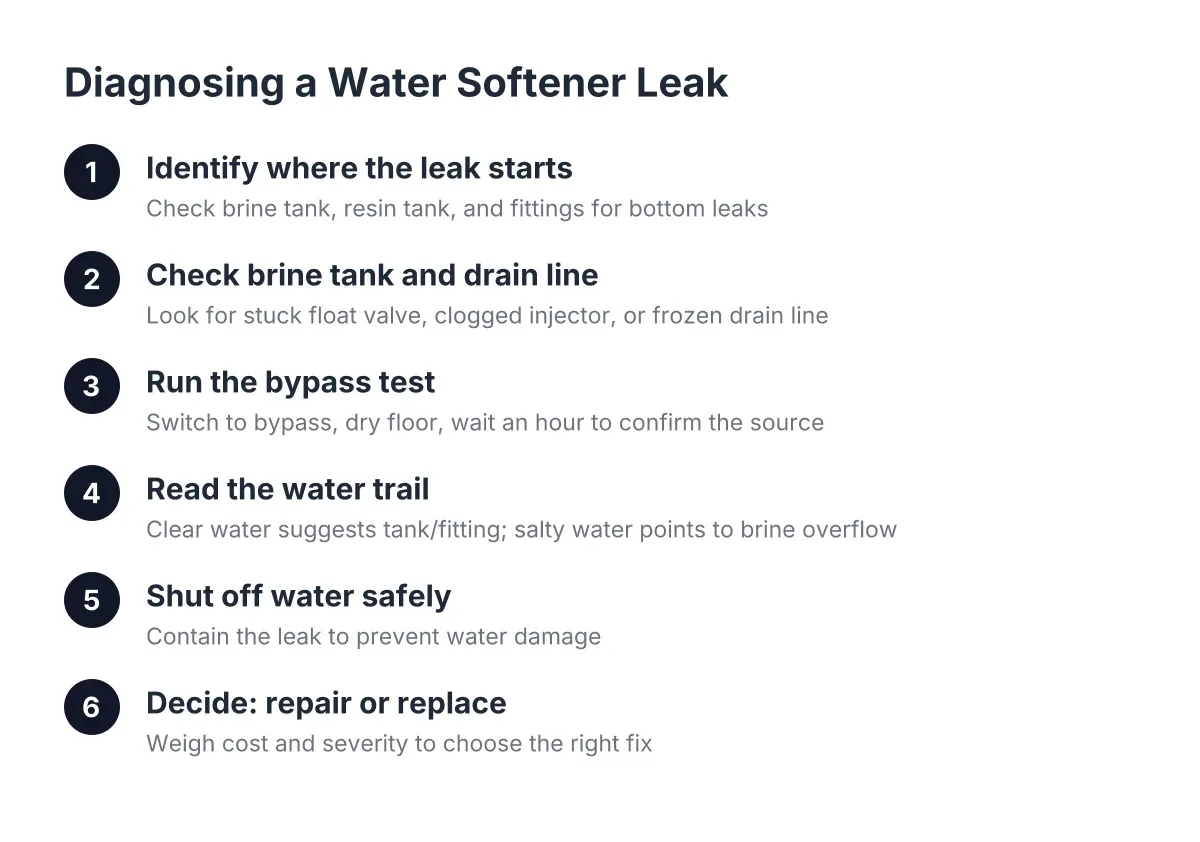
Start by drying the floor completely with a towel. Then watch where new water appears first. If it beads up on top of the brine tank lid, drips from the control valve head, or seeps from the tank seam, the softener is your suspect. However, if water tracks along the floor from a wall, a pipe joint, or another appliance, look upstream instead. Our guide to diagnosing a water softener leak tonight walks through this process in detail, including the touch-and-trace test that isolates the source in minutes.
Stop the Water First, Diagnose Second
Once you confirm the softener is leaking, put it into bypass. Nearly every unit has a bypass valve where the plumbing meets the control head. Turning it routes water around the softener entirely, so your home keeps running water while the unit sits dry. If the bypass valve itself is the leak point, or it will not turn, shut off the main water supply instead. To put it simply, bypass buys you time. A softener in bypass can wait until morning in almost every case.
Next, narrow down the location. In practice, most leaks trace back to three spots: the brine tank, the control valve, and the bypass assembly. Each one leaks for different reasons and carries a different repair price. Our breakdown of common water softener leak locations explains what each spot looks like when it fails, and which failures you can safely ignore overnight. With this in mind, resist the urge to start disassembling anything tonight. Loosening the wrong fitting on a pressurized system turns a slow drip into a flood.
Why Minneapolis Water Is Hard on Softeners
Twin Cities softeners work harder than most, and that workload shows up as leaks. Minneapolis-area homes draw mineral-heavy water from the Mississippi River, producing hardness levels of 15 or more grains per gallon, according to HomeWater 101. For comparison, the USGS Water Science School classifies anything above 10.5 grains as very hard. Statewide, the picture is similar: across 49 measured Minnesota cities, median hardness sits at 9.5 grains per gallon, and 61 percent of cities fall in the hard or very hard bands.
That mineral load matters for leaks in two ways. First, high hardness means your softener regenerates more often. Every regeneration cycle moves the rotor, pistons, and seals inside the control valve. Consequently, a Minneapolis softener racks up wear faster than the same unit would in a soft-water region. Worn seals are one of the most common leak sources we repair, and they wear out on a schedule set by your water, not the calendar.
Second, minerals that escape the resin bed build up inside the valve body and around O-rings. Over time, that grit scores the sealing surfaces and lets water weep past. Salt bridging and brine tank sediment cause their own problems, including overflow leaks when the float valve sticks. If terms like rotor seal, float valve, or brine line are new to you, our plain-English glossary of leak terminology covers each one without the jargon.
Suburban Well Water and Iron: How Mineral Problems Create Water Softener Leaks
Beyond hardness, many Twin Cities suburbs deal with iron and manganese in their well water. You know these minerals by the orange and black staining they leave on fixtures. Inside a softener, iron fouls the resin bed and clogs the injector, which forces the system to strain during regeneration. That strain accelerates seal wear and can push water out of fittings that would otherwise hold for years. Additionally, 75 percent of Minnesotans rely on groundwater for drinking water, according to the Minnesota Pollution Control Agency, so well-water mineral problems are the rule here, not the exception. If your softener leaks and your water shows staining, mention both when you call. The two issues usually connect.
Repair, Replace, or Wait Until Morning
Once you know where the leak is, the decision comes down to three factors: the leak location, the age of the unit, and the cost gap between fixing and replacing. Fortunately, the location tells you most of what you need to know. A loose fitting or a worn O-ring is a quick, inexpensive fix on a unit of almost any age. However, a cracked resin tank or brine tank changes the math entirely. Tanks rarely justify replacement on their own, because a new tank plus labor often approaches the cost of a new softener.
Age is the second lever. A five-year-old softener with a valve seal leak deserves a repair, since the rest of the system has plenty of life left. That said, a fifteen-year-old unit leaking from the tank seam is telling you something. Older softeners lose efficiency, burn through more salt, and stack repair bills one after another. At that point, replacement usually costs less over the next five years than keeping the old unit alive. Our water softener leak repair cost guide puts real numbers on each scenario, broken down by leak location and unit age.
What Can Safely Wait and What Cannot
Most water softener leaks can wait until morning once the unit sits in bypass. A slow drip from a fitting, a weeping valve seal, or minor brine tank seepage will not damage your home overnight if the water supply to the unit is off. For example, a softener in bypass with a towel under the drip point is a stable situation, not an emergency.
A few situations deserve a same-night call. An overflowing brine tank that will not stop, water spraying under pressure from the valve or plumbing connections, or a leak you cannot isolate with the bypass all fall in that category. Likewise, water reaching finished flooring, drywall, or stored belongings raises the stakes beyond the softener itself. In those cases, shut off the main water supply and get help on the phone. The cost of an emergency visit is small next to the cost of water damage remediation.
One more note for Minneapolis homeowners weighing replacement: newer demand-initiated softeners use dramatically less salt than old timer-based units. The Minnesota Pollution Control Agency reported that a rebate and optimization program in Marshall, Minnesota cut salt use by up to 320,000 pounds per year, with some households reducing salt use by as much as 86 percent. In other words, a leak on an aging timer unit can be the push toward a system that costs less to run and puts less chloride down the drain.
Ready to Get Started?
If you have water on the floor and a softener you do not trust, Twin Cities Water Softening can diagnose the leak, repair what makes sense, and give you a straight answer when replacement is the smarter spend. We work on softeners exclusively, across Minneapolis and its suburbs, so you get a specialist who has seen your exact failure before. Call us tonight if the leak will not stop, or first thing tomorrow if the bypass is holding.