
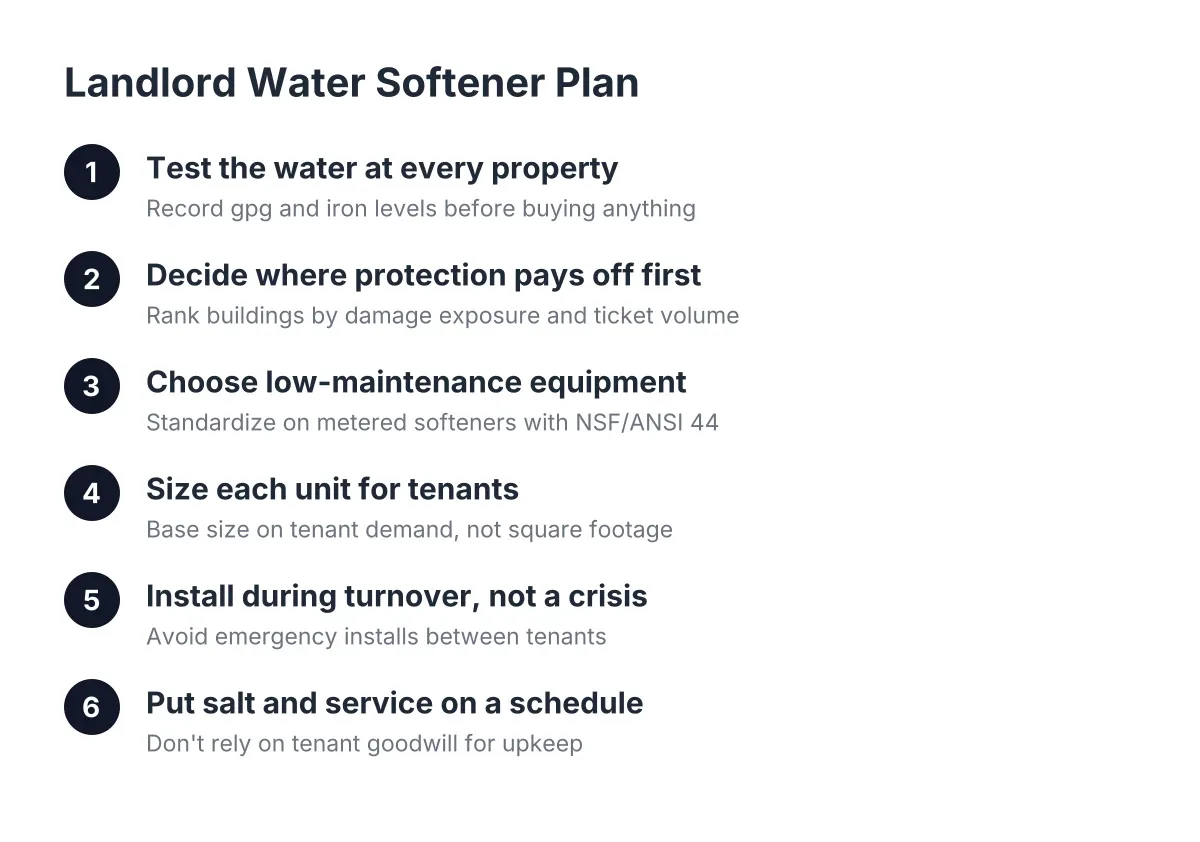
Hard Water Damage Protection for Rental Properties: A Landlord’s Step-by-Step Plan
If you manage rental units in the Twin Cities, hard water damage protection is not optional. Minnesota's average statewide water hardness is 278.3 PPM, classified as very hard, according to USGS Water Quality Portal. That mineral load eats water heaters, clogs dishwashers, stains fixtures, and generates the tenant complaints and maintenance tickets you deal with every week. Insurance may cover a burst pipe, but it will not cover the slow scale buildup that shortens equipment life across 20 units. This guide walks you through a practical, step-by-step landlord water softener plan to protect your properties with reliable, low-maintenance softening equipment, so failures stop landing on your desk as emergencies.
Step 1: Test the Water at Every Property Before You Buy Anything
Start with hardness numbers, not assumptions. Across 49 measured Minnesota cities, the median hardness is 162.0 mg/L (9.5 gpg), and 61% of cities fall in the hard or very hard bands, according to USGS Water Science School. However, hardness varies from one suburb to the next, and well-served properties in the outer metro often carry iron and manganese on top of it.
Test at the tap in each building, or have a local water treatment company do it during a service call. Record grains per gallon (gpg) plus iron levels for every address. For properties with an existing softener, test the water both before and after the unit. That tells you whether the softener has failed completely, is only partially softening, or is running out of capacity early.
This one step prevents the most common landlord mistake: buying the same softener for every unit when one building sits on 12 gpg municipal water and another sits on 25 gpg well water with iron. Sizing to the actual water matters more than brand.
Step 2: Decide Where Hard Water Damage Protection Pays Off First
You do not have to soften every unit in year one. Rank your portfolio by damage exposure and ticket volume. A softener works by exchanging hardness minerals before they can scale onto pipes, water heaters, and fixtures, so the biggest payoff comes where scale is doing the most harm.
Prioritize properties that show these signs:
- Water heaters failing early or rumbling from scale buildup on the elements or tank bottom
- Repeat dishwasher and washing machine service tickets in the same building
- Hard water stains on fixtures, shower doors, and toilets that turnover crews cannot scrub out
- Orange or brown iron staining in sinks and tubs, common in metro suburbs on well water
- Tenant hard water complaints about dry skin, spotted dishes, or dingy laundry
For example, suppose you manage a fourplex in Bloomington where two water heaters failed within three years and the turnover crew spends an extra hour per unit fighting scale on glass and chrome. In that scenario, a properly sized softener on the main line protects all four units at once, and it typically costs less than one water heater replacement plus the labor you are already burning.
There is a trade-off worth naming. Softening protects equipment going forward and can even help dissolve some existing scale over time, but it will not restore a water heater that is already half full of sediment. Budget for the softener and any equipment that is past saving.
Step 3: Choose Low-Maintenance Equipment You Can Standardize
For rentals, the right question is not which softener is best. It is which softener creates the fewest service calls per year across your whole portfolio. Standardizing rental property water softeners around one or two proven models means your maintenance staff learns one control valve, stocks one set of parts, and diagnoses problems over the phone instead of on site.
As of 2026, here is how the main choices break down for rental use:
- Demand-initiated (metered) softeners regenerate based on actual water use, not a timer. Tenants use water unpredictably, so metered units waste far less salt and work whether a unit sits vacant or houses a family of five. This should be your default.
- Timer-based softeners regenerate on a schedule whether needed or not. They burn salt in vacant units and run short in full ones. Minnesota is actively moving away from them; a rebate program in Marshall offered $500 to $700 for replacing timer-based softeners as part of a chloride reduction effort, according to Minnesota Pollution Control Agency.
- Salt-free conditioners avoid salt handling entirely, but they do not remove hardness minerals. They reduce some scale adhesion, yet stains and spotting continue, and tenant complaints usually continue with them.
- Dual-tank systems provide soft water around the clock, since one tank works while the other regenerates. They make sense for larger multi-unit buildings with heavy, continuous demand, but they cost more and are usually overkill for a single-family rental.
Look for NSF/ANSI 44 certification when comparing units. That certification means the softener passed independent testing verifying it removes calcium and radium from water, according to NSF International. It is a simple, neutral way to screen equipment without relying on marketing claims.
In addition, favor equipment with commonly available parts and a manufacturer that stands behind it. If a resin tank or valve failure ever floods a basement unit, you want a manufacturer with real recourse behind the product, not an off-brand import with no support.
Step 4: Size Each Unit for Tenants, Not for the Building's Square Footage
An undersized softener is a slow-motion failure. When a family of four on hard water runs showers, laundry, and the dishwasher on a Sunday morning, an undersized unit lets water pass through too fast to fully soften. The tenant reports spotty dishes, you send a tech, and the tech finds nothing wrong because the unit tests fine at low flow.
Size on three inputs: measured hardness in gpg, realistic occupant count, and peak flow. For a single-family rental, assume full occupancy, not current occupancy. For small multi-unit buildings on one softener, size for simultaneous demand across units. A local installer who handles water softener sizing can run these numbers in one visit and spec a unit that will not choke during peak use.
Iron changes the math. Ion exchange softeners can help reduce small amounts of iron in well water in addition to hardness, according to Penn State Extension. However, heavier iron loads will foul the resin bed and kill the softener early. Properties with significant iron need a dedicated iron filter ahead of the softener, or you will be back to replacing equipment in a few years.
Step 5: Install During Turnover, Not During a Crisis
Unit turnover is the cheapest window for a water softener install. The unit is empty, water can be shut off without a tenant complaint, and your crew is already scheduling trades. A straightforward softener installation or replacement typically takes a few hours, so it slots into a turnover calendar without extending vacancy.
During each install, require these items in the scope:
- A bypass valve on every unit, so water keeps flowing to the property if the softener ever needs service
- Dedicated inlet and outlet shutoffs, which let a tech isolate the softener without cutting water to the whole building, a standard setup noted by InspectAPedia
- A drain connection that meets code and cannot back up into the mechanical room
- A floor drain or leak pan placement check, since a leaking softener in a finished basement unit is a tenant displacement problem, not just a repair
- A written record of the model, settings, hardness reading, and install date for your property file
The bypass valve deserves emphasis. When a softener fails, a working bypass means the tenant still has water and you can schedule the softener repair on business hours instead of paying emergency rates. A stuck or corroded bypass turns a routine fix into an urgent one, so have it exercised at every service visit.
Step 6: Put Salt and Service on a Schedule, Not on Tenant Goodwill
Softeners rely on salt to regenerate the resin bed that removes hardness minerals, according to North Dakota State University Extension. Tenants will not manage this for you. Some will never add salt; others will dump in the wrong product. Typical households refill salt every two to four months on average, according to Culligan, but usage varies with hardness, occupancy, and tank size.
Therefore, build salt into your maintenance routine. A landlord water softener plan works best when you own the maintenance schedule completely. Options that work for portfolio managers:
- Fold salt checks into quarterly filter or smoke detector visits your staff already makes
- Set up a water softener service contract with a local company that covers salt delivery, settings checks, and inspection across all your addresses on one invoice
- For single-family rentals, spell out salt responsibility in the lease, then verify at inspections anyway
Annual service should include inspecting internal components, cleaning out the brine tank, and reprogramming after occupancy changes. Salt contains insoluble material that settles at the bottom of the brine tank and needs periodic cleanout, according to Cargill. Skipping that cleanout is one of the quiet reasons softeners stop regenerating, salt stops going down, and hard water sneaks back into the unit without anyone noticing until the complaints start.
One more scheduling note: sanitize a softener after a municipal boil-water order, after extended vacancy, or when tenants report bad taste or odor, guidance that comes from Kinetico. Extended vacancy is common in rentals, so add sanitizing to your turnover checklist for any unit that sat empty.
Step 7: Track Damage Protection Results Across the Portfolio
Hard water damage protection only proves itself if you measure it. Keep a simple log per property: softener model, install date, hardness before and after, salt refill dates, and every water-related maintenance ticket. Within a year or two, the pattern shows up. Water heater tickets drop, fixture replacement slows, and turnover cleaning gets faster in softened buildings.
That log also settles the repair-versus-replace question fast. A unit under ten years old with a clean service history usually earns a repair. A unit that keeps generating tickets, has a fouled resin bed from iron, or uses an outdated timer valve is a replacement candidate. As a result, you stop making that call under pressure with a tenant on the phone and water on the floor.
Salt efficiency belongs in the log too. Minnesota is pushing hard on chloride reduction because 75% of Minnesotans rely on groundwater vulnerable to salt contamination, according to Minnesota Pollution Control Agency. Well-tuned, metered softeners cut salt use sharply; the Marshall optimization program cut salt use by up to 320,000 pounds per year, with some households reducing use by as much as 86%, per Minnesota Pollution Control Agency. Efficient settings save you money on salt and keep you ahead of any future local rules on softener discharge.
When to Bring in a Local Specialist
You can handle salt schedules and inspections in house. However, sizing across mixed municipal and well-water properties, iron filtration decisions, drain code questions, and diagnosing a softener that only partially softens are jobs for a company that works on water treatment daily. A specialist who installs, repairs, and sizes softeners across the Minneapolis metro will also know the local water, which changes block by block more than most landlords expect.
The landlord water softener plan itself is simple. Test every property, prioritize by damage, standardize on metered NSF/ANSI 44 equipment, install at turnover with bypass and shutoffs, and put salt and service on a schedule you control. Do that, and hard water stops being a stream of surprise tickets and becomes one more system you manage on purpose.
If you need water softener installation, Twin Cities Water Softening can help.
Prefer to talk it through? Call +16512171659 — a quick call is usually the fastest way to get a straight answer for your situation.