
7 Signs Your Water Softener Is Failing Before It Breaks Down Completely
Most water softeners do not die overnight. They fade. The signs your water softener is failing show up months before the unit quits for good, and if you catch them early, you can plan a replacement on your own schedule instead of dealing with a leak on the basement floor at 9 p.m. on a Sunday. Recognizing the water softener warning signs in Minneapolis matters more than most places. According to USGS Water Science School, the median water hardness across 49 measured Minnesota cities is 162.0 mg/L (9.5 grains per gallon), and 61% of those cities fall in the hard or very hard range. When a softener slips here, your home feels it fast.
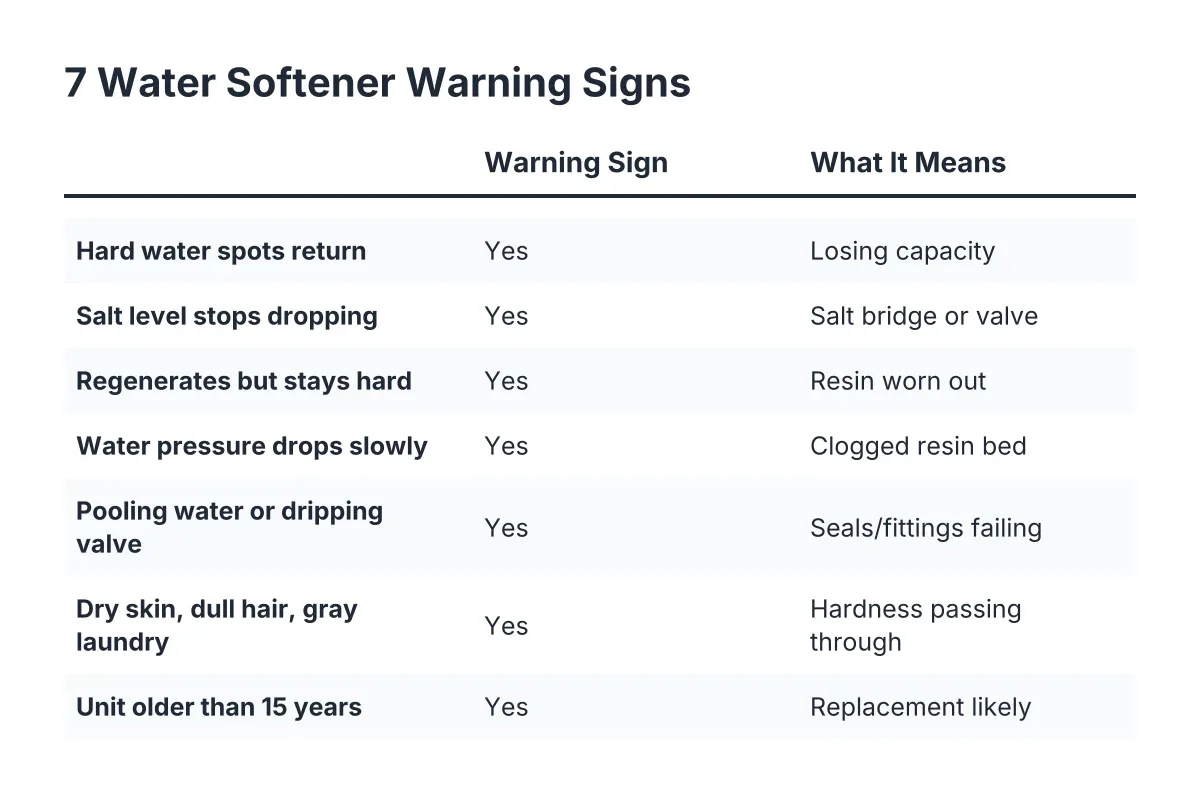
If your softener is 12 to 15 years old, or it came with the house and nobody remembers installing it, this list is for you. Here are seven performance warning signs, in roughly the order they tend to show up, plus a quick guide on how to confirm what you are seeing.
1. Hard Water Spots Come Back After Years of Soft Water
The first sign most homeowners notice is the return of white spots on dishes, cloudy glassware, and soap scum that will not rinse off the shower door. If you had soft water for years and these problems creep back in, your softener is losing capacity even if it still hums along and runs its cycles.
Do not wait for the unit to stop entirely. A softener that only partially softens is already letting scale buildup form inside your water heater and dishwasher. In a pre-1980 Minneapolis home with original galvanized or copper lines, that scale stacks on top of decades of existing buildup, and fixtures pay the price.
2. The Salt Level in the Brine Tank Stops Going Down
A healthy softener eats salt. According to Culligan, a typical household refills the salt supply about every two to four months, depending on water hardness, family size, and tank size. So if you look in the brine tank and the salt level has not moved in months, something is wrong.
Salt that never drops usually means one of two things. Either the unit is not regenerating at all, or a hard crust called a salt bridge has formed above the water line, so the softener cannot make brine. You can break up a salt bridge with a broom handle. But if the salt still will not go down after that, the control valve or timer is likely failing, and on an older unit that is often the beginning of the end.
3. The Softener Regenerates but the Water Stays Hard
This one confuses people, and it is one of the clearest water softener warning signs to watch for. The unit cycles on schedule, you hear it running at 2 a.m., salt gets used, and the water is still hard. According to North Dakota State University Extension, softeners rely on salt to regenerate the resin bed, which is what actually removes hardness minerals. If regeneration happens but softening does not, the resin itself has likely worn out.
Before you blame the resin, check one thing first: the bypass valve. Every softener has one, and it is easy to bump it into bypass during a basement project or a furnace filter swap by someone else working down there. If the bypass is open, water skips the softener entirely. Rule that out, then suspect the resin bed.
Resin in Twin Cities suburbs takes a beating. Iron and manganese in well water and some municipal supplies foul the resin over time, which is why units out here often wear out faster than the brochure suggests. On a newer unit, a resin tank service or rebed can make sense. On a unit past 12 to 15 years, replacing resin in an old tank with an old valve is usually money better put toward a new system.
4. Water Pressure Drops Slowly Throughout the House
A softener with a fouled or breaking-down resin bed can restrict flow through the whole home. The change is gradual, so most homeowners blame their old pipes first. In a pre-1980 house, that guess is fair, but there is a simple way to test it.
Put the softener into bypass and run a few faucets. If pressure improves noticeably with the softener out of the loop, the unit is choking your water flow, and the resin media is likely clogged or degraded. If pressure stays the same in bypass, the problem is in your plumbing, and a plumber is the right call, not a softener tech.
5. Water Pooling Around the Tanks or a Bypass Valve That Drips
Any water on the floor near the softener deserves attention the same day. Small leaks at the bypass valve, the rotor seals, or the brine line often start as a slow drip that leaves a ring of moisture. On a unit past its expected water softener lifespan, plastic fittings get brittle, o-rings flatten out, and a small drip can become a steady stream.
Here is the good news for a nervous homeowner: you almost never have to shut water off to the whole house. According to InspectAPedia, softeners typically have dedicated inlet and outlet valves separate from the main shutoff, so you can isolate the unit and keep normal (hard) water flowing while you sort out repair versus replacement. Learn where those valves are now, before you need them in a hurry.
6. Your Skin, Hair, and Laundry Tell You Before the Unit Does
Your body often notices hard water before your eyes do. Dry, itchy skin after showers, hair that feels stiff or dull, towels that come out of the wash scratchy, and whites that gray over time are all classic hard water symptoms. If these creep back into a home that has had a softener for years, treat them as an early warning, not a coincidence.
In addition, watch the toilet bowl and faucet aerators. A gray or white ring inside the bowl and crusty buildup on aerators are visible proof that hardness minerals are getting past the softener.
7. Water Softener Warning Signs in Older Units Past 15 Years
Age alone is not a death sentence, but it changes the math. Once a softener passes 15 years, parts get harder to find, seals and spacers wear together, and each service call fixes one weak point while three others keep aging. If you are replacing a 15 year old water softener part this year and expect another failure next year, a planned replacement usually costs less over five years than serial repairs.
There is also a real efficiency gap. According to Culligan, high-efficiency softeners can be programmed to use less salt, water, and energy than standard units. Older timer-based softeners regenerate on a clock whether you used water or not; modern demand-initiated units regenerate based on actual water use. That difference is big enough that a rebate program in Marshall, Minnesota offered $500 to $700 to residents replacing timer-based softeners, according to Minnesota Pollution Control Agency. The same agency reports the broader Marshall program cut salt use by up to 320,000 pounds per year, with some households cutting salt use by as much as 86%. Less salt matters here, since 75% of Minnesotans rely on groundwater that is vulnerable to chloride contamination, per Minnesota Pollution Control Agency.
How to Confirm Your Water Softener Warning Signs and Test Results
Before anyone talks replacement, confirm what is actually happening. A cheap hardness test kit from a hardware store answers most of it in ten minutes. Here is the sequence:
- Test water hardness at an outside spigot or a pre-softener tap. That is your raw number.
- Test a cold softened tap. If the two numbers match, the softener is doing nothing at all.
- Test a hot tap too. If hot and cold readings differ, the unit is likely running out of capacity early rather than fully dead.
- Check the bypass valve position, look for a salt bridge, and confirm salt is going down over time.
- Note the unit's age from the serial number or install sticker if you can find one.
This 15-minute check tells you whether you are looking at a stuck bypass, a salt problem, worn resin, or a unit at end of life. It also protects you from an upsell, because you walk into any conversation with your own numbers.
One honest caution: hardness tests will not catch everything. Iron fouling, a cracked distributor tube inside the resin tank, or a failing control valve can need a professional diagnosis, and a leak that turns out to be a plumbing joint rather than the softener needs a plumber instead. If you are unsure which trade to call, a local softener specialist can usually tell you within a few questions.
Repair or Replace: A Simple Rule for Older Units
For a unit under 10 years old with a single clear fault, a stuck bypass valve, a salt bridge, or a failed timer motor, softener repair is usually the right move. For a unit past 12 to 15 years with returning hard water stains, rising salt use, or a leak, water softener replacement is usually the smarter spend, especially in a metro where, according to USGS Water Quality Portal, 65 of Minnesota's 87 counties have very hard water above 180 mg/L.
Suppose a homeowner in a 1962 Richfield rambler notices spots on glassware in March, tests the water, and finds the softener only partially working. In that scenario, she can research brands over a few weeks, compare an eco water softener model against standard units, read EcoWater Systems reviews and other brand feedback, get the new unit sized to her actual water use, and schedule the install for a convenient Saturday. Compare that to her neighbor who ignores the same signs until the tank leaks in July and has to take whatever is available that week. Same replacement, entirely different experience.
The pattern is simple. Failing softeners announce themselves through performance decline: spots, salt behavior, pressure, and skin. Read the water softener warning signs your unit gives you early, run the hardness test, and you get to replace the system as a planned project instead of an emergency.
If you need water softener installation, Twin Cities Water Softening can help.
Prefer to talk it through? Call +16512171659 — a quick call is usually the fastest way to get a straight answer for your situation.