
Water Softener Replacement — Complete Guide
Your water softener has served you for a decade or more, and now you're wondering how much life it has left. This guide covers water softener replacement from start to finish: how long softeners actually last, the warning signs that a unit is fading, and whether repair, upgrade, or full replacement makes the most sense for your home. Because Minneapolis water runs hard on both municipal and well supplies, a failing softener shows up fast as scale, stains, and shortened appliance life. With this in mind, you'll learn how to plan a softener swap on your own schedule instead of scrambling after a Sunday-night leak. Every section below links to a deeper resource so you can go as far into any subtopic as you need.
What You'll Find in This Guide
- Minneapolis Water Hardness Levels: How to Test and Know When to Replace Your Softener
- 7 Signs Your Water Softener Is Failing Before It Breaks Down Completely
- How Much Does Water Softener Replacement Cost?
- Water Softener Replacement in Minneapolis, MN
- Water Softener System Upgrades in Minneapolis, MN
- Water Softener Replacement Terms Explained: A Plain-English Glossary
Prefer to have a pro handle it? Water softener replacement is one call away.
How Long Water Softeners Last and When Yours Is Due
Most water softeners last 10 to 15 years. Some push past that, especially units that were sized correctly and maintained well. However, age alone tells only part of the story. A softener in a Minneapolis home works harder than one in a soft-water region, because Minnesota's average statewide hardness sits at 278.3 PPM, which the USGS Water Quality Portal classifies as very hard. That workload wears out resin beads, valves, and seals faster than the brochure lifespan suggests.
So how do you know your unit is due for a new softener? Start with what you can observe. Spotty dishes, stiff laundry, dry skin after showers, and scale ringing your faucets all point to hard water slipping through. Additionally, watch the salt level in the brine tank. If salt stops going down, the softener has likely stopped regenerating. These fading signals rarely show up all at once. Instead, they build over months, which is exactly why catching them early gives you time to plan. Our breakdown of the 7 signs your water softener is failing covers each signal and what it means for the unit's remaining life.
Test Before You Decide Anything
Before you commit to any path, get your actual water hardness number. Across 49 measured Minnesota cities, the median hardness is 162.0 mg/L, or 9.5 grains per gallon, and 61% of cities fall in the hard or very hard bands, according to the USGS Water Science School. Your specific reading matters more than any statewide figure, though. For example, a suburban well home with iron and manganese in the water needs different equipment than a Minneapolis home on municipal supply. Our guide to testing water hardness before a softener replacement shows you how to get that number and what it tells you. In practice, that single test often settles the repair-or-replace question on its own.
Repair, Upgrade, or Replace: Choosing the Right Path
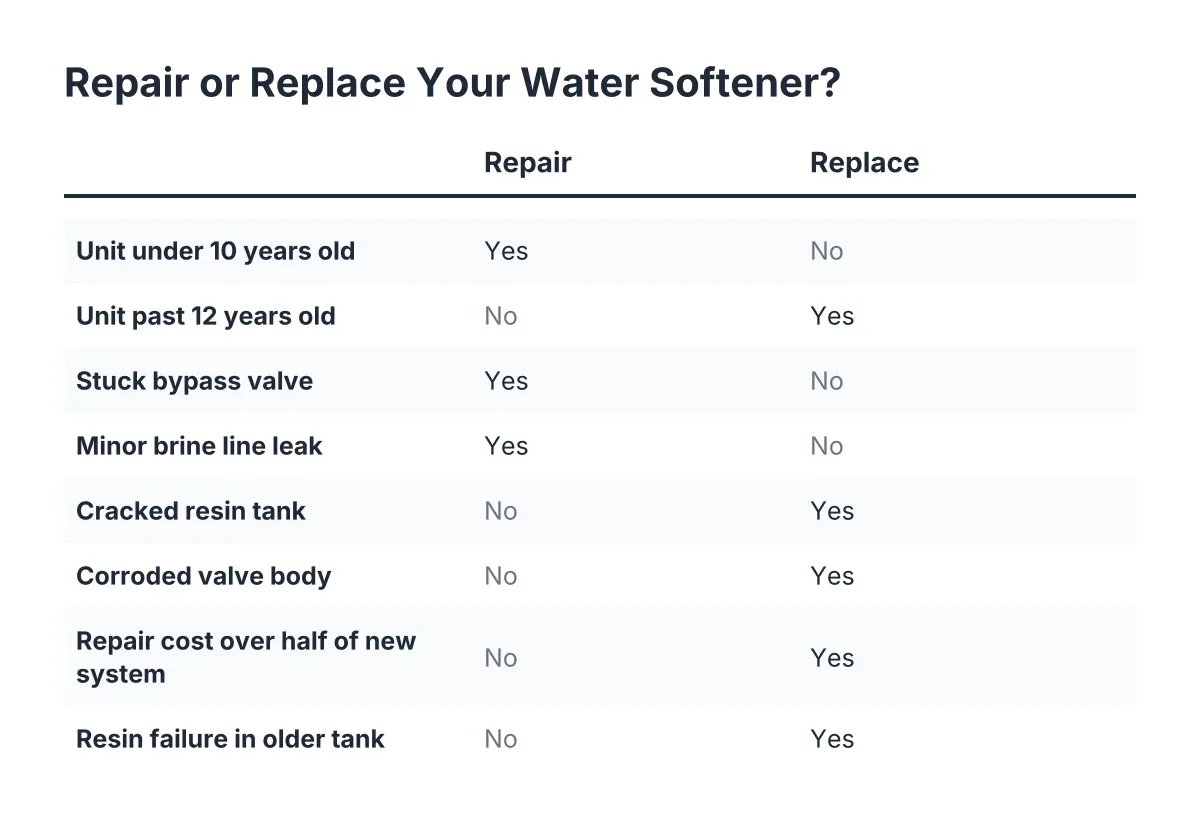
Not every aging softener needs to go to the curb. In fact, three distinct paths exist, and picking the wrong one wastes money in both directions. Repairing a unit that's near the end of its life throws good money after bad. On the other hand, swapping out a unit that only needed a new bypass valve costs you a thousand dollars or more for no reason.
Repair makes sense when the softener is under ten years old and the problem is isolated. A leaking bypass valve, a stuck float, or a clogged injector can each be fixed for far less than a new system. Beyond that age, the math shifts. Resin degrades, control valves wear, and each repair buys less time than the last. As a result, most homeowners with a 12 to 15 year old unit come out ahead by installing a new system outright.
The Upgrade Path Most Homeowners Miss
There's a middle option many people never hear about. If your old softener still runs but wastes salt, misses regenerations, or lets hardness slip through, a system upgrade can deliver most of the benefits of swapping the whole unit. Modern metered softeners regenerate based on actual water use, not a timer, so they use dramatically less salt. The stakes here are real. According to the Minnesota Pollution Control Agency, 75% of Minnesotans rely on groundwater for drinking water, and chloride from softener discharge threatens that supply. One Minnesota program in Marshall helped nearly 300 homes and businesses optimize or replace old softeners, cutting salt use by up to 320,000 pounds per year, with some households reducing salt use by as much as 86%. That same program offered $500 to $700 rebates for replacing timer-based units. In other words, efficiency upgrades pay off for your water bill and your watershed. Our water softener system upgrades page explains what a swap to metered equipment involves. You can also read more about Minnesota's chloride challenge from the Minnesota Pollution Control Agency.
What a New Softener Installation Involves
Once you've decided to replace your unit, the process is simpler than most homeowners expect. That said, the decisions you make before installation day matter more than the installation itself. Doing this right starts with three questions: what size system does your home need, what type of system fits your water, and what will the whole project cost?
Sizing comes first. A softener sized by guesswork either runs out of capacity between regenerations or wastes salt regenerating too often. Proper sizing accounts for your household's daily water use, your tested hardness, and any iron in the supply. Iron matters especially in the Twin Cities suburbs, where well water often carries enough iron and manganese to stain fixtures orange and foul standard resin. In those homes, the plan may include iron filtration alongside the new softener.
Understanding Quotes and Costs
Type comes next. You'll weigh salt-based against salt-free conditioning, and single-tank against dual-tank designs that deliver soft water even during regeneration. Each choice carries tradeoffs in cost, maintenance, and performance. However, the right answer depends on your water test, not on which system a salesperson wants to move. Our water softener replacement cost guide walks through how size, type, and plumbing changes shape the final price. Meanwhile, if the quotes you collect read like a foreign language, the plain-English glossary of replacement terms decodes grain capacity, regeneration cycles, and every other term you'll see on paper.
The installation itself usually takes a few hours. A specialist removes the old unit, updates any plumbing that needs it, sets the new system, and programs it to your tested hardness. For instance, our water softener replacement service in Minneapolis typically has soft water flowing the same day, with the old unit hauled away. Compare that to the emergency version of the same project: a leaking tank on the basement floor, a rushed decision, and whatever equipment happens to be available that week. Planning ahead gives you better equipment, a better price, and zero water damage.
Ready to Get Started?
If your softener is past its tenth birthday or showing any of the warning signs above, now is the time to plan ahead rather than wait for the failure. Twin Cities Water Softening handles nothing but water softening and filtration for Minneapolis and its suburbs, so you get a specialist's answer on sizing, system type, and cost, not a generalist's guess. Reach out for a water test and a straightforward recommendation, and replace your softener on your schedule instead of your softener's.