
Minneapolis Water Hardness Levels: How to Test and Know When to Replace Your Softener
Your water softener is 12 or 15 years old. Maybe it still runs. Maybe it just started leaking on the basement floor, or the salt in the tank has not gone down in weeks. Before you decide whether to repair it or replace it, you need one number: your home's actual water hardness. Understanding how to test water hardness in Minneapolis, along with what the hardness numbers mean for your tap water, is the fastest way to know whether your softener is still doing its job or quietly coasting toward failure.
This guide walks through what the hardness numbers mean here in the Twin Cities, how to test your water at home for a few dollars, and how to read the results so you can plan a replacement on your schedule instead of during a Saturday morning emergency.
Why Hardness Testing Is the First Step, Not the Last
Most homeowners find out their softener died the hard way. White spots come back on the dishes. Skin gets dry and itchy within a week. Or worse, there is water pooling around the resin tank and nobody is sure if it is the softener or the plumbing.
Here is the thing a testing habit fixes: a softener rarely fails all at once. The resin bed loses capacity slowly over years. The unit still runs, still uses salt, still sounds normal, but the water coming out of it gets harder and harder. By the time you can feel the difference in the shower, the softener may have been underperforming for months.
Therefore, a simple hardness test does two jobs at once. It tells you whether your current unit is still softening, and it gives you the number you need to size the replacement correctly. Both decisions depend on the same measurement, so start there.
Minneapolis Water Hardness Levels: What the Numbers Say
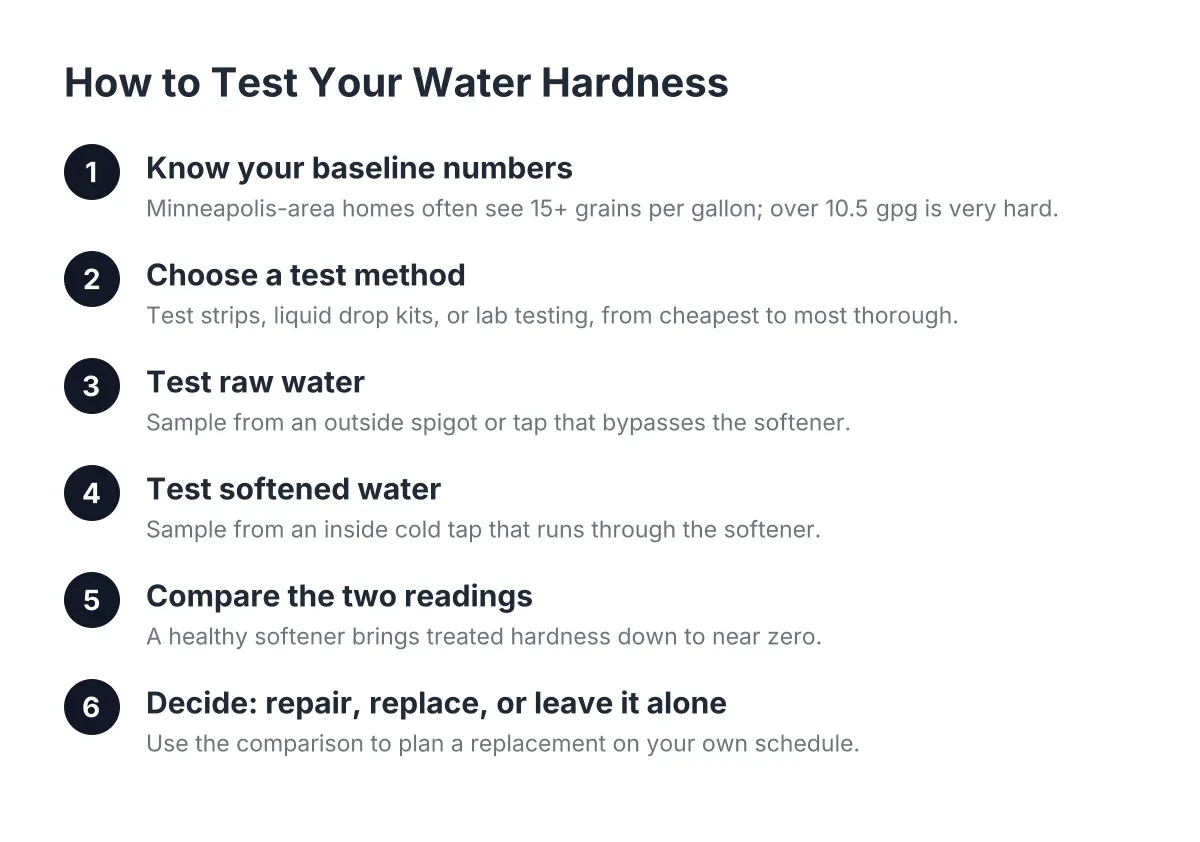
Minneapolis has hard water, and the suburbs on well water often have it worse. That is not a sales line; it is geology. The metro draws mineral-heavy water, and Minneapolis-area homes commonly see hardness of 15 or more grains per gallon, according to HomeWater 101. On the standard scale, anything over 10.5 grains per gallon counts as very hard.
The statewide picture is similar. Across 49 measured Minnesota cities, the median hardness is 162.0 mg/L, about 9.5 grains per gallon, which lands in the hard category, and 61 percent of those cities fall in the hard or very hard bands, according to USGS Water Science School. Zoom out further and Minnesota's average water hardness sits at 278.3 PPM, classified as very hard, based on USGS Water Quality Portal data across 87 counties. Of those 87 counties, 65 have very hard water above 180 mg/L, and only 5 have soft water.
So if you are asking "does Minneapolis have hard water," the answer is yes, and it is not close. The follow-up question matters more: how hard is the water at your specific address? City averages are a starting point, but hardness varies block to block, and suburbs like Eagan, Woodbury, and Hugo each have their own numbers depending on the water source. Homes on private wells in the outer suburbs often see higher hardness plus iron and manganese, which show up as orange and gray staining on fixtures and laundry.
Grains per Gallon, Explained in One Minute
Hardness gets measured two ways. Milligrams per liter (mg/L or PPM) is what city water reports use. Grains per gallon (gpg) is what softeners are sized in. Divide PPM by 17.1 to get grains. So 162 mg/L is about 9.5 gpg, and 278 PPM is about 16 gpg.
Why it matters: your softener has a setting for hardness, and a total grain capacity. If the setting is lower than your real hardness, the unit runs out of soft water between regenerations and hard water slips through. If you are replacing a unit, the installer uses your gpg number plus household size to pick the right capacity. Guessing leads to a softener that is too small and wears out early, or too big and wastes salt.
How to Test Water Hardness at Home
Testing your home's water hardness takes about two minutes with a test strip and costs a few dollars. You dip a strip in a glass of tap water, wait, and compare the color to a chart. That single reading tells you whether your softener is working, failing, or already dead.
You have three practical options, from cheapest to most thorough:
- Hardness test strips. Sold at hardware stores and online, often in packs of 25 or more. Accurate enough to tell soft from hard, which is usually all you need.
- Liquid drop test kits. You add drops to a water sample until it changes color, then count the drops. More precise than strips, still a homeowner-friendly job.
- Laboratory testing. A certified lab gives you exact numbers for hardness, iron, and manganese. Worth it for private wells, or when hardness is moderate and the difference between hard and soft water is subtle enough that strips will not settle the question.
For most Minneapolis homes on city water, strips answer the immediate question. For well homes in the suburbs, a lab test is the smarter move, because sizing a replacement softener properly requires knowing iron and manganese content, not just hardness.
Testing Water Hardness: Before and After the Softener
This is the step most homeowners skip, and it is the one that separates a repair decision from a replacement decision. Take two samples. First, test water from an outside spigot or any tap that bypasses the softener; that is your raw hardness. Second, test water from an inside cold tap that runs through the softener.
Now compare. A healthy softener should bring the treated reading down to near zero. A test strip on softened water should show the color for zero or close to it. Three outcomes tell you three different things:
- Raw water is hard, treated water is near zero. The softener works. Any symptoms you noticed are likely something else, or the unit is running out of capacity late in its cycle.
- Raw water is hard, treated water is partially softened. The resin bed is losing capacity, the hardness setting is wrong, or the unit is undersized. On a unit past 12 years, tired resin is the usual suspect.
- Raw and treated readings match. The softener is doing nothing. The bypass valve may be stuck open, the unit may have stopped regenerating, or the resin is fully exhausted.
For example, say a homeowner in Northeast Minneapolis tests an outside spigot at 16 gpg and the kitchen tap at 9 gpg. In that scenario, the 15-year-old softener is still trying, but it is only pulling out about half the hardness. That unit is not broken in a way a service call fixes; the resin bed is worn out, and money spent on repair would be money spent on borrowed time.
Reading the Signs: Repair, Replace, or Leave It Alone
The before-and-after test gives you the data. The age and condition of the unit tell you what to do with it. Most water softeners last 10 to 15 years. Past that point, individual repairs may work, but the failures start stacking up, and each fix buys less time than the last.
Weigh these signs together, not one at a time:
- Hard water symptoms returned after years of soft water. Spots on glasses, film on shower doors, stiff laundry, and dry skin. Combined with a failed treated-water test, this points at the resin bed.
- Salt is not going down. Softeners rely on salt to regenerate the resin bed, which is what removes hardness minerals, according to North Dakota State University Extension. A typical household refills salt every two to four months, per Culligan. If your salt level has not moved in months, the unit likely is not regenerating, or a salt bridge has formed a hard crust above a hollow space in the tank.
- The unit runs constantly or regenerates at odd hours. A control valve losing its programming, or a head assembly wearing out.
- Water around the tank. A leak can come from the bypass valve, a cracked brine tank, a loose fitting, or plumbing near the unit. Softeners have their own inlet and outlet valves separate from the main house shutoff, according to InspectAPedia, so you can isolate the unit without cutting water to the whole house while you sort out the source.
- Salt use climbed with no change in household. Older valves lose efficiency and regenerate more often than they need to.
One or two of these on a 6-year-old unit usually means softener repair is the right call. A stuck bypass valve, a salt bridge, or a leaking fitting are routine fixes. Three of these on a 15-year-old unit means you are firefighting, and a planned water softener replacement will cost less over the next five years than a string of emergency service calls, each one arriving while you have no soft water.
Not every case is clear-cut, though. If the leak source is ambiguous, or a partial-softening result does not match what you see at the taps, have a professional test the water and inspect the unit before you commit either way. A good technician tests hardness before and after the unit as the first diagnostic step, for exactly the reasons covered above.
What a Modern Replacement Looks Like in 2026
If the numbers say replace, the good news is that softeners have improved meaningfully since the unit in your basement was installed. A replacement done in 2026 is not a like-for-like swap of a 2008 machine.
Here is what has changed, and what your hardness number controls:
Sizing is calculated, not guessed. A proper install starts with your tested hardness in grains per gallon, iron and manganese levels if you are on a well, and the number of people in the house. Those inputs determine the grain capacity you need. This is where Minneapolis water hardness levels stop being trivia and become the spec sheet. A four-person household at 16 gpg needs a materially larger unit than the same family at 8 gpg, and an undersized softener will exhaust itself years early.
Metered regeneration replaced timer regeneration. Old units regenerated on a clock whether you used water or not. Modern demand-initiated units track actual gallons used and regenerate only when the resin needs it. High-efficiency softeners can be programmed to use less salt, water, and energy than standard units, according to Culligan. Over a decade, that is a lot of salt bags you do not carry down the stairs.
Salt choice is flexible. Most current units can run on standard sodium chloride or potassium chloride, depending on the salt setting, according to NSF International. That matters in Minnesota, where 75 percent of residents rely on groundwater that is vulnerable to chloride contamination linked in part to softener discharge, according to the Minnesota Pollution Control Agency. An efficient new unit that regenerates less often is the practical way to soften your water and send less salt down the drain.
Certification is checkable. Look for NSF/ANSI 44 certification, which means the unit passed independent testing verifying it removes calcium as well as radium-226 and radium-228, per NSF International. It is a simple way to filter marketing claims.
Iron handling can be built into the plan. Ion exchange softeners can reduce small amounts of iron in well water in addition to hardness minerals, according to Penn State Extension. However, suburban well homes with heavy iron or manganese staining often need a dedicated iron filter or whole-house filter ahead of the softener. Testing tells you which situation you have before anyone quotes equipment.
A Note on DIY Kits and Diagrams
If you are handy, you will find a water softener installation kit at any big-box store, and a water softener installation diagram comes in every unit's manual. The plumbing concept is straightforward: the softener sits on the main line after the meter, with a bypass loop so you can isolate it. A drain line carries regeneration discharge to a floor drain or standpipe.
The catch is rarely the pipe work. It is the setup. The hardness setting, reserve capacity, and regeneration programming all depend on your tested water, and a unit programmed wrong will either pass hard water or burn through salt. If you install it yourself, at minimum test hardness before and after startup to confirm the treated side reads near zero. Local drain and discharge rules also apply, so check what your city requires before you cut pipe.
Planning the Swap on Your Schedule, Not the Softener's
The whole point of testing is to move this decision out of emergency mode. A homeowner who tests twice a year knows months in advance that the resin bed is fading. That homeowner picks the install week, compares equipment options calmly, and never spends ten days showering in 16-grain water while waiting on parts.
Compare that with the emergency version. Suppose the softener starts leaking on a Friday night. Now you are shutting off the bypass valves in a hurry, mopping the basement floor, and calling for the first available service call. You will still get it fixed, but you lost the leverage of time, and you may end up choosing equipment under pressure.
A simple proactive routine looks like this:
- Buy a pack of hardness test strips; they keep for years.
- Test a treated tap twice a year, and note the reading.
- Test raw water once so you know your baseline hardness in gpg.
- Watch salt use; mark the tank level monthly on a piece of tape.
- When treated readings start creeping up on a unit past 10 years, start pricing replacement before it fails outright.
If you just moved to Minneapolis from a soft-water region, run steps 1 through 3 in your first month. Many relocators do not realize how hard the water here is until the shower doors fog with scale buildup, and by then the water heater has been collecting sediment for months. A five-dollar test in week one tells you whether the house has a working softener, a dead one, or none at all.
The Short Version
Minneapolis water hardness levels sit firmly in hard-to-very-hard territory, with metro homes commonly at 15 grains per gallon or more. A test strip on your raw and treated water tells you in two minutes whether your softener is working, fading, or done. Fading units past 10 to 12 years are usually better replaced than repaired, and your tested hardness number is the single input that makes the replacement sized right the first time.
Test first. Decide second. The homeowners who do it in that order replace their softeners once every 15 years on a Tuesday of their choosing. The ones who skip the test meet their softener's end date the hard way, usually with a wet basement floor and no soft water in the house.
If you need water softener installation, Twin Cities Water Softening can help.
Prefer to talk it through? Call +16512171659 — a quick call is usually the fastest way to get a straight answer for your situation.