
Common Water Softener Problems: White Residue, Low Pressure, and Leaks Explained
Your softener quit, and now you are seeing white spots on dishes, weak water pressure, or a puddle spreading across the basement floor. The good news: most common water softener problems trace back to a handful of causes, and with water softener troubleshooting steps you can rule out several of them yourself in under an hour. This guide walks you through triage in order, from the fastest checks to the ones that tell you whether you need a repair visit or a new unit. It also flags where a repair truly makes sense versus where someone might push a replacement you do not need.
One Minneapolis note before you start. Twin Cities water runs 15 or more grains per gallon of hardness, according to HomeWater 101, which is firmly in the very hard range. When a softener fails here, you see it fast. Spots show up on glassware within days, and scale starts working on your water heater soon after. So move through these steps promptly, but do not panic; a few days of hard water will not ruin anything.
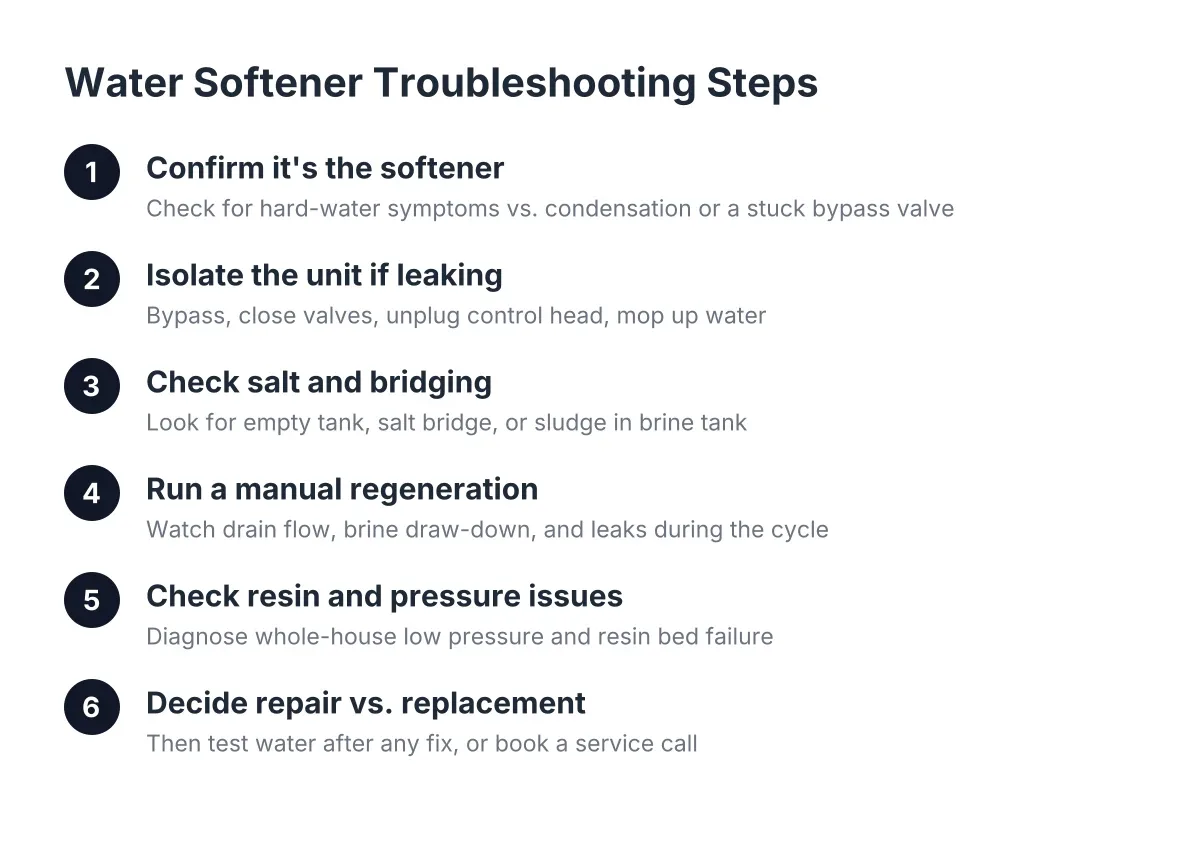
Step 1: Confirm the Problem Is Actually the Softener
Before you touch anything, verify the symptom points at the softener and not your plumbing. White residue on dishes, cloudy spots on shower glass, soap that will not lather, and a gray or white ring inside the toilet bowl all point to hard water getting past the softener. Those are softener symptoms.
However, a leak needs a closer look. The most common "leak" on a softener is not a leak at all. Cold water flowing through an uninsulated resin tank causes condensation, and that sweat drips onto the floor and looks like a failure. Wipe the tank dry, wait an hour, and see where moisture reappears. If it beads evenly across the tank surface, that is condensation. If water seeps from a fitting, the bypass valve, or the drain line, you have a real leak and can move to Step 2.
Also check the bypass valve position. A softener suddenly producing hard water after any service visit, even an unrelated plumbing job, is often just a bypass valve left in the wrong position. A technician closes it to work on the lines and forgets to reopen it. Turn it back to service mode and test your water in a day or two.
Step 2: Isolate the Unit If Water Is on the Floor
If you have a genuine leak, stop the water first and protect the basement. You do not need to shut off water to the whole house. Softeners have dedicated inlet and outlet valves separate from the main house shutoff, according to InspectAPedia, so you can isolate the unit and still shower and run the dishwasher on hard water in the meantime.
Do this in order:
- Turn the bypass valve to bypass mode so water routes around the softener.
- Close the inlet and outlet valves at the unit if it has them.
- Unplug the control head so it does not try to regenerate while isolated.
- Mop up standing water and set a fan on the floor to head off damage.
If the bypass valve itself is stuck, do not force it with a wrench. Bypass valves on older units seize, and cracking the valve body turns a small softener repair into a bigger plumbing job. A stuck bypass is a legitimate reason for a service call on its own.
Step 3: Water Softener Troubleshooting Steps for Salt and Bridging Issues
An empty or bridged brine tank causes more hard-water complaints than any mechanical failure. Softeners rely on salt to regenerate the resin bed, which is what pulls calcium and magnesium out of your water, according to North Dakota State University Extension. No usable salt means no soft water, no matter how healthy the rest of the unit is.
Open the brine tank lid and look. A typical household refills salt about every two to four months, according to Culligan, so if you cannot remember your last refill, start there. If the tank looks full but the salt level has not dropped in months, you likely have a salt bridge: a hard crust that forms over a hollow gap, so the softener cannot reach the salt below. Tap around the edges with a broom handle to break the crust, then run a manual regeneration.
While you are in the tank, look at the bottom. Softener salt contains insoluble material that settles at the bottom of the brine tank over time and needs periodic cleanout, according to Cargill. A layer of gray sludge down there can clog the brine draw. Clean pellet salt, such as Diamond Crystal water softener salt or a comparable brand, slows this buildup, but no salt eliminates it entirely.
Step 4: Run a Manual Regeneration and Watch What Happens
Next, force a regeneration cycle and observe. On most units, including popular Fleck valve softeners and Whirlpool water softener models, you hold the regen button or turn the manual cycle knob on the control head. The cycle takes roughly 60 to 90 minutes.
Watch for three things:
- Water flowing to the drain. No drain flow during backwash means a clogged drain line or a control valve problem.
- The brine tank drawing down. Water should pull out of the brine tank during the brine cycle. If the level never drops, the brine draw is clogged or the venturi assembly is fouled.
- Leaks at each stage. A drain line that only leaks during regeneration often points to a worn piston seal inside the control valve. That is a repairable part, not a dead softener, and replacing the piston and seal pack costs far less than a new unit.
If the cycle completes cleanly and your water tests soft the next day, you may be done. If symptoms return within a week, the problem is deeper, usually the resin bed or the control valve, and it is time for a professional diagnosis.
Step 5: Troubleshooting Water Softener Steps for Resin Failure and Pressure Issues
Low water pressure through the whole house, combined with a softener that no longer softens, points at the resin bed. On chlorinated municipal water, which covers most of Minneapolis and its suburbs, chlorine slowly breaks down the resin beads. The fragments then clog the tank and choke flow. If your pressure drops noticeably when the softener is in service mode but recovers in bypass, degraded resin is the likely cause.
Resin failure sits on the repair-or-replace line. A resin tank service, where a technician replaces the media in an otherwise sound unit, makes sense on a softener under about 10 years old with a working control valve. On a 15-year-old unit with a corroded valve body, new resin is money into a system that will fail somewhere else soon. This is the honest version of the triage: resin alone is a repair; resin plus valve plus age is a replacement.
For example, suppose a homeowner in Richfield notices white film on every glass and a weak shower on the second floor. The softener is 8 years old, the salt is fine, and pressure recovers in bypass. In that scenario, a resin replacement and a valve inspection likely solve it, and anyone quoting a full softener replacement as the only option should explain specifically why the valve and tanks are not worth saving.
Step 6: Decide Repair or Replacement Before Anyone Quotes You
You already suspect some companies lead with replacement because it pays better. Use these rules of thumb to keep the conversation honest:
- Repair usually makes sense for salt bridges, brine tank cleanouts, clogged injectors, piston and seal replacements, bypass valve repair, drain line fixes, and resin replacement on younger units.
- Replacement usually makes sense when the unit is past 12 to 15 years, the control valve body is cracked or corroded, parts are no longer available, or you are stacking a second major repair within a year or two.
- Sizing failure is its own category. A softener that was undersized for Twin Cities hardness will regenerate constantly, burn through salt, and wear out early. Replacing it with a correctly sized unit fixes the root problem instead of the symptom.
There is a trade-off worth naming. A well-executed repair on an aging unit buys you time, but it does not reset the clock; budget for eventual softener replacement either way. And if the leak turns out to be in your home's plumbing rather than the softener itself, you will need a plumber rather than a water treatment specialist, so confirm the leak source before booking either.
If you manage rental properties, apply the same triage across units but track it. A property manager with 20 units across the metro who logs every softener's age, model, and repair history can standardize on one platform, stock common seal kits, and stop paying emergency rates for predictable failures. Scale buildup in water heaters across a portfolio is a recurring-cost problem, not a one-off ticket.
Step 7: Test the Water After Any Fix
Finally, verify the fix instead of assuming it. Run a full regeneration after any repair, and check the unit at different stages of the cycle for leaks. If anything drips, put the unit back in bypass and fix it before returning to service. Then test your water hardness with strips or a test kit a day or two later, once the soft water has worked through your water heater.
In addition, sanitize the softener if it sat unused or bypassed for an extended stretch, or after a boil-water order, per Kinetico's guidance. A clean, tested system also matters beyond your own faucets. Seventy-five percent of Minnesotans rely on groundwater for drinking water, according to Minnesota Pollution Control Agency, and softener discharge contributes to chloride in that water. A properly tuned unit uses less salt, which is easier on your budget and the watershed.
When to Stop Troubleshooting and Book a Service Call
Call a local water softener specialist when you hit any of these: a stuck bypass valve that will not turn by hand, a leak from the control valve body or resin tank itself, a regeneration cycle that will not complete, or hard water that returns within a week of a clean salt refill and manual regen. Those are the common water softener problems that need parts, tools, and diagnosis you cannot do from the brine tank lid.
Bring your notes to the call. The unit's brand and approximate age, what you checked in Steps 1 through 5, and what happened during the manual regen will shorten the diagnosis and keep the quote grounded in what is actually broken. A specialist who works on softeners all day, rather than a generalist fitting one in between other jobs, should be able to tell you plainly which parts failed and whether the rest of the unit is worth keeping. That plain answer is what fast, honest triage looks like.
If you need water softener installation, Twin Cities Water Softening can help.
Related guide: water softener repair — Complete Guide
Prefer to talk it through? Call +16512171659 — a quick call is usually the fastest way to get a straight answer for your situation.