
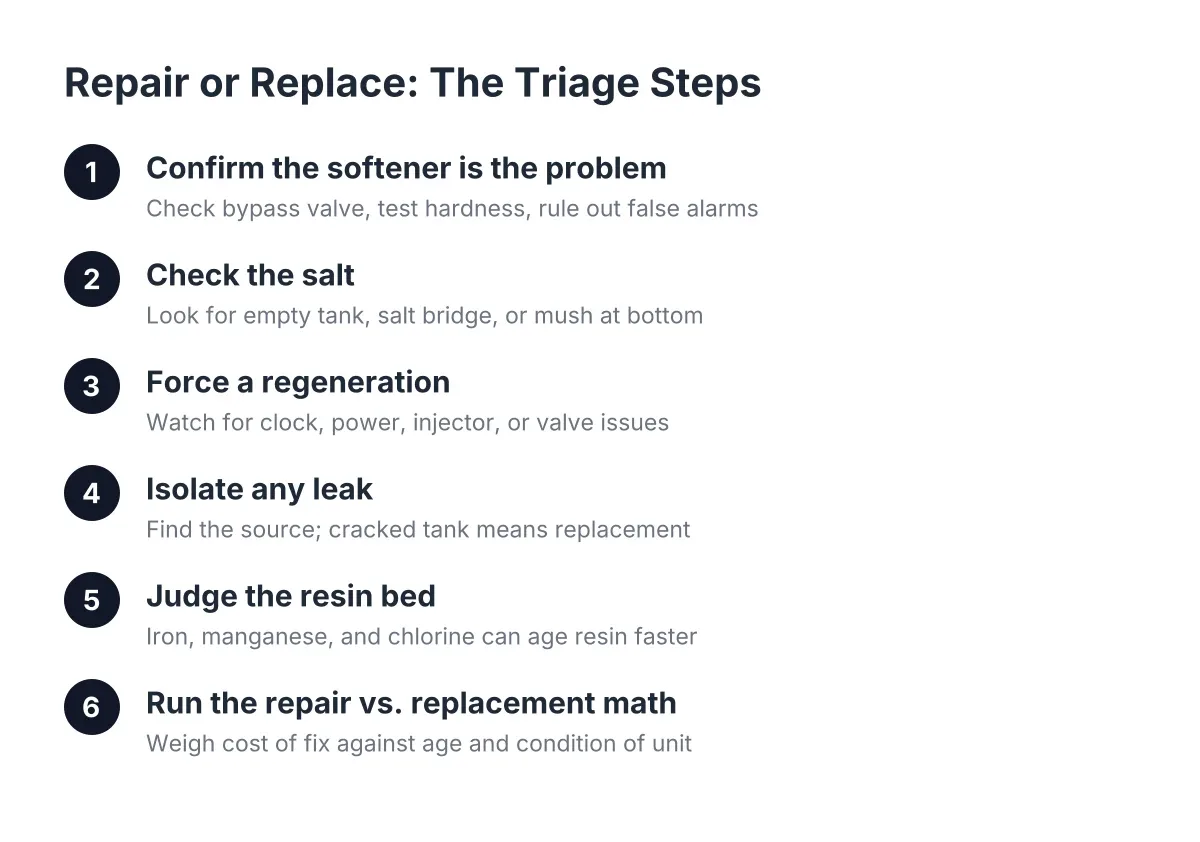
Water Softener Repair or Replacement? A Step-by-Step Triage Guide for Minneapolis Homes
Your softener quit, your glasses are cloudy again, and white scale is creeping back onto the faucets. Before you spend anything, you need one answer: is this a quick fix or a dying unit? This guide to water softener repair or replacement walks you through the same triage a technician runs, in order, so you know what a fair recommendation looks like before anyone quotes you.
This matters more in Minneapolis than in most places. The Twin Cities metro draws mineral-heavy water from the Mississippi River, producing hardness of 15 or more grains per gallon for Minneapolis-area homes, according to HomeWater 101. When a softener fails here, scale buildup shows up fast on shower doors, dishwashers, and water heaters. Work through the steps below before you decide anything.
Step 1: Confirm the Softener Is Actually the Problem
First, prove the water is hard again. Do not skip this, because some "failed softener" calls turn out to be a bypass valve someone bumped during a move or a remodel.
Run a simple check:
- Rub wet fingers together after washing with soap. Squeaky and filmy means hard water is getting through.
- Look for fresh white spots on a glass you just ran through the dishwasher.
- Check the bypass valve on top of or behind the unit. If it got knocked into bypass, untreated water is skipping the softener entirely.
- Use a cheap hardness test strip on a cold tap. Anything above 7 grains per gallon means the softener is not doing its job.
If you just moved here from a soft-water state, this step matters double. Statewide, the median hardness across 49 measured Minnesota cities is 162.0 mg/L, about 9.5 grains per gallon, and 61% of cities fall in the hard or very hard bands, according to USGS Water Science School. Hard water here is not your imagination.
Step 2: Check the Salt Before You Touch Anything Else
Next, open the brine tank lid. Salt problems cause most "water softener not working" complaints, and they cost almost nothing to fix.
Look for these three things:
- Empty or nearly empty tank. Water softeners rely on salt to regenerate the resin bed, which is what removes hardness minerals, according to North Dakota State University Extension. No salt means no soft water, period. Typical households refill salt every two to four months, according to Culligan, so if you moved in six months ago and never added any, you found your problem.
- A salt bridge. If the salt level has not dropped in months, a hard crust may have formed above the water line. The tank looks full, but no salt is dissolving. Tap the crust gently with a broom handle to break it up. Never use anything sharp; you can crack the tank.
- Salt mush at the bottom. Softener salt contains insoluble material that settles at the bottom of the brine tank over time and needs periodic cleanout, according to Cargill. A thick sludge layer can block the brine line.
If salt was the issue, fix it, run a manual regeneration, and retest the water in a day or two. You may be done for the price of a bag of salt.
Step 3: Force a Regeneration and Watch What Happens
Now trigger a manual regeneration cycle, usually a button or dial on the control head. Then listen and watch for about 90 minutes.
A healthy unit will draw brine, rinse, and refill the brine tank with a few inches of water. A softener that is not regenerating on its own often has one of these problems:
- Wrong time of day set on the clock, so it regenerates while you are using water.
- A dead power supply or tripped outlet, common in basements with GFCI circuits.
- A clogged venturi or injector, the small part that pulls brine into the resin tank.
- A stuck or worn control valve piston.
Clock settings and power are free fixes. A clogged injector is a cheap part, and a control valve rebuild is a standard softener repair on a unit worth keeping. This is also where a water softener repair kit comes in; kits with seals, spacers, and pistons exist for most common valve brands, and a technician who services softeners full time usually carries them on the truck.
Step 4: Isolate Any Leak and Find Its Source
If water is pooling around the unit, deal with the leak before anything else. Most softeners have their own inlet and outlet valves separate from the main house shutoff, so you can isolate the unit without cutting water to the whole house, according to InspectAPedia. Put the bypass valve into bypass, close those valves if you have them, and mop up.
Then find where the water came from:
- Fitting or bypass valve leaks are usually O-rings or a stuck bypass valve. These are simple repairs.
- Brine tank overflow points to a float or fill-control problem. Also fixable.
- A cracked resin tank or a split in the tank body is different. That is a replacement conversation, not a repair.
A stuck bypass valve deserves a mention on its own. If you cannot move the valve at all, do not force it with a wrench; the plastic bodies crack. That is a reasonable moment to book a service call rather than gamble on a broken valve flooding the utility room.
Step 5: Judge the Resin Bed, the Real Heart of the Unit
The resin bed does the actual softening, and it wears out. If the unit regenerates on schedule, salt goes down normally, and the water still tests hard, suspect exhausted or fouled resin.
Two Minneapolis-specific factors age resin faster. Iron and manganese, common in suburban well water and some municipal supplies, foul resin over time even though ion exchange softeners can reduce small amounts of iron, according to Penn State Extension. And chlorinated city water slowly breaks resin down over the years. Rust-orange staining in the brine tank or resin beads showing up in faucet aerators are both bad signs.
Resin tank service, meaning a cleaning or a full resin rebed, can revive some units. However, on an old builder-grade softener, a rebed can cost enough that replacement makes more sense. This is where deciding whether to repair or replace the softener becomes crucial.
Step 6: Run the Repair vs. Replacement Math
Here is the honest framework. Weigh three things: the unit's age, the cost of the fix, and how the unit was built.
Age. A softener under 8 years old with a salt bridge, a clogged injector, or a leaky O-ring is nearly always worth repairing. A unit past 12 to 15 years with a failing valve or dead resin is usually not, because the next failure is already coming.
Cost of the fix. A useful rule: if the repair costs more than half of what a properly sized new water softener installation would, put the money toward replacement. You get new resin, a new valve, a warranty, and current efficiency in one move.
Build quality. Big box store softeners with integrated one-piece cabinets are widely treated as disposable; parts are limited, and labor to open them up can approach the cost of a new mid-grade unit. A standalone two-tank softener with a standard valve is far more repairable, and a water softener repair kit for that valve family is easy to source.
For example, suppose a homeowner in Linden Hills has a 14-year-old cabinet softener that stopped regenerating. As an illustrative estimate, a valve rebuild plus a resin rebed might run $600 to $900 in parts and labor, while a new correctly sized unit installed might run $1,500 to $3,000. In that scenario, replacement wins; the same failure on a 6-year-old two-tank system flips the answer to repair.
Whether to Replace a Water Softener or Repair It
Sometimes the decision to repair or replace a water softener favors a new system even when the old one limps along. Three cases come up in Minneapolis homes:
- The unit is undersized. A softener sized for two people cannot keep up with a family of four on 15-plus grain water. Water moves through too fast to fully soften during heavy use, like Sunday morning showers plus a laundry load. No repair fixes wrong sizing.
- It is a salt-free conditioner. Salt-free systems often get swapped for true salt-based softeners because they never delivered the softening the homeowner expected. If you inherited one with the house and still see hard water stains, that is a replacement, not a repair.
- It is a timer-based dinosaur. Old timer units regenerate on a fixed schedule whether you used water or not, wasting salt. Minnesota takes this seriously; a program in Marshall paid $500 to $700 rebates for replacing timer-based softeners, according to the Minnesota Pollution Control Agency. High-efficiency demand-based softeners can be programmed to use less salt, water, and energy than standard units, according to Culligan.
Salt waste is not just a money issue here. Seventy-five percent of Minnesotans rely on groundwater for drinking water, which is vulnerable to chloride contamination linked partly to softener discharge, according to the Minnesota Pollution Control Agency. An efficient replacement uses less salt and sends less chloride down the drain.
How to Tell a Fair Recommendation From an Upsell
A fair diagnosis names the specific failed part, quotes the repair and the replacement side by side, and explains the age-and-cost math above. Be wary of anyone who jumps straight to replacement without opening the valve, testing your water hardness, or checking the brine tank. Equally, be wary of endless small repairs on a 15-year-old unit; that is an upsell in slow motion.
Step 7: Know Your Limits and Book the Right Help
You can safely handle salt bridges, brine tank cleanouts, settings, and hardness testing yourself. Valve rebuilds, resin rebeds, plumbing leaks, and anything involving soldered or press-fit connections belong with a professional, especially if you have never opened a softener before. As of 2026, a water softener specialist rather than a general plumber is the better call for diagnosis, because they see these exact failures daily and stock the parts. When you need to decide whether to replace or repair a softener, a specialist can walk you through the same analysis this guide covers.
One more Minneapolis note: if your softener sat unused while the house was vacant before your closing, sanitize it before relying on it. A softener should be sanitized after sitting idle during an extended absence, after a boil-water order, or if the water tastes or smells off, according to Kinetico. It is a quick add-on to any service call, and for a relocator settling into a new home, it closes the loop on the whole system.
Work the steps in order, keep the half-the-cost rule in mind, and the repair-or-replace decision mostly makes itself.
If you need water softener installation, Twin Cities Water Softening can help.
Prefer to talk it through? Call +16512171659 — a quick call is usually the fastest way to get a straight answer for your situation.