
When to Regenerate Your Water Softener: Cycle Frequency by Hardness and Usage
If your softener is 15 years old and you can't remember the last time anyone checked its settings, the question of how often a water softener undergoes regeneration and at what frequency matters more than you might think. Regenerate too often and you burn through salt and water for nothing. Regenerate too rarely and hard water slips through, leaving scale buildup on your water heater and hard water stains on every fixture in the house. This guide gives you a practical way to figure out the right frequency for your home, plus a maintenance schedule you can actually follow so the unit keeps working until you're ready to replace it on your own terms.
Minneapolis water is not gentle on softeners. The Twin Cities metro draws mineral-heavy water from the Mississippi River, producing hardness of 15 or more grains per gallon for Minneapolis-area homes, according to HomeWater 101. Statewide, Minnesota's average water hardness is 278.3 PPM, classified as very hard, according to the USGS Water Quality Portal. That level of hardness means your softener regenerates more often than the same unit would in most of the country, and its settings need to reflect that.
What Happens During a Regeneration Cycle
Regeneration is the softener's self-cleaning process. The resin beads inside the tank grab calcium and magnesium out of your water. Over days of use, those beads fill up. Once they're saturated, they can't soften anything. Regeneration flushes them clean so they can start over.
The unit does this by drawing salty water from the brine tank and rinsing it through the resin. The salt strips the hardness minerals off the beads and sends them down the drain. Water softeners rely on salt to regenerate the resin bed, and that resin bed is what removes hardness minerals from your water, as North Dakota State University Extension explains it. No salt, no regeneration. No regeneration, no soft water.
A full cycle runs through several stages: backwash, brine draw, rinse, and brine tank refill. It usually happens in the middle of the night, typically around 2 a.m., because the softener is offline or running in bypass while it cleans itself. You'll hear it running if your bedroom is above the utility room. That sound is normal. Silence for weeks, on a unit that should be cycling, is the thing to worry about.
Determining the Right Water Softener Regeneration Frequency for Your Home
Most softeners on Minneapolis water need to regenerate every two to seven days, depending on household size, water hardness, and the unit's resin capacity. The frequency of water softener regeneration varies based on whether you have a metered or timer-based unit. A metered softener figures this out on its own by tracking gallons used. A timer-based unit regenerates on a fixed schedule whether the resin needs it or not, which is one of the main reasons older units waste salt and water.
Here's the difference in plain terms. A metered valve counts every gallon that passes through the softener. When total usage reaches the tank's rated capacity, it triggers a cycle that night. Your water use drives the schedule. Go on vacation for two weeks and the unit just waits.
A timer-based softener from the 1990s or early 2000s doesn't count anything. It regenerates every three days, or whatever it was set to decades ago, even if you've been away and used zero gallons. Over a year, that adds up to a lot of wasted salt going down the drain and into Minnesota's lakes and rivers. The chloride problem is real enough that a rebate program in Marshall, Minnesota offered $500 to $700 for replacing timer-based water softeners, according to the Minnesota Pollution Control Agency. That same program cut salt use by up to 320,000 pounds per year, with some households reducing salt use by as much as 86 percent.
If your aging unit is timer-based, that alone is a strong argument for softener replacement rather than another repair. A modern metered unit regenerates only when the water you've actually used demands it.
The Simple Math Behind Water Softener Regeneration Frequency
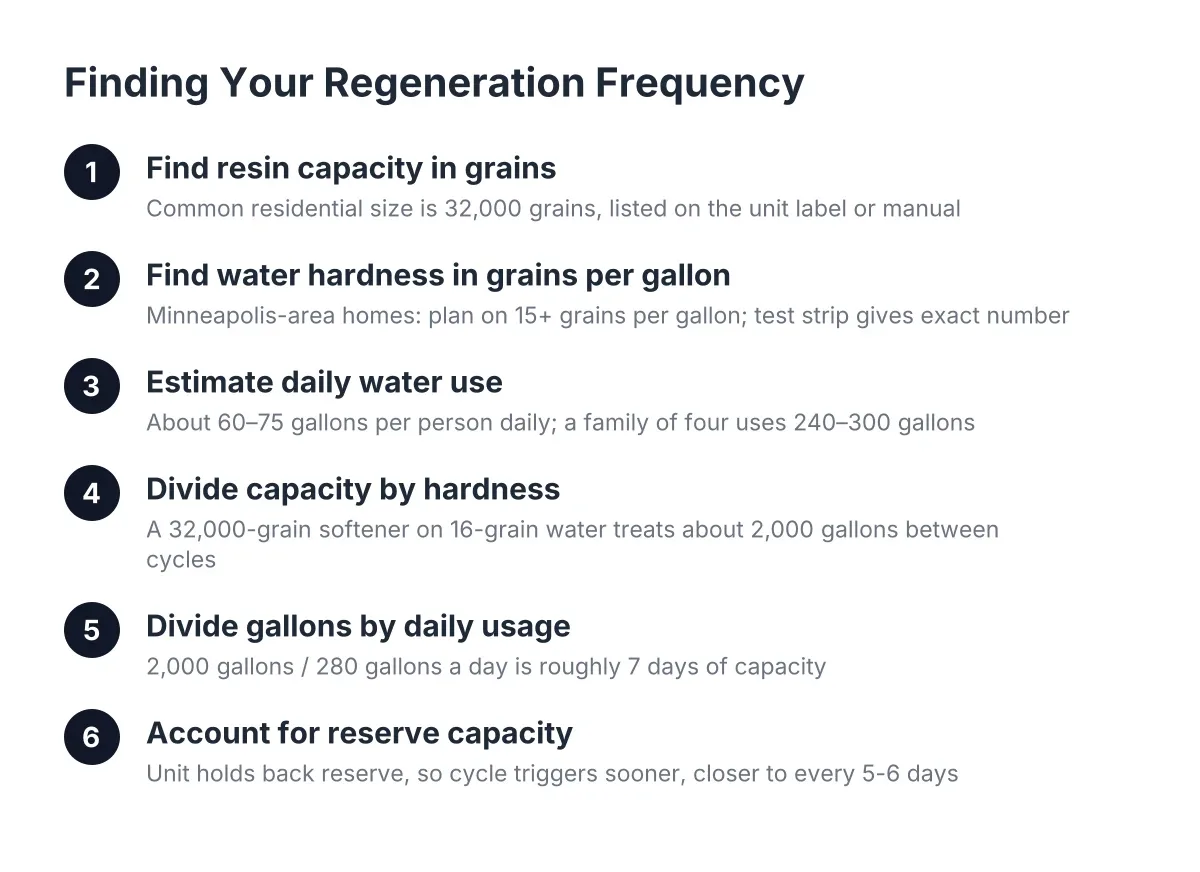
You can estimate your own regeneration interval with three numbers: resin capacity, water hardness, and daily usage.
- Find your resin capacity in grains. A common residential size is 32,000 grains. It's usually on the unit's label or in the manual.
- Find your water hardness in grains per gallon. For Minneapolis-area homes, plan on 15 or more grains per gallon. A test strip or a professional test gives you the exact number, and suburban well water often runs higher, with iron on top.
- Estimate daily water use. Figure about 60 to 75 gallons per person per day. A family of four lands around 240 to 300 gallons daily.
Now divide capacity by hardness. A 32,000-grain softener on 16-grain water can treat about 2,000 gallons between cycles. Divide that by 280 gallons a day for a family of four and you get roughly seven days of capacity. In practice, the softener holds back a reserve so it doesn't run out of soft water mid-cycle, so it will trigger a regeneration sooner, closer to every five or six days.
Suppose a homeowner in a 1962 rambler in Richfield runs that math and finds their old 24,000-grain unit on 17-grain city water. That's only about 1,400 treatable gallons, which for a family of four means regenerating about every four days, sometimes more. In that scenario, the unit was likely undersized from day one, and the constant cycling explains both the salt bill and why the resin wore out early. This is exactly the sizing conversation worth having before a replacement, so the new unit matches your actual household instead of whatever was cheapest in 2003.
Signs Your Regeneration Schedule Is Off
An aging softener rarely dies all at once. It drifts. Watch for these signals that the regenerate cycle on your water softener is set wrong, or that the unit is losing capacity:
- Hard water stains come back between cycles. Spots on glasses, film on the shower door, or white crust on faucets a day or two before the unit regenerates means it's running out of capacity early.
- Salt use suddenly changes. Burning through bags faster than usual can mean the unit is cycling too often. Salt sitting untouched for months can mean it isn't cycling at all, or a salt bridge has formed.
- Soap won't lather like it used to. Hard water fights soap. If shampoo and dish soap feel weak, hardness is getting through.
- The unit regenerates at random times or not at all. A failing control valve or dead clock throws the whole schedule off.
- Water pressure drops through the house. Fouled resin or sediment in the tank can restrict flow, which is common in pre-1980 homes with original galvanized plumbing feeding the softener.
Any one of these on a unit past 15 years is worth a service call. Two or more usually means the repair-versus-replace conversation, and on a timer-based unit that math tilts toward replacement fast.
A Maintenance Schedule That Prevents Emergency Calls
The point of water softener maintenance is boring reliability. A softener that gets ten minutes of attention a month almost never fails on a Saturday night. Here is a schedule built for a Minneapolis homeowner with hard city or well water, not a generic national checklist.
Monthly: Check the Salt
Lift the brine tank lid and look. The tank should be at least one-third full, and salt should sit a few inches above the water level. Typical households refill salt every two to four months, though that varies with water hardness, family size, water usage, and brine tank size, according to Culligan. On 15-plus grain Minneapolis water with a family in the house, expect the shorter end of that range.
While you're in there, check for a salt bridge. That's a hard crust that forms across the tank while the salt below dissolves away, leaving a hollow gap. The tank looks full, but the softener is drawing plain water instead of brine, so every regeneration cycle after that accomplishes nothing. Tap the crust gently with a broom handle to break it up. Never pour hot water in or bang on the tank walls; older brine tanks crack.
On salt type: most units run on standard sodium chloride, and the salt setting can typically be switched between sodium chloride and potassium chloride depending on which you use, according to NSF International. Potassium chloride costs more but adds no sodium to your water. Whichever you choose, stick with clean pellet or cube salt rather than rock salt, which carries more insoluble junk.
Every Six Months: Look, Listen, and Test
Twice a year, give the system fifteen minutes. Run a hardness test strip on a softened tap; you want a reading near zero grains. Check the floor around the unit and the drain line for moisture, because small leaks at the bypass valve or fittings start quietly and end badly in a finished basement. Listen for a regeneration one night to confirm the cycle actually runs.
In addition, confirm the clock on the control head is right. Power blips reset older units, and a softener that thinks 2 a.m. is 2 p.m. will regenerate while you're showering, sending hard water through the house mid-cycle. On the control panel, leave the factory cycle presets alone; the time of day and the gallon-capacity setting are the only things a homeowner should ever adjust.
Yearly: Clean the Brine Tank and Inspect the Works
Once a year, clean out the brine tank. Salt contains insoluble material that accumulates at the bottom of the tank over time and needs periodic cleanout, according to Cargill. Let the salt run low, scoop out the sludge at the bottom, wash the tank with mild soapy water, rinse, and refill. A dirty brine tank clogs the injector, and a clogged injector quietly kills regeneration.
An annual once-over is also the time to inspect the resin tank, the valve seals, and the drain line. Every couple of years, or sooner if symptoms show up, it's worth having a professional open up the control valve, clean or replace worn internals, and reprogram the unit if your household has changed. Kids moving out, a new high-use bathroom, or a switch from well to city water all change how often the softener should cycle. This is the visit that catches a $40 seal before it becomes a flooded utility room, and it's a fair moment to search for water softener service or a water softener specialist near me if you don't already have someone local.
After Unusual Events: Sanitize
A softener should be sanitized after a municipal boil-water order, if the water is deemed unsafe, if there's a bad taste or odor, especially on private wells, or after the system sits unused during an extended absence, according to Kinetico. For a Minnesota homeowner, that last one matters: if you winter somewhere warm and the softener sits idle from November to April, sanitize it and run a manual regeneration before trusting the water again.
Running a Manual Regeneration, and When You Should
A manual regeneration forces the softener to run a full cycle now instead of waiting for its trigger. On most units, you press and hold a "regen" button, or turn a dial on older mechanical heads, and the cycle starts within a minute or two.
Run one manually in these situations:
- After breaking up a salt bridge or refilling a tank that ran completely empty
- After the brine tank annual cleanout
- After any repair or part replacement
- After sanitizing the system
- When you return from an extended absence
After any service work, run the unit through a complete cycle and check it at each stage for leaks. If you spot a drip, put the unit in bypass and fix it before letting the cycle finish. Most softeners have dedicated inlet and outlet valves separate from the main house shutoff, so you can isolate the unit without cutting water to the whole house, as InspectAPedia notes. In a pre-1980 home, find and exercise those valves before you need them; forty-year-old valves that have never turned tend to seize or weep.
One honest limitation: if a manual regeneration doesn't restore soft water, the fix is usually inside the control valve or the resin bed, and that's professional territory. Resin tank service, valve rebuilds, and bypass valve repair involve pressurized fittings and, in older homes, brittle original plumbing. A wrong move there costs more than the service call would have.
When Maintenance Stops Being Enough
Every softener has a point where upkeep can't outrun age. Resin degrades, especially on chlorinated city water and iron-heavy suburban wells. Control valves wear out. If your unit is past 15 years, is timer-based, or needs its second repair in two years, put the money toward replacement instead.
The upside of replacing on your schedule, rather than after a failure, is that you get to size the new system correctly. Run the capacity math above with a real hardness test, count the people in your house honestly, and pick a metered, high-efficiency unit. High-efficiency softeners can be programmed to use less salt, water, and energy than standard units, according to Culligan. When comparing equipment, look for NSF/ANSI 44 certification, which means the unit was independently tested and verified to remove calcium as well as radium-226 and radium-228 from water, per NSF International. That certification is a more useful filter than any "best water softener system" list, because the best system is the one sized for your hardness and your household.
A planned water softener installation also avoids the mess a failure creates. A dead softener discovered during a plumbing emergency means weeks of hard water hammering your water heater while you scramble. Additionally, a planned swap takes an afternoon, the installer works around your utility space, and as of 2026 the modern metered units on the market regenerate only when your usage demands it. That's the whole goal: a softener that cycles exactly as often as your water requires, no more, no less, and a maintenance routine short enough that you'll actually keep doing it.
If you need water softener installation, Twin Cities Water Softening can help.
Prefer to talk it through? Call +16512171659 — a quick call is usually the fastest way to get a straight answer for your situation.