
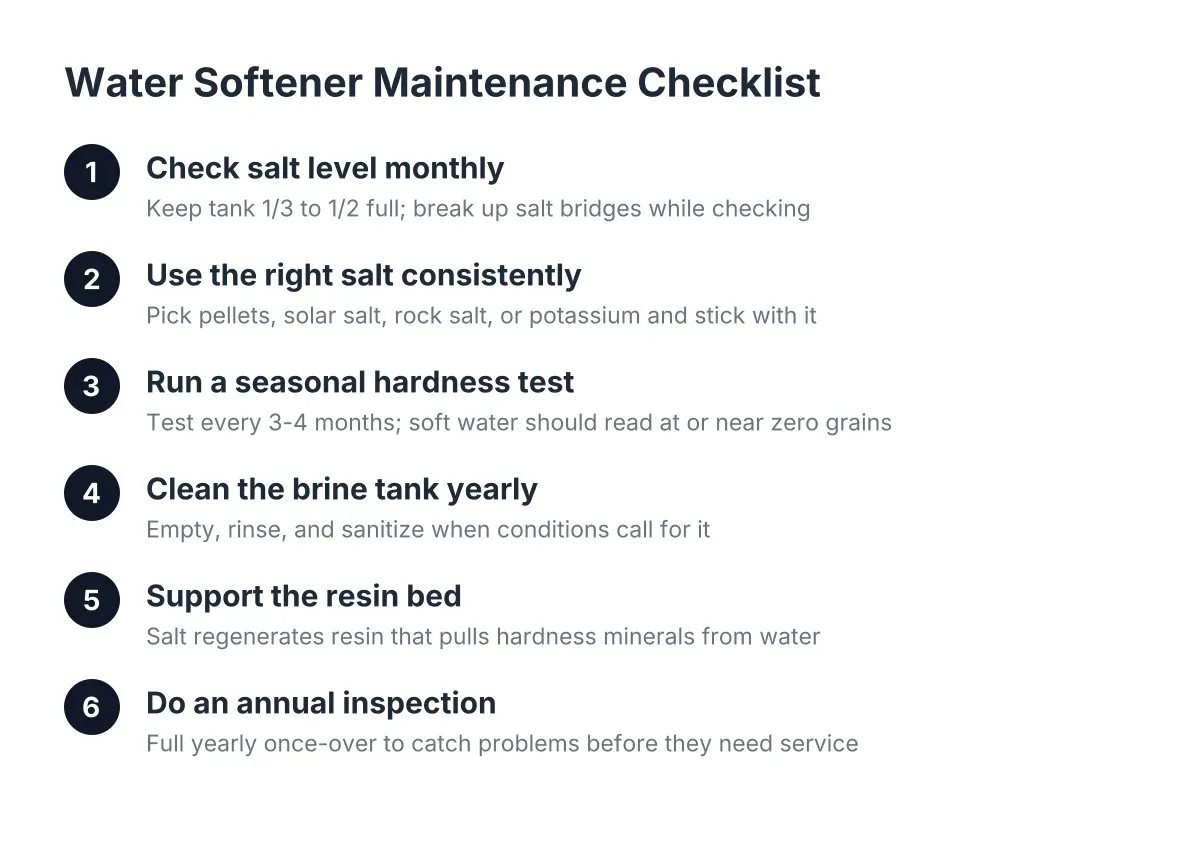
Water Softener Maintenance Checklist: Monthly and Seasonal Tasks for Minneapolis Homes
If you just moved to Minneapolis, or your softener is old enough to drive, this water softener maintenance checklist gives you a schedule you can actually follow. Twin Cities water is hard. According to HomeWater 101, the metro draws mineral-heavy water from the Mississippi River, and Minneapolis-area homes often see hardness of 15 or more grains per gallon. That workload wears on any softener, and it wears faster on one that never gets checked. The steps below are laid out in order, from a five-minute monthly check to an annual once-over, so you can catch small problems before they turn into a service call, or a full softener replacement, at the worst possible time.
One note before we start. A softener that runs daily needs less babysitting than most people think. Once the settings are right, the main job is keeping salt in the tank and watching for a few warning signs. This checklist is about doing that consistently, not tinkering every weekend.
Step 1: Check the Salt Level Every Month
Open the brine tank lid once a month and look. The salt should cover the water in the tank. A common rule of thumb is to keep the tank at least one-third to one-half full, and to refill when salt drops below that line.
How often will you actually add salt? According to Culligan, typical households refill every two to four months, though hard water, a big family, and a small brine tank all shorten that window. In a Minneapolis home with 15+ grain water and four people showering daily, expect the shorter end of that range.
While the lid is open, watch how fast the salt drops over a few months. That pattern is your baseline. If the softener suddenly stops eating salt, the system is probably not regenerating, and that is a repair sign, not a fuel savings.
Water Softener Maintenance Checklist: Break Up Salt Bridges While You're There
A salt bridge is a hard crust that forms above the water line. The tank looks full, but the salt underneath is gone and the softener regenerates with weak brine, or none at all. Push a broom handle gently into the salt each month. If it hits a crust before it hits loose salt, break the bridge apart by hand. Never pound on the tank walls; older plastic cracks.
Humid Minnesota summers and cheap salt make bridging more likely. Which brings us to salt choice.
Step 2: Use the Right Salt, and Stick With It
Water softener salt types matter more than the price difference suggests. Your basic options:
- Evaporated salt pellets. The purest common option, and the least likely to leave sludge in the tank. The safest default for most homes.
- Solar salt crystals. Cheaper, but they carry more insoluble material. According to Cargill, the insolubles in softener salt settle at the bottom of the brine tank over time and need periodic cleanout.
- Rock salt. The cheapest and the dirtiest. It saves a few dollars per bag and costs you tank cleanings.
- Potassium chloride. A sodium-free regenerant. According to NSF International, most softeners can be set for either standard sodium chloride or potassium chloride, depending on which you load. Potassium costs more per bag, and some units need a setting change to meter it correctly.
Pick one type and stay with it. Switching back and forth changes how the unit brines, and mixing types speeds up the mush at the bottom of the tank.
A quick word on the salt-free question, since many relocators from soft-water states ask. A salt-free water softener is really a conditioner; it changes how minerals behave rather than removing them. On 15+ grain Minneapolis water, a salt-based unit is what actually stops scale buildup and hard water stains. Salt-free units have a place, but severe hardness is not it.
Step 3: Run a Seasonal Hardness Test
Every three or four months, test your water. Cheap test strips work fine for this. Test a cold tap after the softener has had a normal week of use, and write the number down with the date.
Soft water should read at or near zero grains. If hardness is creeping back, something upstream on this checklist failed: bridged salt, an empty tank, a stuck valve, or tired resin. Returning hard water stains on shower glass and faucets are the everyday version of the same test.
Seasonal timing matters in Minnesota. Spring and fall are natural checkpoints, and a quick test before winter means you are not diagnosing a failing softener in a freezing utility room in January. If your home draws from a well in the suburbs, test for iron too. According to Penn State Extension, ion exchange softeners can remove small amounts of iron along with hardness, but iron duty is hard on resin, and softeners handling iron need more frequent attention than hardness-only units.
Step 4: Clean the Brine Tank Once a Year
Once a year, or any time you see gray sludge, empty and rinse the brine tank. Wait until the salt is nearly gone so you are not hauling out fifty pounds of wet pellets. Scoop out the residue at the bottom, wash the tank with mild dish soap and water, rinse well, and refill with fresh salt.
In addition, this is the right moment to sanitize the system if conditions call for it. According to Kinetico, a softener should be sanitized after a boil-water order, after bad taste or odor shows up (especially on private wells), or after the system sat unused during an extended absence. Snowbirds who winter away from Minneapolis, take note of that last one.
Step 5: Give the Resin Bed Some Help
The resin bed does the actual softening. According to North Dakota State University Extension, softeners rely on salt to regenerate that resin bed, which is what pulls hardness minerals out of your water. Over years, iron and sediment coat the beads and regeneration stops restoring full capacity.
A periodic dose of resin cleaner helps keep the bed working, and it matters most on iron-bearing suburban well water. Follow the product directions; most pour into the brine well before a regeneration. Think of this as resin tank care you can do yourself. If cleaner no longer brings performance back, the resin may be spent, and a resin tank service or rebed is a job for a water treatment pro.
Step 6: Annual Inspection Checklist for Water Softener Maintenance
Once a year, spend twenty minutes on a full water softener maintenance checklist. Here is the annual pass:
- Check the bypass valve. Turn it to bypass and back. Most units have their own inlet and outlet valves separate from the main house shutoff, according to InspectAPedia, so you can isolate the softener without killing water to the house. A bypass that hasn't moved in a decade tends to seize or leak exactly when you need it.
- Inspect for leaks and drips. Look at the fittings, the drain line, and the floor around the unit.
- Confirm the settings. Check the clock, the hardness setting, and the regeneration schedule, especially after a power blink or a change in household size. A kid off to college or a new baby changes your water use.
- Trigger a manual regeneration and watch it. Listen through the cycles and check for leaks at each stage. If you find one, put the unit back in bypass and fix it before running water through again.
- Test the water afterward to confirm soft results.
This is also the honest limit of DIY. An annual professional service, where a technician cleans the control valve, inspects internal parts, and tests the water, catches wear you cannot see from outside. If your unit is 15 or more years old, that annual visit doubles as a replace-or-repair conversation on your schedule instead of during a basement flood.
What a Water Softener Maintenance Schedule Looks Like in Practice
Suppose a family of four buys a 1970s home in Richfield in 2026, relocating from Denver's softer water. The inspection notes a softener from the mid-2000s. In that scenario, a sensible routine looks like this: a monthly salt check with a broom-handle poke, pellets only, a hardness strip every season, a brine tank rinse each spring, resin cleaner twice a year because the strips show trace iron, and a professional checkup each fall before winter. Total homeowner time, maybe an hour a year.
That routine also tells them when replacement makes sense. An old timer-based unit regenerates on a schedule whether you used water or not, wasting salt and water. Modern high-efficiency softeners can be programmed to use less salt, water, and energy than standard units, according to Culligan. The stakes are bigger than your salt budget; the Minnesota Pollution Control Agency notes that 75 percent of Minnesotans rely on groundwater that is vulnerable to chloride contamination linked partly to softener discharge. In one Minnesota optimization program in Marshall, some households cut salt use by as much as 86 percent, per the same agency. If your maintenance log shows heavy salt use, repeated bridging, and hardness creeping through, that is your signal to price a water softener system for home replacement now, calmly, rather than after a failure.
Warning Signs That Maintenance Alone Won't Fix
Consistent water softener maintenance extends a unit's life, but it cannot make an old softener young. Call a local softener repair specialist, or start planning a replacement, when you see:
- Hard water symptoms that return within days of a regeneration
- A unit that stops using salt even though the tank is full
- Standing water rising high in the brine tank
- Rust-colored staining that softening no longer controls
- A unit past 15 years that needs its second or third repair
For an aging system, the math usually favors replacement over another repair once fixes start stacking up. The best water softener for your house is one sized to your actual hardness and household, so get the water tested before anyone quotes you a tank size.
Keep this water softener maintenance checklist taped near the unit or saved as your own maintenance schedule PDF, and mark each check on a calendar. Ten minutes a month and one honest annual inspection will keep soft water flowing, cut emergency service calls, and let you replace the system on your timeline, not the softener's.
If you need water softener installation, Twin Cities Water Softening can help.
Prefer to talk it through? Call +16512171659 — a quick call is usually the fastest way to get a straight answer for your situation.