
How to Clean Water Softener Resin and Stop Iron From Fouling the Tank
If your water softener seems to be losing its grip, the white scale creeping back onto faucets, cloudy glasses out of the dishwasher, orange streaks in the toilet tank, the resin inside the unit is the first place to look. Learning to clean water softener resin is the single most useful maintenance skill a Minneapolis homeowner can pick up, because around here the resin bed takes a beating. Twin Cities water runs hard, and in many suburbs it carries dissolved iron and manganese on top of that. Iron is the quiet killer of softeners. It coats the resin beads, the softener keeps regenerating like nothing is wrong, and the hard water sneaks back into your house anyway.
This guide walks you through a practical cleaning routine, step by step, with a schedule you can actually keep. Follow it and you will head off most of the breakdowns that turn into emergency service calls.
Why Your Clean Water Softener Resin Matters in Minneapolis Water
Inside the tank, thousands of small resin beads do the real work of water treatment. Calcium, magnesium, and dissolved iron stick to the beads more strongly than the sodium already on them, so the beads swap them out and the water leaves soft. Every few days the softener runs a regeneration cycle, flushing the beads with salty brine to recharge them. Water softeners rely on salt to regenerate the resin bed; that exchange is what removes hardness minerals, according to North Dakota State University Extension.
Here is the problem. Regeneration handles calcium and magnesium well, but iron does not rinse off as easily. Over months it builds a stubborn coating on the beads. A softener pulling iron out of well water or suburban municipal water needs more frequent care than one handling hardness alone. The resin can also get compromised if the unit runs out of salt, if a salt bridge clogs the brine tank, or if the softener is doing iron-removal work it was never sized for.
The stakes are higher here than in most of the country. The Twin Cities metro draws mineral-heavy water from the Mississippi River, with hardness at 15 or more grains per gallon for Minneapolis-area homes, according to HomeWater 101. Across Minnesota, 61 percent of measured cities fall in the hard or very hard range, per the USGS Water Science School. Your softener does not get easy days off.
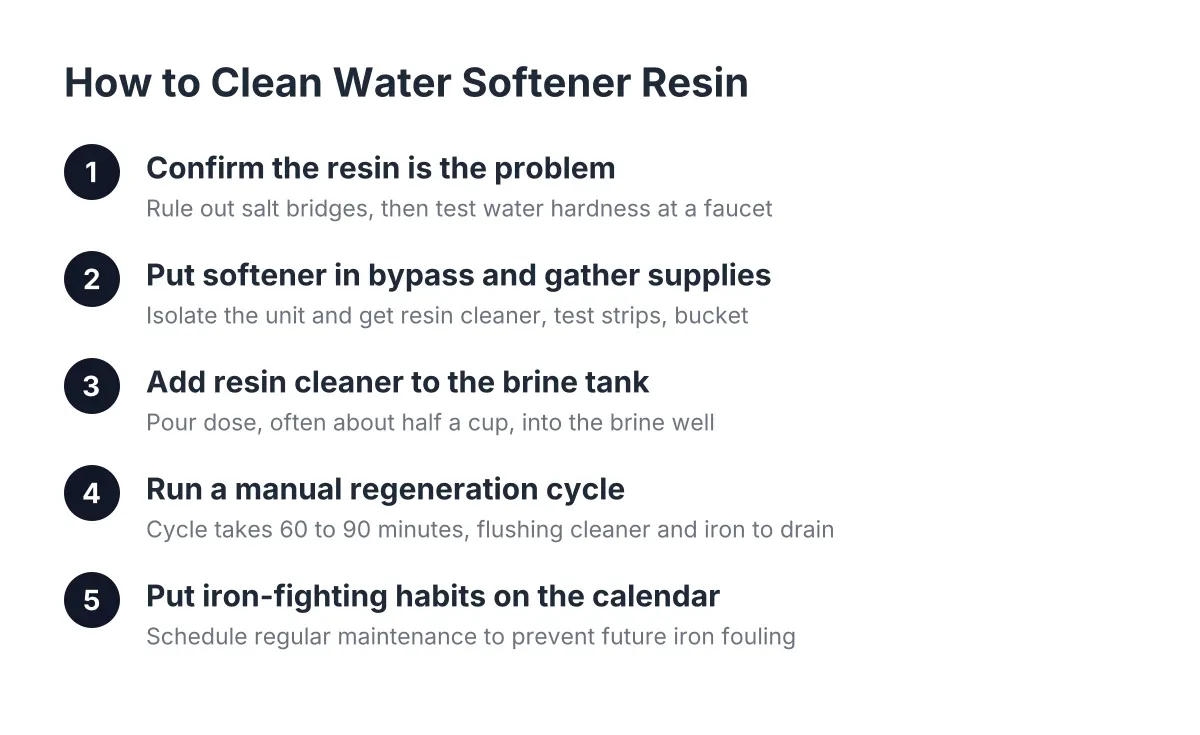
Step 1: Confirm the Resin Is the Problem
Before you clean anything, check the symptoms. Fouled resin usually announces itself in a few ways:
- Hard water stains and scale buildup returning even though the salt level looks fine
- Soap that will not lather the way it used to
- Orange or rust-colored staining in toilets, tubs, or the softener's brine tank
- Water that tastes or smells metallic
- A softener that regenerates on schedule but the water still tests hard
First, rule out the simple stuff. Look in the brine tank. If the salt has formed a hard crust with a hollow space underneath, that is a salt bridge, and the fix is breaking it up, not cleaning resin. If the salt level is fine and the brine looks normal, and you still see the symptoms above, the resin bed is your likely culprit.
A cheap hardness test strip settles the question. Test the softened water at a faucet. If it reads hard while the softener has salt and power, move to Step 2.
Step 2: Put the Softener in Bypass and Gather Supplies
Most softeners have their own inlet and outlet valves or a bypass lever, separate from the main house shutoff, so you can isolate the unit without cutting water to the whole house, according to InspectAPedia. Flip the bypass so the household keeps running on unsoftened water while you work. An hour or two of hard water will not hurt anything.
You will need:
- A liquid or powdered resin cleaner made for iron removal (sold at hardware stores, often labeled as an iron-out or resin-cleaning product)
- A hardness test strip or kit
- A small bucket and a cup for measuring
- Fifteen minutes now, and a few minutes the next day to check results
Skip the shortcuts you may have seen online. Vinegar gets mentioned a lot for cleaning a resin tank, and it can help dissolve light mineral film, but it does little against iron fouling. For Minneapolis-area water, a purpose-made resin cleaner is the right tool.
Step 3: Add Resin Cleaner to the Brine Tank
Follow the dose on your cleaner's label; a common amount is about half a cup for a standard residential unit. Pour it into the brine well, the smaller tube inside the salt tank if your unit has one, or directly into the brine tank if it does not. Pouring it into the well keeps the cleaner concentrated where the brine draw happens instead of soaking into forty pounds of salt.
The cleaner does not work sitting in the tank. It works when the softener pulls brine through the resin during regeneration, stripping the iron coating off the beads as it passes. That is the whole trick to a deep clean of water softener resin: get the chemistry to the beads, then rinse it all to the drain.
Step 4: Run a Manual Regeneration Cycle
Take the softener out of bypass, then start a manual regeneration. On most units that means holding the regen button or turning the control dial to the regeneration position. The full cycle takes 60 to 90 minutes and sends everything, cleaner, loosened iron, and spent brine, down the drain line.
If the fouling is heavy, say the unit sat for years without any resin care, run a second regeneration the next day with a fresh dose of cleaner. One pass rarely undoes five years of iron buildup. Afterward, run a cold tap for a few minutes to flush any residual cleaner from the lines before drinking the water.
Retest with your hardness strip a day later. Soft reading, you are done. Still hard, the resin may be past the point of cleaning, which brings up an honest limit: resin beads physically break down after roughly 10 to 15 years in hard, iron-bearing water. Cleaning restores fouled resin; it cannot rebuild degraded resin. At that point a resin rebed or softener replacement is the real fix, and that is a job for a local water softener pro, since it involves emptying and refilling the tank media.
Step 5: Put Iron-Fighting Habits on the Calendar
One cleaning buys you a reset. A schedule keeps you from ever needing an emergency softener repair call. Here is a routine that works for Twin Cities water:
- Monthly: Check salt level and break up any crust. Most households refill salt every two to four months, according to Culligan, but check more often than you refill.
- Every 3 to 4 months (iron-heavy water): Add a dose of resin cleaner before a regeneration. If your water has little iron, once a year is enough.
- With each salt purchase: If your softener is handling iron or manganese without a separate iron filter, buy the resin-cleaning salt, usually the green bag at the store, instead of plain pellets. It cleans the beads a little with every cycle.
- Yearly: Clean out the brine tank bottom. Softener salt contains insoluble material that settles there over time and needs periodic cleanout, according to Cargill.
- After a boil-water order or a long absence: Sanitize the system. Kinetico notes a softener should be sanitized after a boil order, after extended non-use, or if the water develops a bad taste or odor.
In addition, fold a quick visual check into your regular water softener maintenance: look for salt bridging, leaks at the bypass valve, and rust staining in the brine tank. Five minutes a month catches most problems while they are still cheap.
What This Looks Like in a Real Minneapolis Home
Suppose a homeowner in a 1960s rambler in Bloomington starts noticing orange rings in the toilet and spots on the shower door, even though the softener in the basement has plenty of salt. In that scenario, the softener has likely been quietly removing low-level iron for years with no resin care at all. A test strip confirms hard water downstream of the unit.
Two rounds of resin cleaner and manual regenerations over a weekend, a switch to iron-fighting salt, and a quarterly cleaner dose on the calendar would likely restore soft water for well under a hundred dollars in supplies, as a rough illustrative estimate. Compare that to replacing a scaled-up water heater early, and the math is not close. For a property manager running twenty rental units across the metro, the same routine standardized across buildings turns surprise unit-by-unit failures into one predictable maintenance line item.
How to Know When Cleaning Water Softener Resin Is Not Enough
Can you clean water softener resin back to full performance every time? No. Cleaning handles fouling, the coating problem. It does not fix three other failure modes: physically degraded beads that have cracked and compacted with age, a softener that was undersized for the home's hardness and iron load from day one, or iron levels high enough that the softener should never have been the iron solution at all.
If your water carries heavy iron, the durable fix is a dedicated iron filter ahead of the softener, so the resin only has to handle hardness. Ion exchange softeners can reduce small amounts of iron, according to Penn State Extension, but small is the key word. Ask a softener specialist to test your water and tell you which situation you are in before you spend another season cleaning resin that is fighting a losing battle.
For most Minneapolis homes, though, the routine above is enough. Clean the resin on a schedule, feed the unit the right salt, and keep iron from ever getting a foothold. Your softener will last years longer, and your faucets, dishes, and water heater will show it.
If you need water softener installation, Twin Cities Water Softening can help.
Prefer to talk it through? Call +16512171659 — a quick call is usually the fastest way to get a straight answer for your situation.