
Water Softener Capacity Calculator: Gallons Per Day Formula for Minnesota Homes
If your old water softener is 15 years old and you are shopping for its replacement, sizing is the decision that matters most. Skip the generic charts. This guide works like a water hardness calculator built for Minneapolis homes: you plug in your actual hardness number, your household size, and your daily water use, and you get a grain capacity you can trust. Minneapolis-area water runs 15 or more grains per gallon according to HomeWater 101, so a size that works in a soft-water state will not work here.
Follow the steps in order. By the end you will have a number you can hand to any installer, and you will know right away if a quote is trying to oversell you.
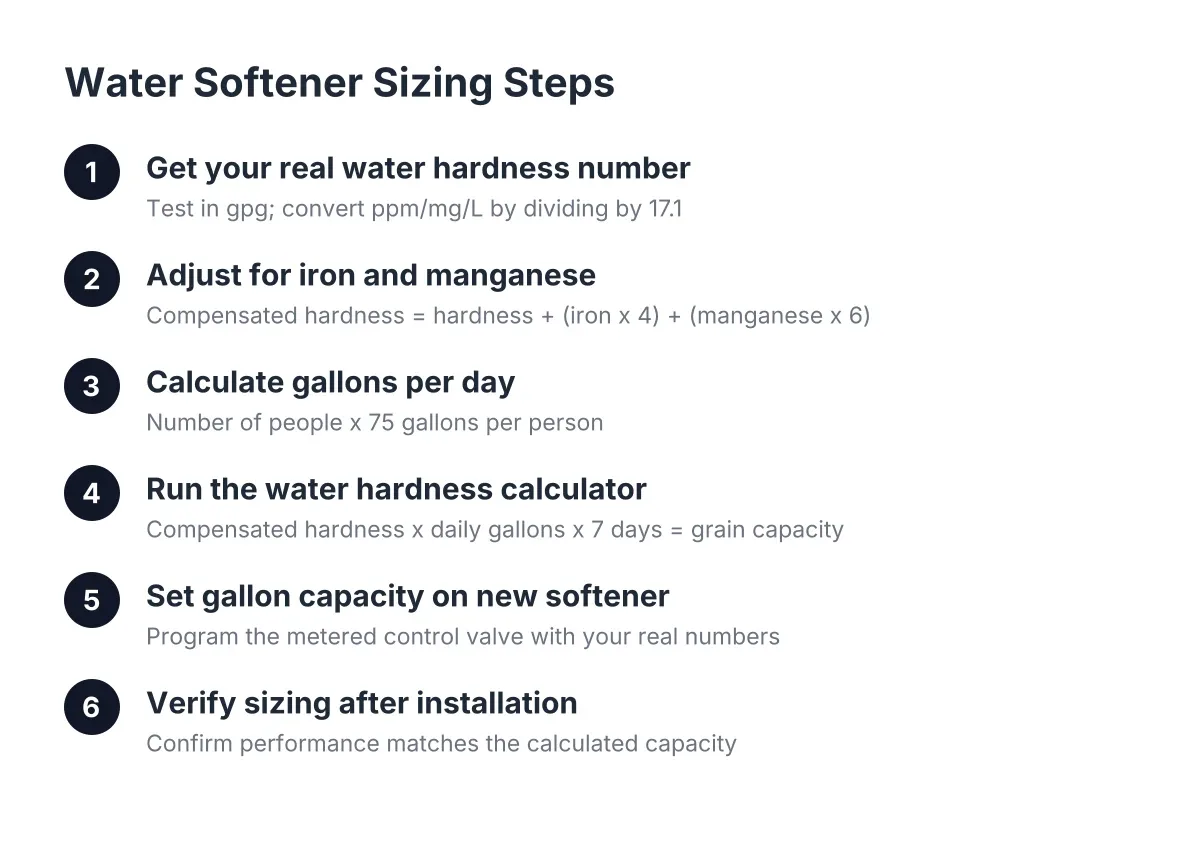
Step 1: Get Your Real Water Hardness Number
Start with hardness, because every other number in the formula depends on it. You need hardness in grains per gallon (gpg). If your test reports water hardness in ppm or mg/L, divide by 17.1 to convert to gpg. For example, 278 ppm divided by 17.1 is about 16.3 gpg.
Minnesota water is hard almost everywhere. According to the USGS Water Quality Portal, the statewide average is 278.3 PPM, which is classified as very hard, and 65 of Minnesota's 87 counties have very hard water above 180 mg/L. Across 49 measured Minnesota cities, the median is 162.0 mg/L, or 9.5 gpg, according to USGS Water Science School. The Twin Cities metro draws mineral-heavy water from the Mississippi River, which pushes many Minneapolis-area homes to 15+ gpg per HomeWater 101.
However, do not size off a regional average. Get your own number one of these ways:
- Use a water hardness test kit for water softener sizing. Drops or strips from any hardware store work fine for a ballpark reading.
- Check your city's annual water quality report; suburbs on wells and suburbs on municipal supply can differ a lot.
- Look up water hardness by zip code as a starting point, then confirm with a test at your own tap.
- Have a water treatment technician test at the house, which is the most accurate option and standard on any softener sizing visit.
If you are new to Minneapolis from a soft-water region, this step explains a lot. The scale on your new home's fixtures is not neglect by the previous owner. It is the local water.
Step 2: Adjust for Iron and Manganese (Compensated Hardness)
Raw hardness is not the whole picture, especially in the suburbs where iron and manganese staining is common. Iron and manganese load the resin bed just like hardness minerals do, so you have to size for them. This adjusted figure is called compensated hardness, and it is what a good water hardness calculator actually uses.
Here is the standard adjustment:
Compensated hardness (gpg) = hardness (gpg) + (iron ppm × 4) + (manganese ppm × 6)
For example, say a homeowner in a western suburb tests at 18 gpg with 1 ppm of iron and no manganese. The compensated hardness is 18 + 4 = 22 gpg. That is the number to carry forward, not 18.
Ion exchange softeners can reduce small amounts of iron along with hardness minerals, according to Penn State Extension. But heavier iron levels usually call for a dedicated iron filter ahead of the softener, and that is a case where you should have a professional test the water before you buy anything. Sizing depends on actual water quality, not guesswork.
Step 3: Calculate Your Household's Gallons Per Day
Next, figure out how much water your household uses each day. The standard planning figure is 75 gallons per person per day. It covers showers, laundry, dishes, and everything else that runs through the softened line.
The formula is simple:
Daily use = number of people × 75 gallons
For water softener sizing for a family of 4, that is 4 × 75 = 300 gallons per day. A couple in a new-to-them Minneapolis bungalow would plan around 150 gallons per day. If you expect the household to grow, or you have teenagers who treat showers as a hobby, round up.
Bathroom count is a rough shortcut some installers use, since flow demand scales with fixtures. It is fine for a gut check, but the people-times-gallons math is more precise, and it is the number the rest of this formula needs.
Step 4: Using Your Water Hardness Calculator
Now combine the two numbers. This is the core calculation:
- Daily grain load = compensated hardness (gpg) × daily gallons used
- Multiply by the days you want between regenerations. Aim for about 7 days; that keeps the resin bed efficient without wasting salt.
- The result is the working grain capacity you need.
Continue the earlier example. Suppose that family of four has 22 gpg compensated hardness and uses 300 gallons per day. Daily grain load is 22 × 300 = 6,600 grains. Over 7 days, that is 46,200 grains. In practice, softeners run most salt-efficiently below their maximum rating, so a unit sold as a 48,000-grain softener is the realistic fit; some installers would even step to the next size to keep salt dosing low.
Compare that with a two-person household at 16 gpg using 150 gallons per day. Daily load is 2,400 grains, and a week is 16,800 grains. A 24,000- or 32,000-grain unit covers it comfortably. Same city, half the capacity. That is why any water softener sizing chart that ignores your hardness number will steer you wrong in Minnesota.
Sizing matters more than brand. An undersized unit for a family of four with hard water lets water pass through too fast to soften fully, especially during heavy-use stretches like weekend mornings. Oversized units regenerate so rarely that the resin can foul. The formula keeps you out of both traps.
Step 5: Set the Gallon Capacity on the New Softener
Do not stop at buying the right size. When the new softener is installed, its metered control valve needs your real numbers, not the factory defaults.
Here is the setting to change. Divide the unit's grain capacity by your compensated hardness to get total treatable gallons. Then subtract one day of household use as a reserve, so the softener regenerates before it runs out mid-day. In the family-of-four example: 48,000 ÷ 22 = about 2,180 gallons, minus a 300-gallon reserve, gives a regeneration trigger near 1,880 gallons.
Enter that gallon figure and your hardness setting into the control head. A modern metered softener programmed this way regenerates only when needed. That is where the efficiency gains over your 15-year-old timer unit actually come from. High-efficiency softeners can be programmed to use less salt, water, and energy than standard units, according to Culligan. The scale of possible savings is real: a Minnesota optimization program in Marshall cut salt use by up to 320,000 pounds per year across nearly 300 participants, with some households reducing salt use by as much as 86%, according to the Minnesota Pollution Control Agency.
Step 6: Verify the Sizing After Installation
Finally, confirm the system is doing its job. About two weeks after the install, test the softened water at a tap with your hardness kit. It should read at or near 0 gpg. If hardness is sneaking through during busy mornings, the unit may be undersized or the settings may need adjusting; that is a quick service call, not a crisis.
Keep an eye on salt use, too. Typical households refill salt every two to four months, according to Culligan, though hardness, family size, and brine tank size all shift that. If you are burning through bags monthly on a right-sized modern unit, something in the settings is off. Salt also leaves insoluble residue at the bottom of the brine tank over time, per Cargill, so plan a periodic cleanout.
One trade-off worth naming: for single-tank versus dual-tank, most Minneapolis households do fine with a properly sized single tank. Dual-tank systems earn their cost mainly in large households or homes that cannot tolerate untreated water during regeneration. If your math lands in that gray zone, or your well water shows heavy iron or manganese, have a local water treatment professional confirm the numbers before you commit. Running an online water hardness calculator gets you close; a tap-side test settles it.
Work through these six steps and you replace your aging softener on your own schedule, sized to your actual water, with no guessing and no oversized tank you did not need.
If you need water softener installation, Twin Cities Water Softening can help.
Prefer to talk it through? Call +16512171659 — a quick call is usually the fastest way to get a straight answer for your situation.