
Common Water Softener Problems: Leaks, Salt Bridges, and Resin Failure
Your softener quit, there may be water on the basement floor, and you need to know one thing fast: is this a cheap fix or the end of the unit? This guide walks through the most common water softener problems, leaks, salt bridges, stuck valves, and worn-out resin, in the order a repair tech would actually check them. We cover how to identify and fix salt bridge water softener issues alongside other frequent failures. Work the steps in order. Most of the time you will know within 30 minutes whether you are looking at a simple repair or a replacement conversation.
One note before you start. Minneapolis water is hard by any standard. Minnesota's average statewide hardness is 278.3 PPM, classified as very hard, according to USGS Water Quality Portal data. That means a softener here works harder than one in most states, and it fails in predictable ways. The good news is that most failures are fixable.
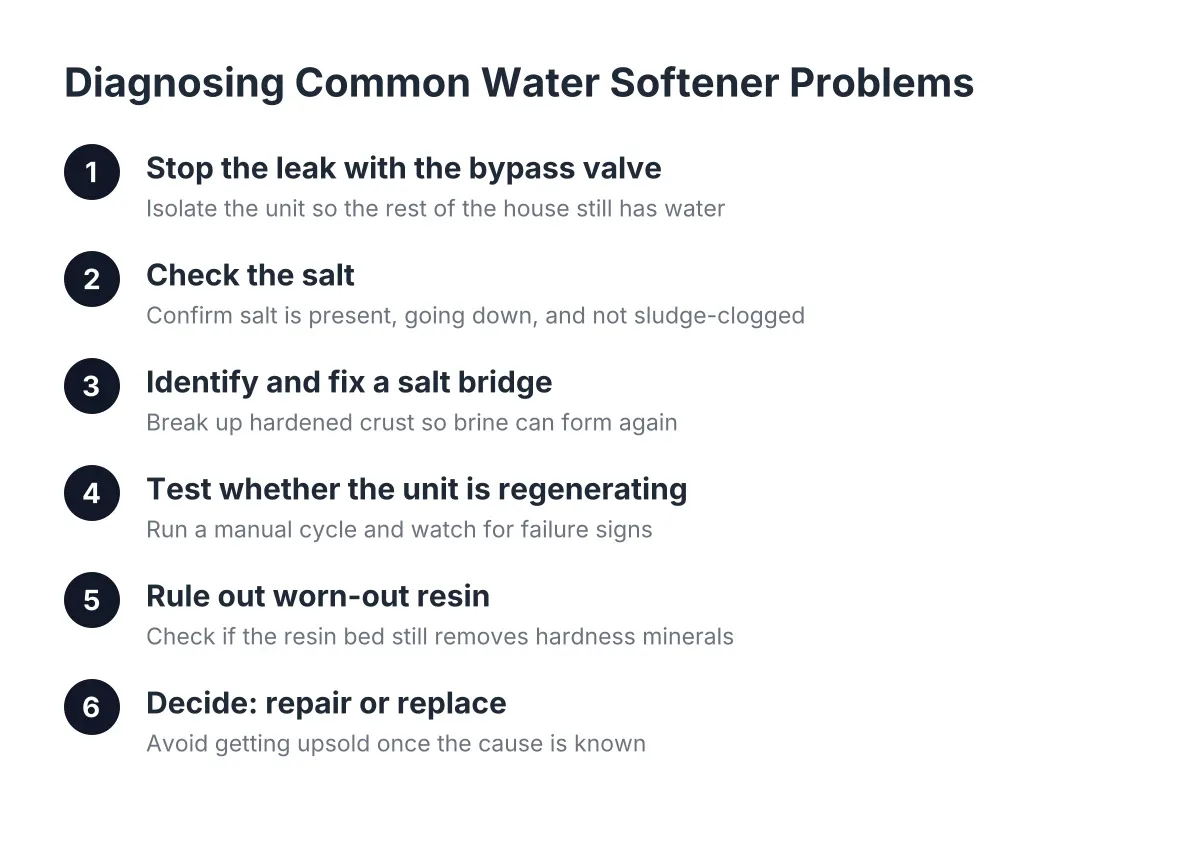
Step 1: Stop Any Active Leak With the Bypass Valve
First, protect your basement. If the softener is leaking, do not wait to diagnose it while water spreads across the floor. Most water softener units have dedicated inlet and outlet valves, or a single bypass valve, separate from the main house shutoff, according to InspectAPedia. Push or turn the bypass and the unit is isolated while the rest of your house still has water.
Look at where the water is coming from before you mop it up. The source tells you a lot:
- Fittings or the bypass valve itself: usually an O-ring or connector, one of the cheaper repairs
- Top of the resin tank near the control head: often a seal or rotor issue in the valve head, still repairable
- A crack in the resin tank or brine tank body: tanks are not patched; this usually means replacing the tank or the unit
- Brine tank overflowing: not a leak at all; the unit is filling with water it cannot draw out, which is a clog, not a crack
If the bypass valve is stuck and will not turn, do not force it with a wrench. Stuck bypass valves are one of the most common water softener problems on units past ten years old, and cracking the valve body turns a service call into an emergency. Shut off water at the main instead and call for softener repair.
For a landlord, this step matters double. Suppose you own a duplex in Richfield and a tenant texts you a photo of water pooling near the softener. Talking them through the bypass valve over the phone can save the flooring, and it buys you a day or two to compare repair quotes instead of paying panic pricing.
Step 2: Check the Salt Before You Blame the Machine
The single most overlooked cause of hard water coming back is an empty or bridged brine tank. It sounds too simple, but it explains a large share of "water softener not working" calls. Softeners rely on salt to regenerate the resin bed, which is what removes hardness minerals from the water, according to North Dakota State University Extension. No usable salt means no soft water, even if the machine looks fine.
Open the brine tank lid and check three things:
- Is there salt at all? Typical households refill salt about every two to four months, according to Culligan, though hard Minneapolis water and a full house can burn through it faster.
- Is the salt actually going down? If the level has not moved in months, the unit is not using it. That points to a bridge or a brine draw failure, covered in Steps 3 and 4.
- Is there sludge at the bottom? Softener salt contains insoluble material that builds up in the bottom of the brine tank over time and needs periodic cleanout, according to Cargill. A tank full of mush can block the brine draw.
If the tank was simply empty, refill it, run a manual regeneration, and test the water the next day. You may be done. This is the outcome nobody searching "emergency water softener repair" expects, but it happens more often than most homeowners think.
Step 3: Identifying and Fixing a Salt Bridge in Water Softeners
A salt bridge is a hard crust of salt that forms above the water line in the brine tank. From the top it looks like a full tank of salt. Underneath, there is a hollow gap, so the water never touches the salt and no brine gets made. The classic symptom is salt not going down in the water softener for months while your dishes spot up and your skin gets dry again.
Here is how to check for one and break it up:
- Take a broom handle or similar blunt tool.
- Push it straight down into the salt. If it hits a hard layer and then punches through into a hollow space, you have a bridge.
- Gently break the crust apart around the edges. Do not stab at the tank walls or the brine well tube.
- Remove the loose chunks, top off with fresh salt, and run a manual regeneration.
Humid basements and cheap pellet salt make bridging worse. If bridges keep coming back, switch to a higher-purity salt and fill the tank only half to two-thirds full. Note that most softeners can also run on potassium chloride instead of standard sodium chloride, with a settings change, according to NSF International; potassium is pricier but bridges less in some setups.
Step 4: Test Whether the Unit Is Regenerating at All
If salt and brine look fine but water stays hard, find out if the softener is cycling. A water softener that is not regenerating cannot soften anything. Locate the manual regeneration button or dial on the control head and start a cycle, ideally in the evening.
Then listen and watch. A healthy regeneration runs water to the drain, draws brine out of the brine tank, and finishes within about 90 to 120 minutes on most units. Watch for these failure signs:
- Nothing happens at all: check power, the outlet, and the display. A dead control head or failed timer motor is a repairable part on most popular water softener system brands.
- It cycles but the brine tank water level never drops: the venturi or injector that pulls brine into the resin tank is likely clogged. This is a common root cause when a softener stops using salt, and it also explains many brine tanks that stay full and eventually overflow onto the floor.
- It cycles constantly or at odd hours: the control head has lost its programming or a valve is stuck mid-cycle.
A clogged injector, a worn valve seal, or a failed timer are the bread and butter of water softener repair. On a unit under ten years old, fixing one of these is almost always cheaper than replacement and gets you back to soft water in one visit.
Step 5: Rule Out Worn-Out Resin
Now the harder question. Say the unit powers on, regenerates on schedule, uses salt, and the brine draw works, but your water is still hard. At that point, the resin bed inside the tank has likely worn out. Resin beads have a working life, and Minneapolis-area water shortens it. Across 49 measured Minnesota cities, the median hardness is 9.5 grains per gallon, and 61 percent of cities fall in the hard-or-very-hard bands, according to USGS Water Science School. Suburban well water with iron is even tougher on resin, since ion exchange resin picks up small amounts of iron along with hardness minerals, as Penn State Extension notes, and iron fouls the beads over time.
Signs of resin failure include:
- Hard water stains and scale buildup returning gradually, not overnight
- Salt use that looks normal while softness fades
- Resin beads, which look like tiny amber balls, showing up in faucet aerators or toilet tanks (that one means a broken distributor screen, and beads are escaping the tank)
Resin can be replaced without replacing the whole softener, and on a solid mid-range unit that resin tank service often makes sense. However, if the control head is also aging, or the unit was undersized for the household from day one, putting new resin in a tired system is money half spent.
Step 6: Decide, Repair or Replace, Without Getting Upsold
This is the step where homeowners worry about being sold a new whole house water softener they do not need. Use these plain rules of thumb as a starting point:
- Repair makes sense when the unit is under 10 years old and the failure is a single part: bypass valve, injector, seal kit, timer, or float. These are routine fixes.
- Resin replacement makes sense when the tank and control head are sound but the water stays hard after a full regeneration cycle checks out.
- Replacement makes sense when the resin tank or brine tank is cracked, the unit is 15 years or older, repairs are stacking up, or the softener was never sized right for your water and household. As of 2026, high-efficiency softeners can also be programmed to use less salt and water than standard units, according to Culligan, which matters when a Minnesota household regenerates as often as ours do.
An honest tech should be able to name the failed part, show it to you, and explain why repair or replacement wins in your case. If someone jumps straight to a new hard water softener without testing the brine draw or the resin, get a second opinion.
Landlords face one extra wrinkle. For a rental, downtime and repeat service calls cost more than the parts do. A durable, low-maintenance replacement during a unit turnover often beats nursing a 15-year-old softener through tenant complaints one repair at a time.
When Common Water Softener Problems Call for a Pro
You can safely check salt, break a bridge, run a manual regeneration, and flip a bypass valve yourself. Draw the line at anything involving plumbing connections, drain line routing, replacing the control head, or a resin rebed; a mistake there can flood a basement or send resin through your pipes. Also call a pro if you cannot tell whether the leak is the softener or the plumbing around it, since chasing the wrong source wastes time and money.
One more Minnesota-specific point. Seventy-five percent of Minnesotans rely on groundwater for drinking water, and that groundwater is vulnerable to chloride contamination linked in part to softener discharge, according to the Minnesota Pollution Control Agency. An old timer-based softener that regenerates on a fixed clock, whether you need it or not, wastes salt and adds to that problem. Some Minnesota programs have even paid rebates of $500 to $700 to replace timer-based units, per the same agency. If your failing softener is that old, the repair-or-replace math tilts further toward a modern demand-based unit.
Work the steps in order, and most common water softener problems sort themselves into one of three buckets: a salt issue you can fix today, a part a tech can swap in one visit, or a worn-out unit where replacement is the honest answer. Knowing which bucket you are in before anyone shows up is the best protection against both a flooded basement and an unnecessary upsell.
If you need water softener installation, Twin Cities Water Softening can help.
Prefer to talk it through? Call +16512171659 — a quick call is usually the fastest way to get a straight answer for your situation.