
Minneapolis Water Hardness Chart: Test Your Water and Size Your Softener Right
If you just found white crust on your faucets or cloudy glasses in the dishwasher, the first useful tool is a water hardness chart. It tells you where your Minneapolis home's water falls, from soft to very hard, in grains per gallon. That number matters because it decides what size water softener you need, and whether you need one at all. This guide walks you through Minneapolis hardness levels by area, how to test your own water, and how to turn that number into a softener size that fits your household instead of a guess pulled from a manufacturer's box.
Here is the short version up front. Minneapolis water is hard. The Twin Cities metro draws mineral-heavy water from the Mississippi River, producing hardness levels of 15 or more grains per gallon for Minneapolis-area homes, according to HomeWater 101. That is not "maybe a little hard." That is squarely in the range where scale buildup shortens the life of water heaters and dishwashers. So the question is rarely whether you need water treatment. It is how much capacity you need, and that is where testing and math beat guessing.
How to Read a Water Hardness Chart
A water hardness chart converts a lab or test-strip result into a plain rating you can act on. Hardness gets measured two ways: grains per gallon (gpg) and milligrams per liter (mg/L), which is the same as parts per million (ppm). One grain per gallon equals about 17.1 mg/L. Softener sizing uses gpg, so if your test comes back in ppm, divide by 17.1.
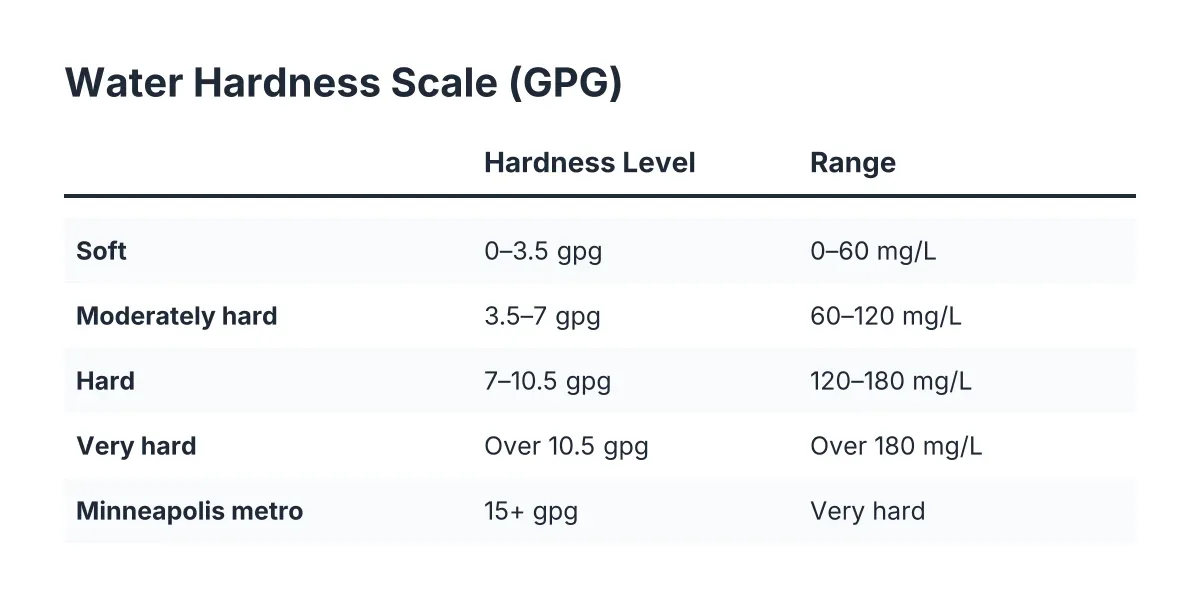
Here is the standard scale most water hardness charts follow, whether you find a water hardness chart in gpg, ppm, or a printable PDF:
- Soft: 0 to 3.5 gpg (0 to 60 mg/L)
- Moderately hard: 3.5 to 7 gpg (60 to 120 mg/L)
- Hard: 7 to 10.5 gpg (120 to 180 mg/L)
- Very hard: over 10.5 gpg (over 180 mg/L)
Now place Minneapolis on that scale. At 15+ gpg, metro homes sit well past the "very hard" line. Statewide it is no better. Minnesota's average water hardness is 278.3 ppm, classified as very hard, according to USGS Water Quality Portal data across 87 counties. The same data shows 65 of Minnesota's 87 counties have very hard water above 180 mg/L, with only 5 counties having soft water.
In other words, when a national water hardness chart shows a color-coded map of the United States, Minnesota lands in the darkest band. Across 49 measured Minnesota cities, the median hardness is 162.0 mg/L, or 9.5 gpg, and 61 percent of those cities fall in the hard-or-very-hard bands, according to USGS Water Science School. The metro tends to run harder than that median.
Water Hardness Chart for Minneapolis Zip Codes and Suburbs
You will see "water hardness by zip code" lookup tools online. They are a decent starting point, but treat them as a rough guide, not a sizing number. Here is why. Within Minneapolis proper, homes on city water share the same municipal source, so hardness is fairly consistent from 55401 downtown out to 55419 in the southwest. The 15+ gpg figure applies broadly across city zip codes.
The picture changes once you cross into the suburbs. Some suburbs buy Minneapolis water. Others run their own treatment plants pulling from wells, and groundwater in this region tends to carry more minerals than river water. A home in Bloomington, Eden Prairie, or Coon Rapids can test noticeably different from a home three miles away in a city on Minneapolis supply.
Then there are homes on private wells, common on the metro's edges. Well water here often brings two extra problems: iron and manganese. If you see orange-brown stains in toilets and tubs, or dark gray streaks, that is iron and manganese, not just hardness. Those minerals change the sizing math, which we will get to below. According to Penn State Extension, ion exchange softeners can help reduce small amounts of iron in well water in addition to softening hardness minerals, but the softener has to be sized for that extra load.
The practical takeaway: a zip code lookup or municipal water report gets you in the ballpark. A test of the water coming out of your own tap gets you the real number.
How Do I Know My Water Hardness in Minneapolis?
You find your actual water hardness three ways: check your city's annual water quality report, run a home water hardness test kit, or have a water treatment professional test your tap water in grains per gallon. For softener sizing, the tap test wins, because it measures what actually reaches your fixtures.
First, the city report. Municipal water quality reports list hardness, usually in mg/L. Divide by 17.1 to get gpg. This is free and reliable for homes on city water.
Second, a water hardness test kit. Hardware stores sell test strips for a few dollars. You dip a strip, wait, and match the color to a small water hardness chart printed on the bottle. Strips are fine for a yes-or-no answer: is my water hard? They are less precise at the high end, and Minneapolis water sits at the high end. A strip that tops out at "15+ gpg" cannot tell you whether you are at 15 or 22, and that gap changes what size softener you buy.
Third, a professional water hardness test. A technician tests hardness in gpg with a titration kit or meter, and on well water also tests iron and manganese. This matters most for private wells and for anyone deciding between softener capacities. Sizing depends on actual water quality, not guesswork, and a proper test removes the guessing.
Turning Your Hardness Number Into a Softener Size
Softeners are sold by grain capacity: how many grains of hardness the resin can remove before it needs to regenerate with salt. Water softener sizing comes down to a simple calculation once you have your hardness number. Here is the math, step by step.
- Find your compensated hardness. Start with your tested hardness in gpg. If you have iron, add 4 grains for every 1 ppm of iron. If you have manganese, add 6 grains for every 1 ppm of manganese. City water in Minneapolis usually has negligible iron, so your tested gpg stands. Well water often needs the adjustment.
- Estimate daily water use. Multiply the number of people in your home by 75 gallons per day. A family of four uses about 300 gallons daily.
- Multiply the two. Daily gallons times compensated hardness equals grains of hardness your softener must remove each day.
- Multiply by days between regenerations. Most systems aim to regenerate about once a week, so multiply your daily grains by 7.
Suppose a family of four in south Minneapolis tests at 16 gpg on city water. Their math: 300 gallons times 16 gpg equals 4,800 grains per day. Over 7 days, that is 33,600 grains. In that scenario, a 32,000-grain softener runs at full salt dose to barely keep up, while a 40,000-grain unit handles the load with capacity to spare and regenerates on an efficient schedule. For water softener sizing for a family of 4 on Minneapolis water, something in the 40,000-grain range is a common landing spot, though your tested number should drive the final call.
Now change one variable. Say that same family is on a private well in the northwest suburbs with 18 gpg hardness and 2 ppm of iron. Compensated hardness becomes 18 plus 8, or 26 gpg. Daily load jumps to 7,800 grains, and the weekly total passes 54,000. That household needs a larger unit, and possibly a separate iron filter ahead of the softener so the resin tank does not foul early.
Why Oversizing and Undersizing Both Cost You
An undersized water softener fails you on busy mornings. When the whole house showers, runs the dishwasher, and starts laundry at once, water moves through a small resin tank too fast to be fully softened. You get hard water breakthrough, and the scale buildup you paid to stop keeps growing on your shower doors.
Oversizing has a quieter cost. A tank far bigger than your household needs regenerates so rarely that the resin bed can develop problems, and you paid for capacity you never use. Bigger is not automatically better; matched is better.
There is a middle path worth knowing about in 2026: high-efficiency softeners. According to Culligan, high-efficiency water softeners can be programmed to use less salt, water, and energy compared to standard units. Whether one fits your home depends on your water test results, family size, and bathroom count. Salt savings are not theoretical, either. A Minnesota water softener optimization program in Marshall enrolled nearly 300 homeowners and businesses and cut salt use by up to 320,000 pounds per year, with some households reducing salt use by as much as 86 percent, according to the Minnesota Pollution Control Agency. Right-sizing and right-programming are where those savings come from.
Single-Tank vs. Dual-Tank for Metro Water
Most Minneapolis homes do fine with a single-tank softener. It softens all day, then regenerates overnight when nobody is using water. During that regeneration window, hard water bypasses into the house, which almost no one notices at 2 a.m.
A dual-tank softener keeps one resin tank in service while the other regenerates, so you get soft water around the clock. That matters in two situations. First, homes with heavy or unpredictable water use, such as large families or homes with big soaking tubs. Second, multi-unit rental properties, where tenants use water at all hours and a regeneration cycle during a busy evening means hard water hitting every fixture in the building.
For a property manager standardizing equipment across 20 or more units, this trade-off scales. A duplex with modest use can run single-tank units sized per the math above. A 12-unit building with shared hot water may justify dual-tank equipment, because hard water slipping through during regeneration accelerates scale in a shared water heater that serves every tenant. Consistent sizing logic across a portfolio also simplifies service: same salt schedule, same parts, fewer surprise service calls.
Setting the Softener to Match the Chart
Buying the right size is half the job. Programming it is the other half. Every softener has a hardness setting, and it should match your tested compensated hardness, not a default. A water softener hardness setting chart in the owner's manual maps your gpg number to the control valve setting. Set it too low and the softener regenerates too late, letting hard water through. Set it too high and it burns salt regenerating more often than needed.
For a Minneapolis home testing at 16 gpg on city water, you set 16. For the well-water example above with iron, you set the compensated number, 26, so the valve accounts for the iron load on the resin. According to North Dakota State University Extension, water softeners rely on salt to regenerate the resin bed, which is what removes hardness minerals from the water; the hardness setting controls how often that regeneration happens.
A few programming and upkeep points that follow from your hardness number:
- Salt refills scale with hardness. According to Culligan, typical households refill salt on average every two to four months, though that varies with water hardness, family size, water usage, and brine tank size. At 15+ gpg, Minneapolis homes land toward the frequent end.
- Salt type is a choice. According to NSF International, most softeners can be set for either standard sodium chloride or potassium chloride as the regenerant, depending on which salt you use. Potassium costs more but appeals to households watching sodium.
- The brine tank needs occasional cleanout. According to Cargill, softener salt contains insoluble material that settles at the bottom of the brine tank over time and requires periodic cleanout.
- Verify performance after install. A quick before-and-after check with a water hardness test kit confirms the treated water actually reads soft at the tap, and confirms the right lines are being treated.
Softener or Filter: Answering the Confusion Point
Plenty of first-time hard water sufferers ask whether they need a water softener or a water filter system. They solve different problems. A water softener removes hardness minerals, calcium and magnesium, through ion exchange. That is what stops scale buildup, hard water stains on glass, and early appliance death. A whole-house filter removes sediment, chlorine taste, or specific contaminants. It does not remove hardness in any meaningful amount.
If your complaint is white crust, cloudy dishes, and a water heater that died young, the water hardness chart points you to a softener. If your complaint is odd taste, smell, or visible particles, a filter belongs in the conversation, sometimes alongside a softener. Many suburban well-water homes end up with both: an iron filter or whole-house filter first, then the softener.
One honest limitation: the sizing math in this guide works cleanly for city water with a known hardness number. Well water with significant iron, manganese, or sulfur odor gets complicated fast, and a wrong guess can foul a resin tank within a couple of years. In those cases, have a professional run a full water test before you buy anything. The same goes for multi-unit buildings, where flow rates and shared plumbing change the equation beyond simple household math.
The Short Checklist Before You Buy
Pull it together in five steps:
- Get your real hardness number, from your city's water report or a professional water hardness test at your tap, in gpg.
- On well water, test iron and manganese too, then calculate compensated hardness: gpg plus iron ppm times 4 plus manganese ppm times 6.
- Multiply people times 75 gallons times compensated hardness times 7 days to get your weekly grain load.
- Choose a softener whose capacity covers that load with room to spare, and weigh single-tank against dual-tank based on how your household or building uses water.
- Program the hardness setting to your tested number, then verify with a test strip after installation.
Minneapolis water is hard enough that most homes here benefit from a softener. The point of the chart, the test, and the math is not to talk you into a bigger unit. It is to land on the size your water and your household actually call for, so the scale stops, the appliances last, and the salt bill stays as low as the water allows.
If you need water softener installation, Twin Cities Water Softening can help.
Prefer to talk it through? Call +16512171659 — a quick call is usually the fastest way to get a straight answer for your situation.