
Rental Property Water Softener FAQs: Requirements and Tenant Duties in Minneapolis
If you own or manage rentals in the Twin Cities, a rental property water softener is not a luxury upgrade. It is equipment protection. Understanding water softener tenant responsibilities is key: Minneapolis-area homes draw mineral-heavy water, and hard water quietly eats water heaters, dishwashers, and fixtures in every unit you own. Most softener advice online is written for homeowners who live with their own equipment every day. Landlords have different priorities: durability, fast turnaround between tenants, and a service vendor who actually shows up. This FAQ answers the questions landlords and property managers ask most, in plain language.
How hard is the water in Minneapolis rental properties?
Minneapolis-area water is hard enough to damage rental equipment without treatment. The Twin Cities metro draws mineral-heavy water from the Mississippi River, producing hardness levels of 15+ grains per gallon for Minneapolis-area homes, according to HomeWater 101. Anything over 10 grains is considered very hard. Suburban rentals on well water often add iron and manganese staining on top of the hardness.
For context, across 49 measured Minnesota cities, the median hardness is 162.0 mg/L, or 9.5 grains per gallon, and 61% of cities fall in the hard-or-very-hard range, according to the USGS Water Science School. Your rentals sit above that median. Scale buildup is not a maybe here; it is the default.
Is a landlord required to provide a water softener in Minnesota?
No Minnesota statute requires a landlord to provide a water softener. Soft water is not part of habitability law the way heat and safe drinking water are. Hard water is a comfort and equipment issue, not a legal one.
However, "not required" and "not worth it" are different questions. Hard water shortens the life of every water heater and dishwasher you own. If you self-manage several units, one failed water heater during a January cold snap costs more in stress and emergency labor than years of softener salt. Many landlords treat the softener as equipment insurance, not a tenant perk.
Tenant responsibilities for water softener maintenance
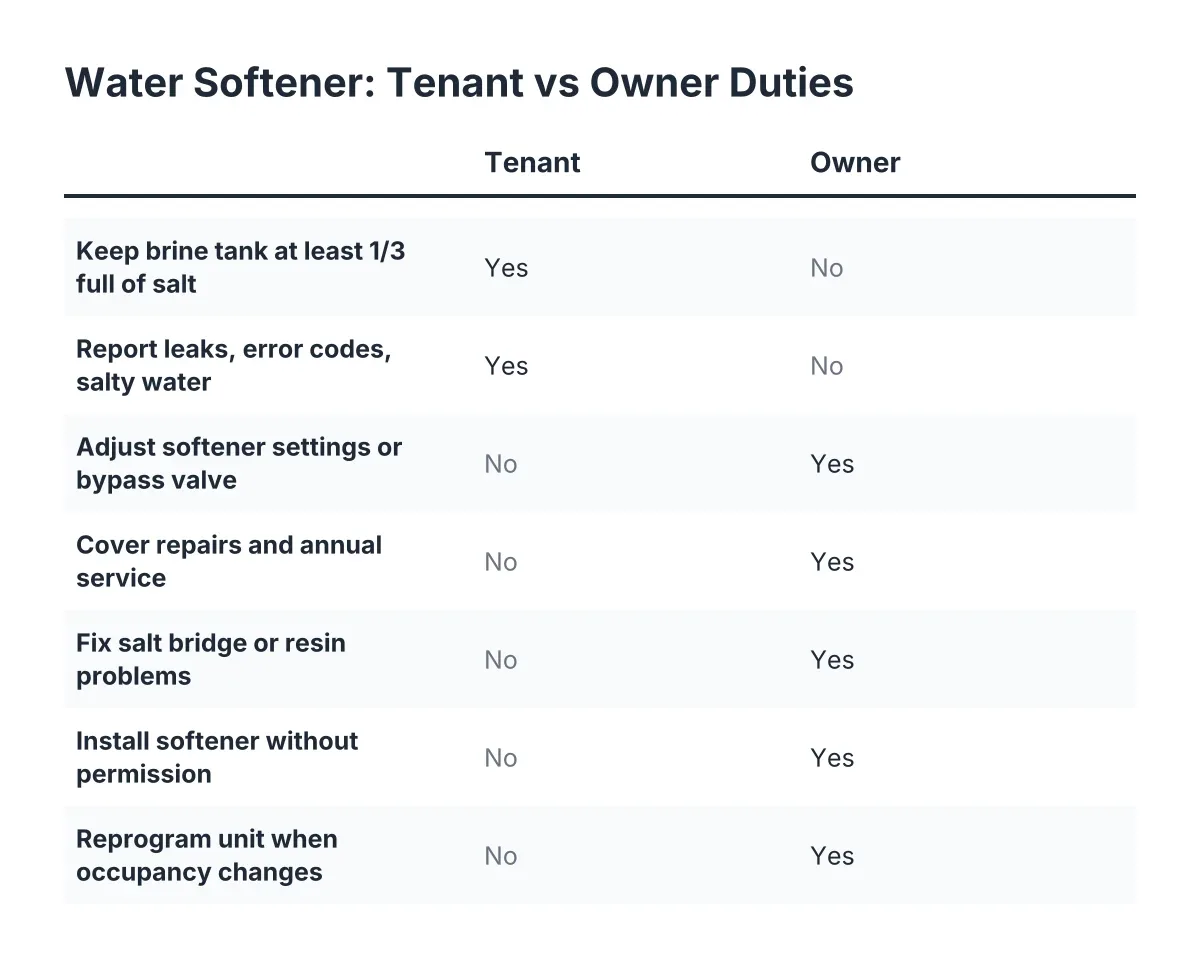
Day to day, the tenant usually handles the simplest task: keeping salt in the brine tank. The softener manages the water level in the tank on its own, but someone has to keep salt in it. A typical household refills salt about every two to four months, according to Culligan, though hard Minneapolis water and larger families push that faster. Clear water softener tenant responsibilities prevent disputes—tenants refill salt, while owners handle repairs and service.
Everything else belongs to the owner or a service vendor. That includes inspecting internal parts, cleaning out the insoluble sludge that softener salt leaves at the bottom of the brine tank over time (a fact noted by Cargill), and reprogramming the unit when occupancy changes. A family of five uses water differently than a single tenant, and the softener settings should match.
A short lease clause settles the split. For example:
- Tenant keeps the brine tank at least one-third full of softener salt.
- Tenant reports leaks, error codes, or salty-tasting water promptly.
- Owner covers repairs, annual service, and salt bridge or resin problems.
- Tenant does not adjust softener settings or close the bypass valve.
Can tenants install their own softener in a rental house?
Tenants can install a softener only with the owner's written permission, and most landlords should say no to tenant-installed units. A rental house water softener ties into the main supply line and drains to a floor drain or standpipe. A bad DIY tie-in risks leaks, and a leak in a finished basement is your claim, not theirs.
The better path is owner-controlled equipment. You pick the unit, you control the install quality, and the softener stays with the property when the tenant leaves. If a tenant asks about a rental apartment water softener in a multi-unit building, point-of-entry treatment at the building level beats unit-by-unit fixes almost every time.
What is the best low-maintenance water softener for rentals?
The best low-maintenance softener for a rental is a demand-initiated (metered) unit, properly sized, with a simple salt-only maintenance routine for the tenant. Metered units regenerate based on actual water use, so they do not waste salt and water when a unit sits vacant between leases. Old timer-based units regenerate on a schedule whether anyone lives there or not.
The efficiency gap is real. A Minnesota program in Marshall that replaced timer-based softeners cut salt use by up to 320,000 pounds per year, with some households reducing salt use by as much as 86%, according to the Minnesota Pollution Control Agency. Less salt means fewer tenant trips to the hardware store, which means fewer empty brine tanks and fewer hard water complaints.
Look for NSF/ANSI 44 certification, which means the unit was independently tested for removing calcium and radium from water, according to NSF International. For suburban rentals on wells, an ion exchange softener can also reduce small amounts of iron, according to Penn State Extension, though heavy iron usually needs a dedicated iron filter ahead of the softener.
Should landlords standardize softeners across multiple properties?
Yes. Standardizing rental property water softeners across your units is one of the highest-return decisions a portfolio owner can make. One brand and one or two models means one set of parts, one service routine, and one set of instructions you can hand every tenant at move-in.
Suppose a landlord owns six single-family rentals across Bloomington and Richfield, each with a different softener brand aged 8 to 20 years. Every service call starts from scratch, and every failure means researching parts for a unit nobody stocks. In that scenario, replacing the two oldest units with the same metered model each year, on a planned schedule, converts random emergencies into a predictable line item. Within three years, every property runs identical equipment.
When should you replace a softener instead of repairing it?
Replace a rental softener when it is 15 or more years old, timer-based, or failing for the second time. Repair makes sense for younger metered units with a single bad part, such as a bypass valve or a brine line. A 15-year-old unit that stops softening is telling you the resin bed is worn out, and resin replacement on old equipment rarely pencils out against a new install.
For a rental, add one more factor: trust. An aging softener that works intermittently generates tenant complaints you cannot schedule around. Replacing it on your timeline, during a vacancy, beats a service call during a lease.
Can you rent a water softener instead of buying one?
Yes, softener rental programs exist, and some landlords use them to avoid upfront cost. You pay a monthly fee, and the rental company owns and services the unit. For a landlord, though, the math usually favors buying. A purchased softener pays for itself over its 10-to-20-year life, while rental fees never stop, and you do not control the service schedule.
Renting can make sense for a property you plan to sell within a year or two, or while you test whether tenant complaints justify permanent equipment. For long-hold rentals, owned equipment installed by a local water treatment specialist costs less over time and gives you one accountable vendor.
Managing water softener tenant responsibilities during unit turnover
Schedule softener work during vacancy whenever you can. An install or replacement takes a few hours in the mechanical room, and doing it between tenants means no scheduling around someone's work-from-home day. It also lets you flush lines, check the water heater for scale buildup, and hand the new tenant a one-page salt instruction sheet on day one. During tenant transition, clarifying water softener tenant responsibilities in writing prevents later confusion about who maintains salt levels and reports problems.
Two more turnover tasks are worth adding to your checklist. First, sanitize the softener if the unit sat unused during an extended vacancy; Kinetico notes softeners should be sanitized after sitting idle, after a boil-water order, or when there is a bad taste or odor. Second, show the incoming tenant the bypass valve. Softeners have dedicated inlet and outlet valves separate from the main house shutoff, according to InspectAPedia, so a softener leak can be isolated without cutting water to the whole unit. A tenant who knows that can stop a small leak from becoming a flooded basement.
One honest trade-off: sizing a softener for a rental is harder than for an owner-occupied home, because occupancy changes with every lease. Sizing depends on water hardness, iron and manganese content, and the number of people using water. If your properties mix city water and well water, have a water treatment professional test each property and size the equipment rather than guessing from a chart.
What is the fastest fix for tenant hard water complaints?
Start with a water test and a look at the existing equipment before buying anything. Half of tenant hard water complaints trace to a softener that exists but is not working: an empty brine tank, a salt bridge, a unit stuck in bypass, or settings programmed for a previous household. Those are cheap fixes, often a single service call.
If the property has no softener, the complaints will not stop, because the water will not change. Spots on dishes, crusty showerheads, stiff laundry, and hard water stains on fixtures are all the same 15-grain water doing what it does. At that point, the question is not whether to treat the water; it is whether to repair, replace, or install, and which standard model goes in across the rest of your portfolio.
If you need water softener installation, Twin Cities Water Softening can help.
Prefer to talk it through? Call +16512171659 — a quick call is usually the fastest way to get a straight answer for your situation.