
Who Pays for the Water Softener in a Minnesota Rental? Lease Clauses That Settle It
If you own rentals in the Minneapolis metro, sooner or later a tenant or a leaking brine tank forces the question: who pays for the water softener, the landlord or the tenant? Minnesota law gives you part of the answer. Your lease gives you the rest. This guide walks through both, then compares the main ways landlords split softener costs so you can write a water softener lease clause that holds up and stops the arguments before they start.
Hard water is not optional here. The Twin Cities metro draws mineral-heavy water from the Mississippi River, producing hardness of 15 or more grains per gallon for Minneapolis-area homes, according to HomeWater 101. Across 49 measured Minnesota cities, the median hardness is 162.0 mg/L, or 9.5 grains per gallon, and 61% of cities fall in the hard or very hard range, according to USGS Water Science School. So the question is not whether your rental needs water treatment. It is who pays for the equipment, the salt, and the softener repair when something fails.
What Minnesota Law Actually Requires
Minnesota's habitability rules require landlords to keep a rental fit to live in and to keep the plumbing in reasonable working order. Hard water alone does not make a unit uninhabitable. So the law does not force you to install a water softener just because a tenant complains about hard water stains on the shower door.
However, the law shifts once equipment exists. If the rental came with a water softener, most attorneys and courts treat it like any other fixture you provided, the same as a water heater or a dishwasher. You are expected to keep it working. A softener leaking across a finished basement floor is a repair problem you own, and if the leak damages a tenant's belongings, ignoring it gets expensive fast.
The practical takeaway: Minnesota law rarely settles who pays for a water softener directly. It settles who pays when you stay silent. Silence usually means the landlord pays for everything tied to a fixture the landlord supplied. If you want the tenant to carry any part of the cost, the lease has to say so in writing.
Who Pays for Water Softener Costs: The Three Main Arrangements
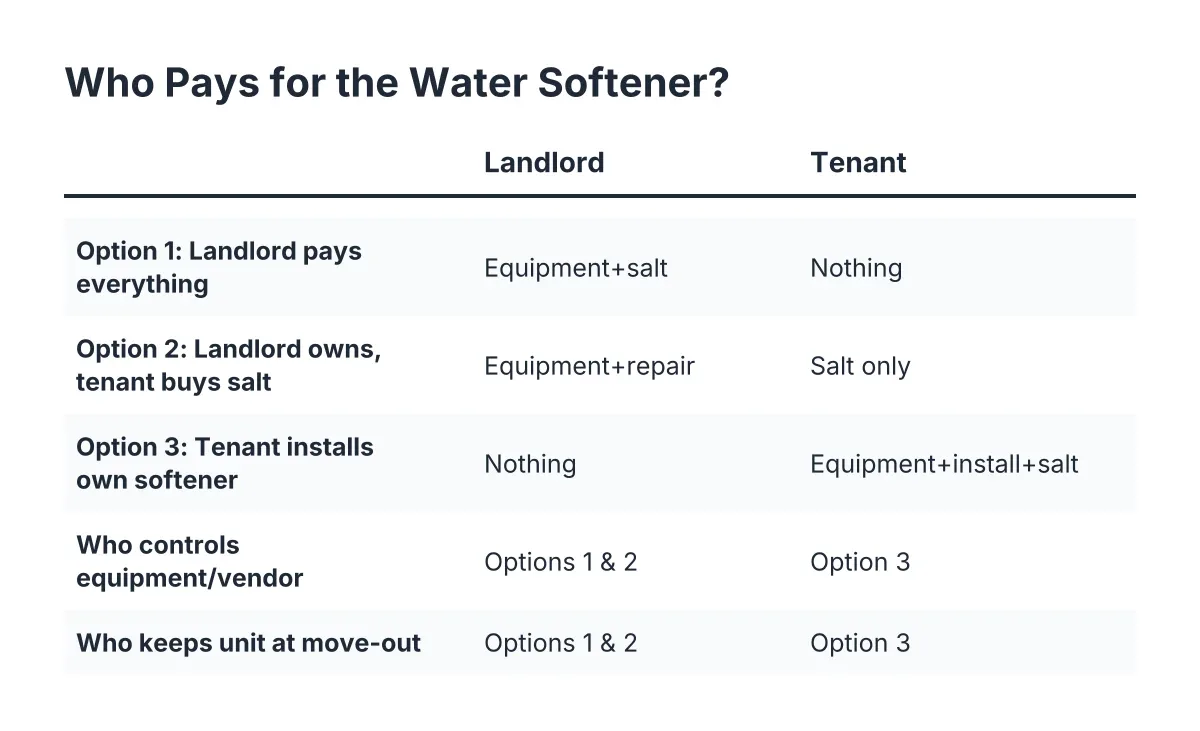
Landlords in the metro generally land on one of three arrangements. Each one answers who pays for water softener equipment, salt, and service differently. Here is how they compare.
Option 1: Landlord Pays Everything
Under this arrangement, the landlord owns the water softener, pays for salt, and pays for every service call. You control the equipment, the salt schedule, and the vendor.
Where it wins: Control and protection. A softener works by exchanging hardness minerals so scale no longer builds up in pipes, water heaters, dishwashers, and washing machines. Those are your appliances and your pipes. When you pay for the salt, you know the tank is not sitting empty for six months while scale buildup quietly shortens the life of a water heater you bought.
Where it hurts: Cost and trips. Typical households need to refill softener salt about every two to four months, depending on hardness, household size, and brine tank size, according to Culligan. With Minneapolis water at 15-plus grains, plan for the shorter end of that range. Across five or six units, that is a lot of salt runs, or a paid maintenance arrangement to handle them.
Best fit: Single-family rentals where you visit anyway, or landlords who want zero doubt about equipment condition at turnover.
Option 2: Landlord Owns the Equipment, Tenant Buys the Salt
This is the most common split for single-family rentals in the metro. You install and maintain the water softener; the lease requires the tenant to keep salt in the brine tank, the same way many leases assign lawn care or filter changes. A water softener lease clause spelling out this arrangement protects both parties and prevents disputes over maintenance duties.
Where it wins: It matches responsibility to daily use. The tenant lives with the water and benefits from soft water every day. Salt is cheap and easy to buy. You keep ownership of the equipment and control over softener repair and replacement decisions, which protects your plumbing.
Where it hurts: Enforcement. Softeners rely on salt to regenerate the resin bed, which is what removes hardness minerals, according to North Dakota State University Extension. An empty tank means hard water is running through the house whether or not anyone complains. Many tenants never check. A softener that sits dry for a year does your appliances no good, and salt also leaves insoluble residue that builds up in the brine tank and needs periodic cleanout, according to Cargill. Tenants will not do that.
Best fit: Longer-term tenants in single-family homes, paired with a salt check at every inspection or filter visit.
Option 3: Tenant Installs Their Own Softener
Some tenants offer to install their own unit, especially in older rentals with no softener and 15-plus grain water. In this arrangement, the tenant pays for the water softener, the install, and the salt, then takes the unit when they leave.
Where it wins: Zero cost to you, and a motivated tenant.
Where it hurts: Almost everything else. Tying a softener into your main water line is real plumbing work with a drain connection and electrical needs, and a bad DIY install can flood a basement. You also lose the equipment at move-out, right when the next tenant asks why the water leaves spots on everything. If you allow this at all, require a licensed installer, proof of the work, and written terms on removal and wall or floor repair.
Best fit: Rarely the right call for landlords in hard-water metros. Most who try it once switch to Option 2.
Writing a Water Softener Lease Clause to Settle Costs
A good water softener lease clause answers four questions before anyone argues about them. Write these into the lease, not into a text message after the dispute starts.
- Equipment ownership. State that the water softener belongs to the landlord and stays with the property, or spell out the tenant-owned exception in writing.
- Salt responsibility. Name who buys and adds salt, how often to check the tank, and what type of salt to use. If the unit is set for standard sodium chloride, say so; softeners can typically run on either sodium chloride or potassium chloride depending on the salt-type setting, according to NSF International, and you do not want tenants switching salt types without telling you.
- Repairs and service calls. Landlord pays for softener repair, leak repair, and replacement, since the equipment protects the landlord's plumbing. Require the tenant to report leaks, salt bridging, or a stuck bypass valve within 48 hours.
- Bypass and tampering. Softener units have their own inlet and outlet valves separate from the main house shutoff, according to InspectAPedia, so the unit can be isolated without cutting water to the whole house. State that tenants may not put the unit in bypass or change settings without written permission.
That fourth clause matters more than landlords expect. A tenant who bypasses the softener because the salt ran out, then never mentions it, can leave you with a year of scale buildup and no warning signs until the water heater fails.
A Turnover Scenario: How the Split Plays Out
Suppose you own a 1960s single-family rental in Richfield and discover at turnover that the softener stopped regenerating two years ago. The outgoing lease said nothing about salt. The tenant never added any, the resin bed sat idle, and the shower heads and dishwasher show heavy hard water stains.
In that scenario, you eat the whole cost, because a silent lease put everything on you. Say the fix is a softener replacement in the low four figures plus a dishwasher that fails a year early. The new lease then takes ten minutes to fix: landlord owns and services the unit, tenant keeps salt in the tank and reports problems within 48 hours, and the softener gets checked at every annual inspection. Same property, same water, no more arguments about who pays for the water softener.
Standardizing Across Multiple Units
Once the lease question is settled, landlords with three or more units should standardize the equipment itself. Rental property water softeners take more abuse than owner-occupied units, because nobody living there owns the water heater the softener is protecting. Standardizing pays off in three ways:
- One model, one parts list. When every unit runs the same demand-initiated softener, one service call teaches you the failure pattern for all of them, and replacement parts are predictable.
- Right sizing per property. Proper sizing depends on water hardness, iron and manganese levels, and household size. Suburban wells around the metro often carry iron that stains fixtures orange; ion exchange softeners can help reduce small amounts of iron in well water, according to Penn State Extension, but heavier iron needs dedicated filtration ahead of the softener.
- Certified equipment. Specify NSF/ANSI 44 certified units, which means independent testing verified the softener removes calcium and radium-226 and radium-228, according to NSF International. That is a simple line to put in your capital plan.
In addition, schedule installs and replacements during unit turnover whenever possible. An empty unit means no tenant scheduling, no wet-floor complaints, and a clean handoff where the new lease and the new equipment start together.
One More Minnesota Wrinkle: Salt and Efficiency
Chloride from softener discharge is a growing water-quality issue here. Seventy-five percent of Minnesotans rely on groundwater for drinking water, which is vulnerable to chloride contamination linked partly to softener discharge, according to the Minnesota Pollution Control Agency. Some cities have pushed hard on the problem; a rebate program in Marshall, Minnesota offered $500 to $700 for replacing old timer-based softeners, according to the same agency.
For a landlord, the takeaway is practical. Old timer-based units regenerate on a clock whether anyone used water or not, wasting salt in a vacant unit. Demand-initiated units regenerate based on actual water use, which cuts salt costs and suits rentals with changing occupancy. As of 2026, if any of your units still run timer-based softeners, a replacement at the next turnover is worth pricing out, and it is worth asking whether your city offers any incentive.
How to Choose
Match the arrangement to the property type and your distance from it.
- Choose landlord-pays-everything if the rental is high-end, the tenants turn over often, or you already visit for other maintenance and can check the brine tank yourself.
- Choose landlord-owns, tenant-buys-salt for most single-family rentals with stable tenants. It is the best balance of cost and protection, as long as the lease spells out the salt duty and you verify it at inspections.
- Avoid tenant-installed units unless a licensed installer does the work and the lease covers removal and repair in writing.
Whatever you choose, put it in the lease before move-in, standardize your equipment as units turn over, and have a local water softener specialist size each unit to its actual water. Lease questions with legal stakes belong with a Minnesota landlord-tenant attorney; this article covers the equipment side, not legal advice. Get the clause and the equipment right once, and hard water stops being a recurring fight and becomes one more line item you have under control.
If you need water softener installation, Twin Cities Water Softening can help.
Prefer to talk it through? Call +16512171659 — a quick call is usually the fastest way to get a straight answer for your situation.