
Rental Property Owner Liability: Water Softener Duties and Tenant Rights in Minneapolis, MN
If you own or manage rentals in the Twin Cities, hard water is not a comfort problem. It is a liability problem. Rental property owner liability covers more than slip-and-fall claims; it also reaches the equipment inside your walls. A neglected water softener can flood a basement unit, kill a water heater early, and give a tenant a documented reason to withhold rent or file a repair complaint. This guide walks through what you owe your tenants, what tenants owe you, and how to set up water softening across your units so the question of fault never comes up.
The Twin Cities metro area draws mineral-heavy water from the Mississippi River, producing hardness levels of 15+ grains per gallon for Minneapolis-area homes, according to HomeWater 101. Across 49 measured Minnesota cities, the median hardness is 9.5 grains per gallon, and 61 percent of cities fall in the hard or very hard range, according to USGS Water Science School. In other words, if you hold property anywhere in this metro, scale buildup is working on your water heaters and fixtures right now.
Why Hard Water Is a Landlord Liability Issue, Not a Comfort Issue
Minnesota law requires landlords to keep rental units fit for the use intended and in reasonable repair. That duty covers the plumbing system, the water heater, and any equipment you installed and the lease includes. Hard water attacks all three. Scale buildup shortens water heater life, clogs aerators and showerheads, and leaves hard water stains that tenants photograph and attach to complaints.
Here is where rental property owner liability gets concrete. Suppose a tenant reports low hot water pressure in October. The cause is scale choking a ten-year-old water heater. You delay, the heater fails in January, and the unit has no hot water for four days during a cold snap. Now you are not fixing a maintenance ticket. You are answering a habitability complaint, possibly a rent escrow action, and paying an emergency replacement price instead of a planned one.
A water softener does not remove that duty. It manages it. A working softener protects the water heater, the dishwasher, and the fixtures you would otherwise replace unit by unit. A failing softener does the opposite, and it adds its own risks: brine tank overflows, resin escaping into the plumbing, and leaks at aging valve connections. The equipment that protects you from one liability can create another if nobody services it.
Who Is Responsible for the Water Softener in a Minnesota Rental
In a Minnesota rental, the landlord is responsible for keeping the water softener in working order unless the lease clearly shifts routine duties, such as adding salt, to the tenant. The appliance is part of the plumbing system you provided. Repairs, leaks, and replacement stay on your side of the ledger in almost every arrangement.
That said, the day-to-day split matters, and it should live in the lease, not in a verbal agreement at move-in. A workable division looks like this:
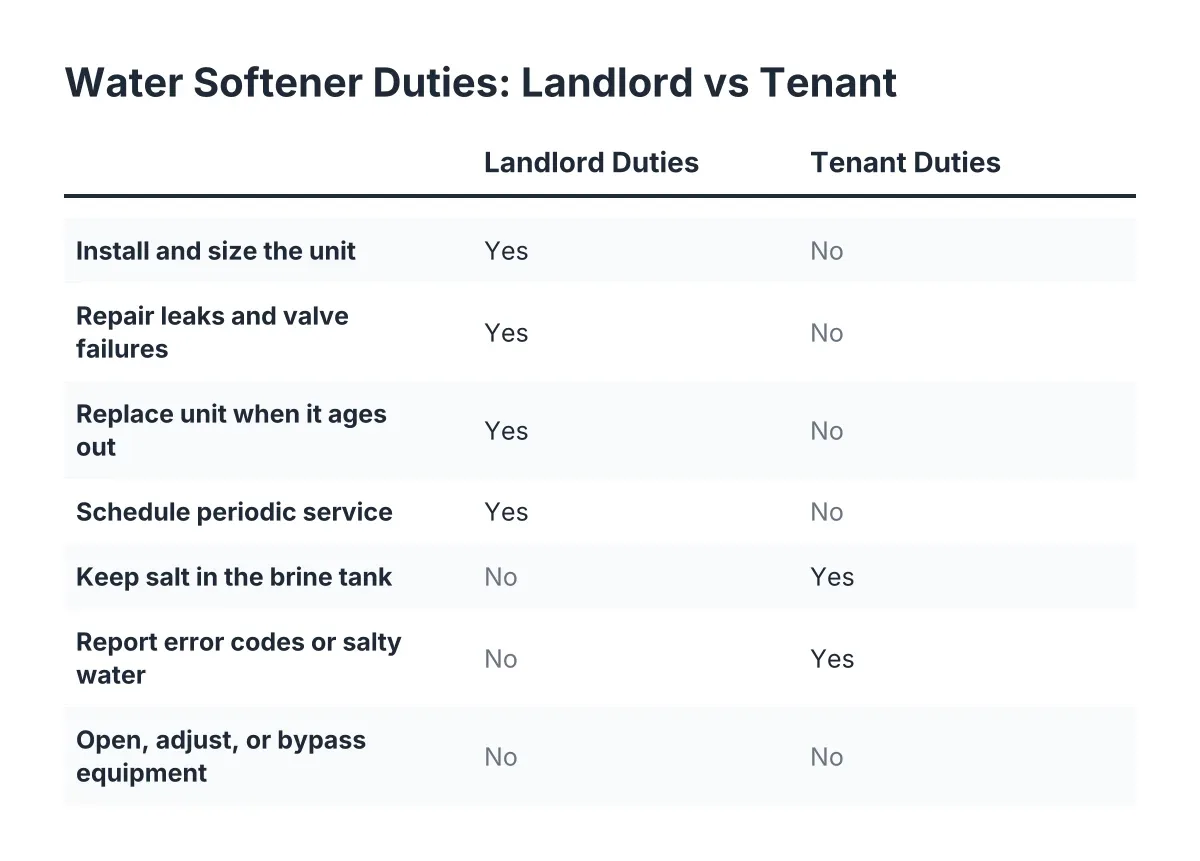
- Landlord duties: install the unit, size it correctly for the household, repair leaks and valve failures, replace the unit when it ages out, and schedule periodic service.
- Tenant duties (if the lease assigns them): keep salt in the brine tank, report error codes or salty-tasting water promptly, and never modify or disassemble the unit.
- Shared ground: the lease should state what type of salt to use and where to report problems, so a tenant cannot claim they did not know.
The disassembly point matters more than landlords expect. Unauthorized modification of a softener voids the manufacturer warranty. If a handy tenant takes the control head apart to "fix" a slow regeneration, you may lose warranty coverage on a unit you paid for. Put a plain sentence in the lease: tenants add salt and report problems; they do not open, adjust, or bypass the equipment.
One more detail works in your favor here. Softeners typically have their own inlet and outlet valves separate from the main house shutoff, according to InspectAPedia. That means a leaking unit can be isolated without cutting water to the whole building. Make sure your maintenance staff, and ideally your tenants, know where those valves are. A tenant who can bypass a leaking softener at 11 p.m. saves you a flooded utility room and the liability that comes with it.
Tenant Rights Around Water Quality and Working Equipment
Tenants in Minneapolis, MN have the right to a unit in reasonable repair, and that includes functioning plumbing and hot water. If the lease lists a water softener as included equipment, tenants can reasonably expect it to work. A dead softener is not an emergency the way a burst pipe is, but a pattern of ignored repair requests builds a paper trail against you.
Tenant hard water complaints usually arrive in one of three forms. First, cosmetic complaints: spotted glassware, orange or brown staining on tubs and toilets, and film on shower doors. Iron and manganese staining is common in Twin Cities suburbs, especially on well water, so these complaints are often legitimate rather than picky. Second, equipment complaints: weak hot water pressure, a dishwasher that leaves grit, or a water heater that runs out fast. Third, taste and odor complaints, which deserve a faster response because they touch on safety perception even when the water is safe.
Respond to all three in writing, with a date. Even when the fix is routine, the documented response is what protects you if the relationship sours. Rental property owner liability cases rarely turn on whether something broke. They turn on what you did after you knew.
There is also a sanitation angle that most landlords miss during turnover. A softener should be sanitized after a boil-water order, when water develops a bad taste or odor, or after it sits unused during an extended vacancy, according to Kinetico. A unit that sat empty from November to February needs that step before a new tenant moves in, not after they complain.
Low-Maintenance Softener Choices That Reduce Your Exposure
The best water softener for a rental is the one that fails least and asks the least of your tenant. That is a different buying standard than a homeowner uses. A homeowner will tolerate a system that needs attention because they live with the payoff every day. Your tenant will not, and every maintenance touch is a ticket, a trip, and a chance for something to go wrong between visits.
For rental property water softeners, a few selection rules hold up across a portfolio:
- Choose demand-initiated regeneration, not timer-based units. Metered units regenerate based on actual water use, so they do not waste salt during a vacancy or run short during a full house. Timer units are outdated enough that a Minnesota rebate program in Marshall paid residents 500 to 700 dollars to replace them, according to Minnesota Pollution Control Agency.
- Pick high-efficiency models. High-efficiency softeners can be programmed to use less salt, water, and energy than standard units, according to Culligan. Less salt means fewer tenant refills and fewer missed refills.
- Look for NSF/ANSI 44 certification. This certification means the unit passed independent testing for removing calcium and radium from water, according to NSF International. It is a simple spec line that keeps your purchasing consistent.
- Favor units with widely available parts. When a valve or control head fails in one unit, you want the repair part on a truck, not on backorder.
- Size for the unit's realistic occupancy. A one-bedroom and a four-bedroom duplex side should not get the same capacity. Oversizing wastes money and shelf space; undersizing causes hard water breakthrough and complaints.
Salt type is worth one line in your tenant handbook. Most units can switch between standard sodium chloride and potassium chloride as the regenerant, depending on which salt you load, according to NSF International. Pick one for the portfolio and tell tenants which bags to buy, because mixing types and letting salt bridge in the tank throws off the brine concentration and the softener stops doing its job while looking fine from the outside.
Standardizing Softeners Across a Portfolio in Minneapolis, MN
Standardization is where property managers pull ahead of single-unit landlords. When every building runs the same two or three softener models, your maintenance team learns one control head, stocks one set of parts, and quotes one repair procedure. Service calls get shorter. Invoicing gets predictable. Training a new maintenance tech takes an afternoon instead of a season.
A practical standardization plan for a 20-plus unit portfolio looks like this. First, inventory what you have: model, age, salt type, and last service date for every unit. Anything timer-based or past 15 years goes on the replacement list. Next, pick a standard metered, high-efficiency model in two sizes, one for smaller units and one for larger households. Then, replace on turnover rather than all at once. A water softener install during unit turnover costs you nothing in tenant disruption, and the unit gets sanitized and programmed fresh for the incoming household.
For example, say a manager runs 24 units across four buildings in south Minneapolis and the first-ring suburbs. Twelve softeners are original equipment, 15 to 20 years old, mixed brands, half of them timer-based. In that scenario, a sensible plan replaces the four worst units this quarter, schedules the rest at turnover over 18 months, and puts every unit on an annual service visit. At typical per-unit install costs in the 800 to 2,500 dollar range, framed here as an illustrative estimate rather than a quote, the spend is predictable and the emergency calls mostly disappear.
Standardizing also supports a service contract conversation. A water softener service contract for landlords usually bundles an annual inspection, brine tank cleanout, resin bed check, and programming review across all units, with consistent invoicing per property. Salt contains insoluble material that settles at the bottom of the brine tank and needs periodic cleanout, according to Cargill. That is exactly the kind of slow, invisible failure a scheduled visit catches and a tenant never will.
What an Annual Service Visit Should Cover
A worthwhile annual visit on a rental softener checks the control head programming against measured hardness, inspects the resin tank and valves, tests softness at a downstream tap, and cleans sediment from the brine tank. It should also confirm the bypass valve works, since a stuck bypass turns a minor leak into a building problem.
Programming matters more in rentals than in owner-occupied homes because occupancy changes. A unit set up for a single tenant will under-regenerate when a family of four moves in, and the new tenants get hard water while the equipment looks fine. Make reprogramming part of every turnover checklist, right next to changing the locks.
How Rental Property Owner Liability Shapes Replacement Timing
Replacement timing in a rental should run ahead of failure, because the cost of waiting lands on your liability side, not just your budget. A softener past 15 years old is a candidate for planned replacement even if it still runs. Old units waste salt and water, their seals and valves are the usual leak points, and parts get harder to source each year.
The replace-or-repair call follows a simple decision rule. If the unit is under ten years old and the problem is a single part, such as a bypass valve or a brine line, repair it. If the unit is past 12 to 15 years, or the resin bed itself has failed, replace it. Resin replacement on an old unit often costs enough that a new high-efficiency softener makes more sense, and the new unit cuts salt use going forward.
There is an equipment-sourcing angle to liability as well. Units built with American-made components tend to come from manufacturers that are insured and bonded, which gives you recourse if an equipment defect floods a finished basement unit. That recourse matters more to a landlord than a homeowner, because the water damage in a rental can include a tenant's belongings and a displacement claim on top of the drywall.
One honest trade-off: proactive replacement means spending money on a unit that has not failed yet. Some managers prefer to run equipment to failure and absorb the occasional emergency. That math can work on hardware that fails dry. It rarely works on water equipment, where the failure mode involves 40 gallons of brine on a basement floor and a tenant with a phone camera.
The Minnesota Chloride Question Landlords Should Know About
Softener discharge is becoming a regulatory topic in Minnesota, and portfolio owners should watch it. Seventy-five percent of Minnesotans rely on groundwater for drinking water, and that groundwater is vulnerable to chloride contamination linked in part to softener discharge, according to Minnesota Pollution Control Agency. Cities are starting to respond. The Marshall program that rebated timer-unit replacements enrolled nearly 300 homeowners and businesses and cut salt use by up to 320,000 pounds per year, with some households cutting salt use by as much as 86 percent, according to Minnesota Pollution Control Agency.
For a landlord, the takeaway is practical. Efficient, metered softeners are the direction regulation is heading, and they already cost less to run. Standardizing on them in 2026 means you will not be forced into a scattered, reactive upgrade cycle later. It also means fewer salt deliveries per unit; typical households refill salt every two to four months on average, according to Culligan, and efficient units stretch that interval further, which matters when the refill depends on a tenant remembering.
A Working Checklist for Softeners Across Your Units
Pull the pieces together and the liability picture gets manageable. Here is the short version to run against your portfolio:
- Put softener duties in the lease: tenant adds salt and reports problems; landlord repairs, services, and replaces.
- Standardize on metered, high-efficiency, NSF/ANSI 44 certified models in two sizes.
- Replace timer-based and 15-plus-year-old units, scheduled at turnover where possible.
- Reprogram and sanitize every unit at turnover, and after any extended vacancy.
- Schedule annual service: brine tank cleanout, resin and valve inspection, hardness test, and bypass check.
- Document every tenant water complaint and your response, in writing, with dates.
- Show maintenance staff where each unit's inlet, outlet, and bypass valves sit.
None of this requires exotic equipment or legal expertise. It requires treating the water softener as part of the building's plumbing, which under Minnesota habitability rules is what it is. For lease language questions or a dispute already in motion, talk to a Minnesota landlord-tenant attorney; equipment strategy reduces risk, but it does not substitute for legal advice.
Handled this way, rental property owner liability around water stops being a background worry. Your tenants get soft water and working hot water. Your water heaters last their full lives instead of scaling out early. And when a softener does fail, it fails as a scheduled line item, not as a 2 a.m. phone call about water on the floor. For a Minneapolis portfolio sitting on 15-plus grain water, that is the difference between managing hard water and being managed by it.
If you need water softener installation, Twin Cities Water Softening can help.
Prefer to talk it through? Call +16512171659 — a quick call is usually the fastest way to get a straight answer for your situation.