
Salt-Based Softener vs. Salt-Free Conditioner: Real Cost Comparison for Minneapolis
If you are pricing water treatment for a Minneapolis home, the first fork in the road is deciding between a salt-based softener vs. salt-free conditioner. The two systems cost different amounts up front, cost different amounts to run, and, more importantly, do different jobs. This guide lays out realistic local cost benchmarks for both, so you can look at a quote and know whether it is fair before you sign anything.
One thing to settle first: Minneapolis water is genuinely hard. This is not your imagination. According to USGS Water Quality Portal data, Minnesota's average statewide water hardness is 278.3 PPM, which lands in the "very hard" category. Across 49 measured Minnesota cities, the median is 9.5 grains per gallon, and 61% of cities fall in the hard or very hard bands, according to the USGS Water Science School. That white crust on your faucets and the cloudy glasses out of the dishwasher are the visible symptoms.
What Each System Actually Does
Before comparing prices, you need to know what you are buying. These two systems are not interchangeable, and that difference drives everything about the cost math.
A salt-based softener removes hardness minerals from your water. It uses a resin bed and an ion exchange process, and it relies on salt to regenerate that resin bed, according to North Dakota State University Extension. The calcium and magnesium leave the water entirely. Scale buildup stops, soap lathers better, and glasses come out of the dishwasher clear.
A salt-free conditioner does not remove anything. It changes the hardness minerals into tiny crystals that are less likely to stick to pipes and fixtures. The minerals stay in your water. That means no salty-slick feel in the shower, no bags of salt to haul, and no brine tank. It also means the word "softener" on the box is misleading; conditioned water is still hard water by every lab test.
That distinction matters for cost because a conditioner that fails to solve your problem is the most expensive option of all. You pay for it once, then pay again for the softener you needed in the first place.
Salt-Free Conditioner vs. Softener: Upfront Cost Comparison
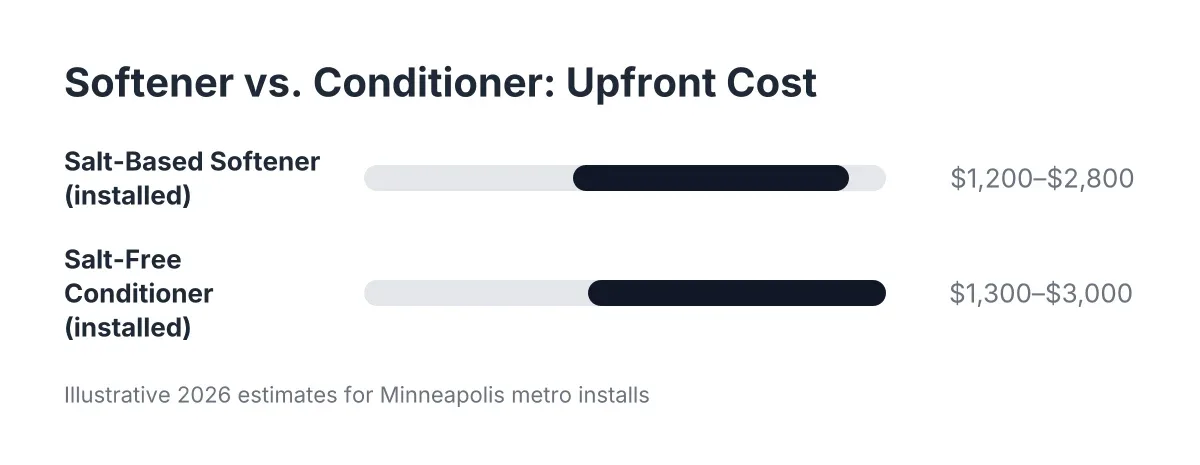
The price gap up front between a salt-free conditioner and softener is smaller than most homeowners expect. As illustrative 2026 estimates for the Minneapolis metro, a properly sized salt-based softener typically runs somewhere in the $1,200 to $2,800 range installed, depending on capacity, valve quality, and how much plumbing work the install needs. Salt-free conditioners often land in a similar or slightly higher band, roughly $1,300 to $3,000 installed, because the treatment media itself is not cheap.
Several things move the installed price on either system:
- Capacity and sizing. A softener sized for a family of five in a house with 20-plus grains of hardness costs more than a unit for a two-person condo on city water.
- Plumbing at the install point. If your mechanical room already has a loop, a drain, and an outlet nearby, the labor is straightforward. If the installer has to run new pipe or add a drain line, expect the quote to climb.
- Valve and control quality. A metered, demand-based valve costs more than an old timer-style control, but it regenerates only when needed and saves salt for years.
- Brand tier. Premium equipment, such as a Kinetico water softener or other high-end lines, carries a higher upfront price than standard builder-grade units.
One install detail worth noting: a salt-based softener needs a drain connection and an electrical outlet, and it takes up real floor space, often two tanks in a basement or utility room. A salt-free conditioner is a single tank with no drain and no power. However, if your quote for a conditioner is priced like a softener but the house has 15 grains of hardness and iron in the well water, that similarity in price should make you ask hard questions.
Ongoing Cost: Salt, Water, and Media Replacement
This is where the two paths split, and where the ten-year math gets decided.
What a Salt-Based Softener Costs to Run
A salt-based softener has three ongoing costs: water softener salt pellets, the water used during regeneration, and eventual service. Typical households refill the salt supply about every two to four months, according to Culligan, though water hardness, family size, and brine tank size all shift that. As a rough illustrative figure, budget a few bags of salt per refill, which for most Minneapolis homes works out to under $150 per year in salt.
Efficiency matters here. High-efficiency softeners can be programmed to use less salt, water, and energy than standard units, according to Culligan. Over ten years, a metered high-efficiency unit can save enough salt to close much of the upfront price gap with a cheaper timer-based model. Minnesota is also pushing in this direction for environmental reasons; 75% of Minnesotans rely on groundwater for drinking water, which is vulnerable to chloride contamination linked partly to softener discharge, according to the Minnesota Pollution Control Agency. One MPCA program in Marshall, Minnesota even paid $500 to $700 rebates for replacing timer-based softeners, and the program cut salt use by up to 320,000 pounds per year across nearly 300 participants.
There is also light maintenance. Softener salt contains insoluble material that settles at the bottom of the brine tank over time and needs periodic cleanout, according to Cargill. A resin bed lasts many years but not forever, and a resin tank service or rebuild is a normal midlife expense.
What a Salt-Free Conditioner Costs to Run
A salt-free conditioner has no salt bags, no brine refills, and no regeneration cycle. Day to day, it costs close to nothing to run. That is its real appeal.
The ongoing cost hides in the media. The treatment media inside the tank wears out and needs replacement on a schedule, and that replacement is not cheap. On well water, the media can foul early, especially with iron or manganese in the supply, which is common in Minneapolis suburbs on private wells. When the media fouls ahead of schedule, your low-maintenance system becomes a recurring expense you did not budget for.
Where Each System Wins on Total Cost
Neither system wins every situation. Here is the honest breakdown.
When the Salt-Based Softener Is the Cheaper Long-Term Choice
A salt-based softener wins on total cost whenever you actually need soft water. In the Minneapolis metro, that covers most homes, because the water measures hard to very hard nearly everywhere. It also holds a specific edge as a water softener for well water; ion exchange softeners can help reduce small amounts of iron in addition to hardness, according to Penn State Extension, while iron tends to shorten the life of conditioner media.
Suppose a first-time homeowner in Richfield with 18 grains of hardness buys a $1,600 salt-free conditioner because the "no salt" pitch sounded easier. Scale slows down some, but spots still form on the shower door, and the water heater keeps collecting sediment. Two years later, that homeowner pays again for a softener install. In that illustrative scenario, the "cheaper to run" option cost more than $3,000 in total, plus two years of continued scale damage. This pattern of conditioner-to-softener replacement is common enough that it should factor into your decision, not just the sticker prices.
When the Salt-Free Conditioner Makes Financial Sense
A salt-free conditioner earns its cost when your goals are narrow: modest hardness, city water with no iron, and a primary interest in slowing scale buildup rather than getting truly soft water. Choosing a salt-free conditioner vs. softener also makes sense for homes where a drain connection is impractical, or where the owner cannot or will not haul salt bags. For a rental property manager standardizing equipment across a portfolio, conditioners can make sense on low-hardness city-water buildings where the goal is protecting water heaters between tenants, not delivering spot-free glassware.
Set your expectations correctly, though. Conditioned water will not feel like softened water, glasses may still show some spotting, and a lab test will still call the water hard. If a tenant or a family member expects soft water, a conditioner will disappoint them at any price.
Side-by-Side Cost Summary
Here is the whole comparison in one place, using the illustrative 2026 Minneapolis-area ranges from above:
- Upfront installed cost: Salt-based, roughly $1,200 to $2,800. Salt-free, roughly $1,300 to $3,000. Close to a wash.
- Annual operating cost: Salt-based, salt plus regeneration water, typically modest. Salt-free, near zero until media replacement.
- Midlife service: Salt-based, brine tank cleanout and eventual resin service. Salt-free, full media replacement on a fixed schedule, sooner on iron-bearing water.
- Performance on very hard water: Salt-based removes hardness outright. Salt-free only reduces scaling tendency, and hard water stains can persist.
- Well water with iron: Salt-based handles small amounts of iron. Salt-free media fouls early. Softener wins clearly here.
- Risk of buying twice: Low with a correctly sized softener. Real with a conditioner on genuinely hard water.
When you compare quotes, make sure both bids specify the same things: tested hardness in grains per gallon, system capacity, valve type, drain and outlet work included, and who handles the first year of service. A quote that skips the hardness number is a quote built on guesswork, and guesswork is how homeowners end up overpaying. The full picture of water softener cost depends as much on correct sizing as on the type of system you pick.
How to Choose for Your Minneapolis Home
Start with a hardness test, not a product. Statewide averages say the water is very hard, but your street, your well, and your building can differ. On municipal water in Minneapolis proper, hardness is high but consistent. On suburban well water, iron and manganese staining change the equation entirely, and a professional water test is worth doing before you spend anything; treating well water without testing it first is the one place where a do-it-yourself decision reliably goes wrong.
Then apply three questions. Do you want scale reduction or actual soft water? Is there any iron in the supply? Can the install location support a drain and an outlet? If you want soft water, have iron, or have very hard water, the salt-based softener is the better long-term spend even with salt costs included. If you have moderate hardness on clean city water and only want scale protection, the salt-free conditioner can justify its price.
Either way, understanding the difference between a salt-free conditioner and softener comes down to matching the system to your tested water, not to the marketing on the box. Get the hardness number first, insist on itemized quotes, and the right answer usually becomes obvious.
If you need water softener installation, Twin Cities Water Softening can help.
Prefer to talk it through? Call +16512171659 — a quick call is usually the fastest way to get a straight answer for your situation.