
Emergency Water Softener Repair Cost in Minneapolis: Fix It or Replace It?
Your water softener picked a bad time to act up. Maybe it stopped using salt, maybe it is leaking on the basement floor, or maybe the water went hard overnight and the shower doors show it. Now you need to know two things: what emergency water softener repair costs in Minneapolis, MN, and whether paying for that repair even makes sense on a unit that is 15 years old. This guide gives you realistic local price benchmarks for both paths, repair and replacement, so you can spot an inflated quote before you sign anything.
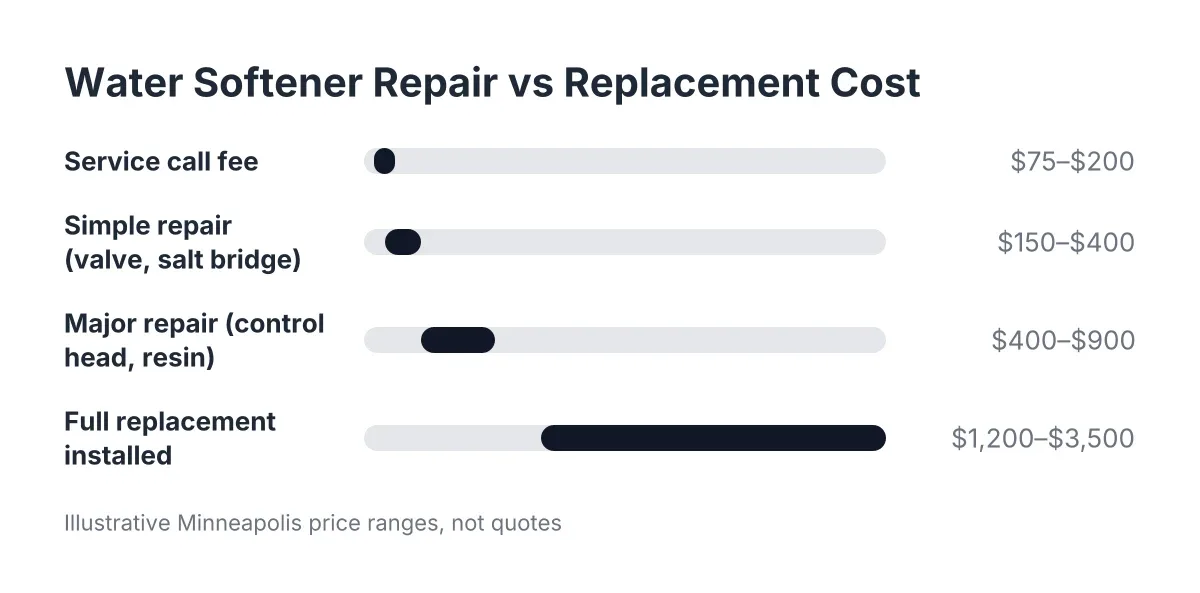
Here is the short version. A repair visit on a softener usually runs a few hundred dollars. A full replacement on an older Minneapolis home typically lands somewhere between $1,200 and $3,500 installed, depending on the system and the plumbing you start with. Those are illustrative local ranges, not quotes, but they give you a yardstick. The rest of this article explains what moves the number up or down, and when the smarter spend is a new system instead of another repair.
Why Softener Failures Feel Like Emergencies in Minneapolis
Hard water does not wait for a convenient moment. The Twin Cities metro draws mineral-heavy water from the Mississippi River, and Minneapolis-area homes see hardness levels of 15 or more grains per gallon, according to HomeWater 101. That is firmly in the "very hard" range. Statewide, the picture is similar; across 49 measured Minnesota cities, the median hardness is 9.5 grains per gallon, and 61 percent of cities fall in the hard or very hard bands, according to USGS Water Science School.
So when your softener quits, scale buildup starts right away. The water heater begins collecting mineral crust. Hard water stains show up on fixtures and glassware within days. In suburbs on well water, iron staining can return fast too, since ion exchange softeners also help reduce small amounts of iron, according to Penn State Extension. When that protection disappears, you notice.
For an older home with original plumbing, this matters more. Pre-1980 houses in Minneapolis often have galvanized or older copper lines that have already lived through decades of hard water. A dead softener accelerates damage that is already underway. That is why a failed unit in a 1965 rambler feels urgent in a way it might not in a newer house.
What Emergency Water Softener Repair Usually Costs
Emergency water softener repair in Minneapolis typically starts with a service call fee, often in the range of $75 to $200 as an illustrative estimate, plus parts and labor on top. Simple fixes like a stuck valve or a salt bridge might total $150 to $400. Bigger repairs, like a control head or resin tank service, can run $400 to $900 or more. These are ballpark local figures, not guarantees; the honest answer always comes after a technician sees the unit.
A few things push the repair bill up or down:
- What failed. A clogged injector or brine line is cheap. A cracked bypass valve, a leaking tank, or a dead control head costs more.
- Parts availability. Common brands have parts on local shelves. Discontinued or off-brand units may need ordered parts, which adds time and cost.
- Age and condition. On a 15-year-old unit, one repair often uncovers another. Seals, valves, and resin all age together.
- Access. A softener crammed behind a furnace or water heater in a tight pre-1980 utility room takes longer to work on, and labor time is money. Technicians may charge hourly or a flat rate, so ask which applies before work starts.
- Timing. After-hours or same-day emergency work usually carries a premium over a scheduled service call.
One piece of good news for a true emergency: most softeners have dedicated inlet and outlet valves separate from the main house shutoff, according to InspectAPedia. That means a leaking unit can usually be isolated or bypassed without cutting water to the whole house. You keep running water while you decide what to do next. The water will be hard in the meantime, but your home stays functional.
Common Failures Behind an Emergency Water Softener Repair Call
The most frequent emergency water softener repair calls trace back to a handful of problems: salt bridges in the brine tank, failed control valves, worn resin beds, and leaks at the bypass or tank connections. Knowing which one you likely have helps you judge whether a quote is fair before anyone opens a toolbox.
Start with the cheap possibilities. Water softeners rely on salt to regenerate the resin bed, which is what removes hardness minerals, according to North Dakota State University Extension. If the salt in the brine tank has hardened into a crust, the softener cannot make brine and the water goes hard. That is a salt bridge, and breaking it up costs little. Likewise, salt contains insoluble material that settles at the bottom of the brine tank over time and needs periodic cleanout, according to Cargill. A sludged-up brine tank can mimic a dead softener.
Next come the mid-range failures. The control head, the computer and valve assembly on top of the tank, runs the regeneration cycles. When it fails, the unit either stops regenerating or regenerates constantly, dumping water down the drain. On units more than a decade old, replacing a control head often costs enough that replacement of the whole system deserves a look.
Finally, the resin bed itself. Here is the decision rule most techs use: if the softener cycles correctly, salt goes down, the bypass is open, and the water still tests hard, the resin inside the tank has likely worn out. Resin can be replaced, but on an old unit that job plus labor frequently lands close to half the cost of a new softener. Iron-heavy well water wears resin faster, so suburban well homes hit this point sooner.
Repair or Replace: The Math for a 15-Year-Old Softener
Whether to repair or replace a 15-year-old water softener comes down to a simple comparison: the repair quote against roughly half the cost of a new installed system. If a repair costs more than about half of replacement, replacement usually wins, because the next failure on an aging unit is a matter of when, not if.
Say a homeowner in a 1972 South Minneapolis house gets an emergency repair quote of $650 for a new control head on a 16-year-old softener. In that scenario, the tank, resin, and brine system are all 16 years old too. Spending $650 buys one new part on a system where everything else is near end of life. If a comparable new system installs for $1,800 to $2,500, that $650 covers a third of a fresh unit with new resin, a modern valve, and current efficiency. Most people in that spot replace, and the math backs them up.
There are efficiency reasons too, not just failure risk. High-efficiency softeners can be programmed to use less salt, water, and energy than standard units, according to Culligan. Older timer-based units regenerate on a clock whether you used water or not, which wastes salt and water every cycle. Minnesota has taken this seriously at the policy level; a rebate program in Marshall, Minnesota offered $500 to $700 for replacing timer-based softeners as part of a chloride-reduction effort, according to the Minnesota Pollution Control Agency. That program enrolled nearly 300 homeowners and businesses and cut salt use by up to 320,000 pounds per year, with some households cutting salt use by as much as 86 percent, per the same source.
The environmental angle is not abstract here either. Seventy-five percent of Minnesotans rely on groundwater for drinking water, and that groundwater is vulnerable to chloride contamination linked partly to softener discharge, according to the Minnesota Pollution Control Agency. A modern demand-initiated softener puts less salt down the drain, which is good for your budget and the watershed.
When does repair still make sense? If the unit is under ten years old, the failure is minor, and the brand has parts support, repair is often the right call. A $200 brine line fix on a seven-year-old softener is easy money well spent. The replace-first instinct applies to aging units with expensive failures, not every hiccup.
What a Replacement Costs Installed in Minneapolis, MN
A water softener replacement in Minneapolis, MN typically runs between $1,200 and $3,500 installed, as a realistic local estimate for 2026. The low end covers a standard single-tank, salt-based unit swapped onto existing plumbing in good condition. The high end covers larger or dual-tank systems, iron filtration add-ons, or plumbing corrections common in pre-1980 homes.
Several factors drive where you land in that range:
- System size and capacity. Sizing follows your household and your hardness. A family of four on Minneapolis city water at 15-plus grains per gallon needs more capacity than a couple in a condo. Right-sizing matters; an oversized unit wastes money up front, and an undersized one regenerates constantly.
- System type. Salt-based softeners remain the standard for Twin Cities hardness levels. Salt-free conditioners cost similar money but do not remove hardness minerals, and homeowners on genuinely hard water often end up replacing them with true softeners later. For 15-plus grain water, that is an expensive detour.
- Brand and features. Consumer brands you may have researched, like an Aquasure water softener or a Springwell water softener, sit at different price points than pro-line equipment. Online-direct units can look cheaper on the sticker, but installation, warranty support, and local parts availability differ, so compare the installed total, not the box price.
- Your existing plumbing. This is the big one for older homes. If the old softener was plumbed decades ago with corroded fittings, a missing bypass, or an improper drain, the installer has to correct it. That adds labor and materials but leaves you with a safer setup.
- Add-ons. A whole-house filter ahead of the softener, an iron filter for well water, or a salt system setup for potassium chloride all add cost. Worth noting: most modern units let you switch the salt setting between sodium chloride and potassium chloride depending on which regenerant you use, according to NSF International.
One more line item people forget when comparing water softener cost between quotes: what happens to the old unit. A fair replacement quote should include disconnecting, draining, and hauling away the old softener and its brine tank. If a quote excludes haul-away, ask what that adds.
How Long Replacement Takes and What the Work Looks Like
A straightforward softener replacement usually takes a few hours in one visit; a half day is common when plumbing corrections are needed. The installer shuts off and bypasses the old unit, disconnects and removes it, sets the new tank and brine tank, connects supply, drain, and bypass lines, then programs and tests the system.
For the Replacement Planner worried about mess in the utility room, here is the honest picture. There will be some water when lines are opened, and the old brine tank is heavy with salt sludge. A careful installer drains the old unit before moving it, protects the floor, and leaves the space cleaner than a 15-year-old softener corner usually looks. The water is off to the softener loop during the work, but the rest of the house keeps running water through the bypass.
After the install, you own two small ongoing tasks. First, keep salt in the brine tank; typical households refill every two to four months depending on hardness, family size, and tank size, according to Culligan. Second, plan on periodic maintenance, generally every couple of years, or sooner if symptoms show up. That includes checking internal components and reprogramming after household changes, like a new baby or a kid moving out, since water use drives regeneration settings.
When to Call for Emergency Softener Repair vs. Handling It Yourself
Call a professional for emergency water softener repair when you see active leaking, water on the floor near the tanks, a unit stuck in regeneration and running water to the drain nonstop, or any plumbing connection you would have to cut or sweat to fix. Those situations risk water damage or a botched connection, and they need a licensed pro.
However, a few things are safe to check yourself before you pay for a visit:
- Look for a salt bridge. Push a broom handle gently into the brine tank. If you hit a crust with hollow space underneath, break it up and run a regeneration.
- Check the bypass valve. If someone bumped it into bypass position, the softener is fine; the water is just going around it. Return it to service position.
- Confirm power and settings. A tripped outlet or a clock reset after a power blip can stop regeneration on electric models. Non-electric, water-powered softeners avoid this failure mode entirely, which is one reason some homeowners choose them at replacement time.
- Check the salt level. Empty tank, hard water. It happens to everyone at least once.
One safety note specific to water quality. If your softener sat unused during a long absence, or if your city issued a boil-water order, the system should be sanitized before you rely on it again, according to Kinetico. The same applies on private wells if taste or odor turns bad. Sanitizing is a reasonable DIY job for some homeowners, but if you are unsure of the procedure for your model, have a technician do it during a service visit.
A limitation worth stating plainly: no article can diagnose your specific unit. Hardness testing, a look at the resin and valve condition, and your home's plumbing layout all change the answer, so treat every range here as a starting point for a real conversation, not a final number.
How to Judge a Quote Before You Sign
A fair emergency repair or replacement quote in Minneapolis should be specific, itemized, and tied to a diagnosis you can understand. Vague quotes hide padding. Before you approve work, ask these three questions:
- What exactly failed, and what is the repair versus replacement price for my situation? A specialist should give you both numbers without being pushed. If the repair quote crosses half the replacement price on a unit over ten years old, the honest recommendation usually shifts to replacement.
- How did you size the recommended system? The answer should mention your water hardness, iron if you are on a well, household size, and water use. "This is the one we always install" is not sizing; it is inventory management. Oversizing is the most common way homeowners get oversold.
- What does the installed price include? Permits where required, new bypass valve, drain connection, haul-away of the old unit, programming, and a walkthrough of settings should be in the number. Anything excluded should be listed in writing.
In addition, favor a local company that works on water treatment as its core trade rather than one line among fifty services. A specialist sees the same Minneapolis water, the same pre-1980 utility rooms, and the same failure patterns every week, which shows up in both the diagnosis and the installed quality. Big box store softeners, for instance, are widely treated as disposable in the trade; a specialist will tell you that up front instead of billing hours against a unit that is not worth fixing.
The Bottom Line for Minneapolis Homeowners
If your softener failed today, you have more room to decide than it feels like. Bypass the unit so the house keeps water, run the quick DIY checks, and then get a diagnosis with both a repair price and a replacement price side by side. On a unit past the 12-to-15-year mark with Twin Cities hardness grinding on it, replacement usually wins the math, and it converts a stressful emergency into a planned upgrade with better salt and water efficiency.
If your softener is merely acting up and has not died yet, you are in the best position of all. You can test your water, size the right system for your household, compare installed quotes without time pressure, and schedule the swap on your calendar instead of the softener's. That is the whole advantage of replacing before failure.
Either way, the next step is the same: have a local water softener specialist look at your unit and your water, and put real numbers to your specific situation. Reach out to schedule a diagnosis or an installation estimate, and get a clear answer on whether your softener deserves one more repair or a well-earned retirement.
If you need water softener installation, Twin Cities Water Softening can help.
Prefer to talk it through? Call +16512171659 — a quick call is usually the fastest way to get a straight answer for your situation.