
How Hard Water Damages Appliances: A Step-by-Step Check for Your Home
If your dishwasher leaves cloudy glasses, your water heater rumbles, or your old softener just quit, you are likely looking at hard water damage to appliances, not bad luck. Minneapolis water is mineral-heavy. According to HomeWater 101, Twin Cities homes draw water from the Mississippi River at 15 or more grains per gallon of hardness. That is enough to coat heating elements, clog spray arms, and shorten the life of every appliance that touches water. An appliance hard water inspection helps identify whether scale buildup is damaging your equipment.
This guide walks you through a room-by-room inspection you can do in about 30 minutes. By the end, you will know whether hard water is the cause, how far the damage has gone, and what to do next. No tools needed beyond a flashlight and a white vinegar bottle.
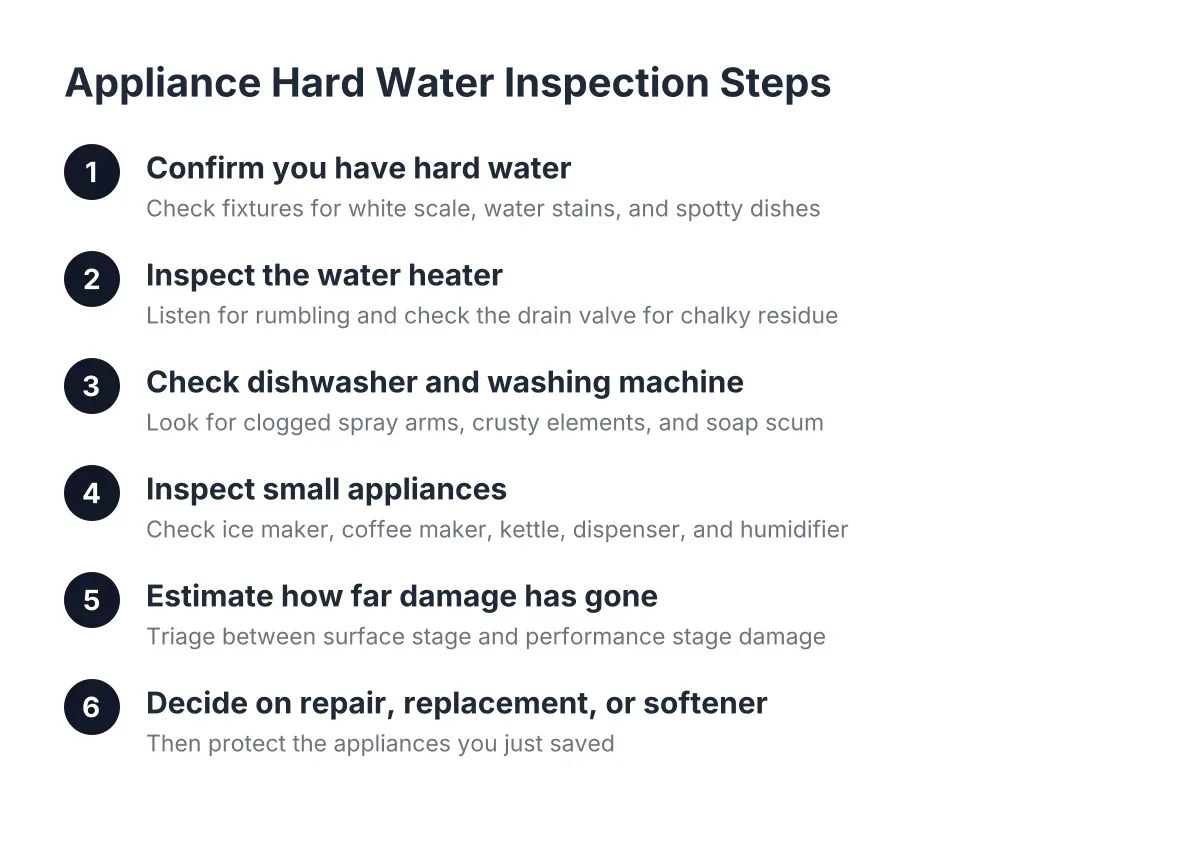
Step 1: Confirm You Actually Have Hard Water
Start with the evidence on your fixtures, because that tells you what is happening inside your appliances. White, crusty scale buildup on faucet aerators and showerheads is the clearest sign. So are water stains on glass shower doors that will not wipe off, spotty dishes, dry skin after showering, and laundry that fades fast.
In Minneapolis, assume hard water until proven otherwise. Across 49 measured Minnesota cities, the median hardness is 162.0 mg/L, and 61 percent of cities fall in the hard or very hard range, according to USGS Water Science School. Statewide, 65 of Minnesota's 87 counties have very hard water above 180 mg/L, per the USGS Water Quality Portal.
If you just moved here from a soft-water region, this matters double. The spots on your glasses are not a detergent problem. They are the first visible stage of the same scale forming inside your water heater right now.
One more check: if you see a water stain on a ceiling or wall, that is a plumbing leak, not hard water. Hard water damage shows up as white or rust-colored crust, not wet drywall. A ceiling stain needs a plumber, not a water test.
Step 2: Inspect the Water Heater for Scale Damage
Does hard water ruin water heaters? Yes, and the water heater usually takes the worst hit in the house. Minerals fall out of solution fastest when water is heated, so calcium settles on the tank bottom and the heating elements. The result is a layer of rock between the burner and the water.
Walk to your water heater and listen while it runs. Popping, rumbling, or crackling sounds mean sediment is boiling on the tank floor. Next, check the drain valve at the bottom. If you open it into a bucket and get chalky white chunks or cloudy water, you have confirmed scale. An appliance hard water inspection of the heating elements reveals white crust accumulation that reduces efficiency.
Watch for these symptoms too:
- Hot water runs out faster than it used to
- Water takes longer to heat up
- Higher energy use for the same hot water habits
- The tank is under 10 years old but already struggling
Scale forces the heater to burn more energy to push heat through a mineral layer. Therefore, an unprotected tank in a 15-plus grain area often fails years early, long before its rated life.
Step 3: Check the Dishwasher and Washing Machine
These two appliances see hard water damage sooner than most because they run hot water through small holes. In the dishwasher, pull out the bottom rack and look at the spray arm. Scale clogs the spray jets, so water pressure drops and dishes come out dirty or filmy. Check the heating element at the base for white crust, and look at the door gasket for chalky residue.
In the washing machine, hard water works two ways. First, minerals react with detergent and form soap scum that sticks to clothes and the drum. Second, scale builds in the inlet valves and hoses, choking flow over time. If you have been adding more detergent, or buying detergent with built-in softening agents, that is a hard water tell.
Does hard water damage a washing machine beyond repair? Not overnight. However, the damage compounds. Every cycle deposits a little more scale, and the longer it runs untreated, the shorter the machine's working life. Front-loaders with their tight door seals and sensors tend to show problems first.
Step 4: Hard Water Appliance Inspection for Small Appliances
Hard water does not stop at the big machines. Check these in five minutes:
- Ice maker: Cloudy or small cubes, or slow ice production, point to scale on internal lines. Ice makers suffer the same mineral damage as any other water appliance.
- Coffee maker and kettle: White flakes in the bottom or longer brew times mean scale on the heating plate.
- Refrigerator water dispenser: Slow flow often means a scaled line or a filter doing overtime.
- Humidifier: White dust around the unit is dried mineral content.
For thick limescale on these small items, a soak in equal parts white vinegar and water usually works. Run a vinegar cycle through the coffee maker, then two water cycles to rinse. To remove thick limescale from a kettle, let the vinegar mix sit overnight. These fixes are temporary, though. The scale returns because the water has not changed.
Step 5: Estimate How Far the Damage Has Gone
How long does it take for hard water to damage appliances? At Minneapolis hardness levels, visible scale shows up on fixtures within weeks, and internal appliance damage builds steadily over the first year or two. The timeline matters because early scale is reversible and late scale is not.
Use this rough triage:
- Surface stage: Spots on glasses, film on shower doors, crust on aerators. Cleanable, no permanent harm yet.
- Performance stage: Water heater rumbles, dishwasher underperforms, hot water pressure drops. Scale is inside the equipment and cutting efficiency.
- Failure stage: Elements burn out, valves stick, the softener you inherited stops regenerating, and salt sits undissolved in the brine tank. Repairs start stacking up.
Suppose a homeowner in Richfield buys a 1990s rambler with a softener the sellers quit maintaining years ago. Within a month of moving in, the shower door films over and the water heater starts popping. In that scenario, the house is already in the performance stage, and every month untreated adds cost. That is typical for this metro, not an edge case.
One honest note on stainless steel: hard water does not corrode it, but it does leave stubborn spots and film on stainless sinks, dishwasher interiors, and cookware that get worse with heat.
Step 6: Decide Between Repair, Replacement, and a First Softener
If you have no softener, the fix is water softener installation sized to your household and your actual hardness number, which is why a hardness test should come before any quote. A properly sized softener stops new scale from forming, and appliances downstream last closer to their rated life. Look for units tested to NSF/ANSI 44, which, according to NSF International, verifies the system removes calcium along with radium-226 and radium-228.
If you have a softener that stopped working, do not assume it is dead. Common failures are fixable:
- Salt not going down usually means a salt bridge, a hardened crust over the brine tank. Break it up with a broom handle.
- A stuck or dripping bypass valve is a repair, not a replacement.
- A pooled leak near the resin tank can be a cracked tank, which argues for replacement, or a loose fitting, which does not. Use the softener's own inlet and outlet valves to isolate the unit without shutting water to the whole house; most units have them, per InspectAPedia.
A fair rule: if the unit is under 10 years old and the control head works, lean repair. If it is a timer-based unit from decades back, replacement often pays for itself in salt alone, since high-efficiency softeners can run on less salt, water, and energy, according to Culligan. Minnesota is pushing this direction too; the Minnesota Pollution Control Agency notes one Marshall program paid $500 to $700 rebates to replace timer-based softeners because of chloride pollution.
If the leak traces to house plumbing rather than the softener, or the water heater is already in the failure stage, bring in a professional before spending on cleaning products. A local softener specialist can test hardness, check iron and manganese, which stain fixtures orange across many Twin Cities suburbs, and tell you straight whether a repair or a replacement makes sense.
Step 7: Protect the Appliances You Just Saved
Once soft water is flowing, finish the job. Flush the water heater to clear old sediment. Run a vinegar cycle through the dishwasher and washing machine to dissolve existing film. Replace clogged faucet aerators; they cost a few dollars each.
Then keep the softener fed. Softeners rely on salt to regenerate the resin bed that pulls hardness minerals out, according to North Dakota State University Extension. Most households refill salt every two to four months, per Culligan, and the brine tank needs an occasional cleanout since salt leaves insoluble residue at the bottom over time, as Cargill notes.
Hard water in Minneapolis is a fact, not a flaw in your house. Catch the signs early, read what your appliances are telling you, and the fix is a single install and a bag of salt every few months instead of a new water heater every several years.
If you need water softener installation, Twin Cities Water Softening can help.
Prefer to talk it through? Call +16512171659 — a quick call is usually the fastest way to get a straight answer for your situation.