
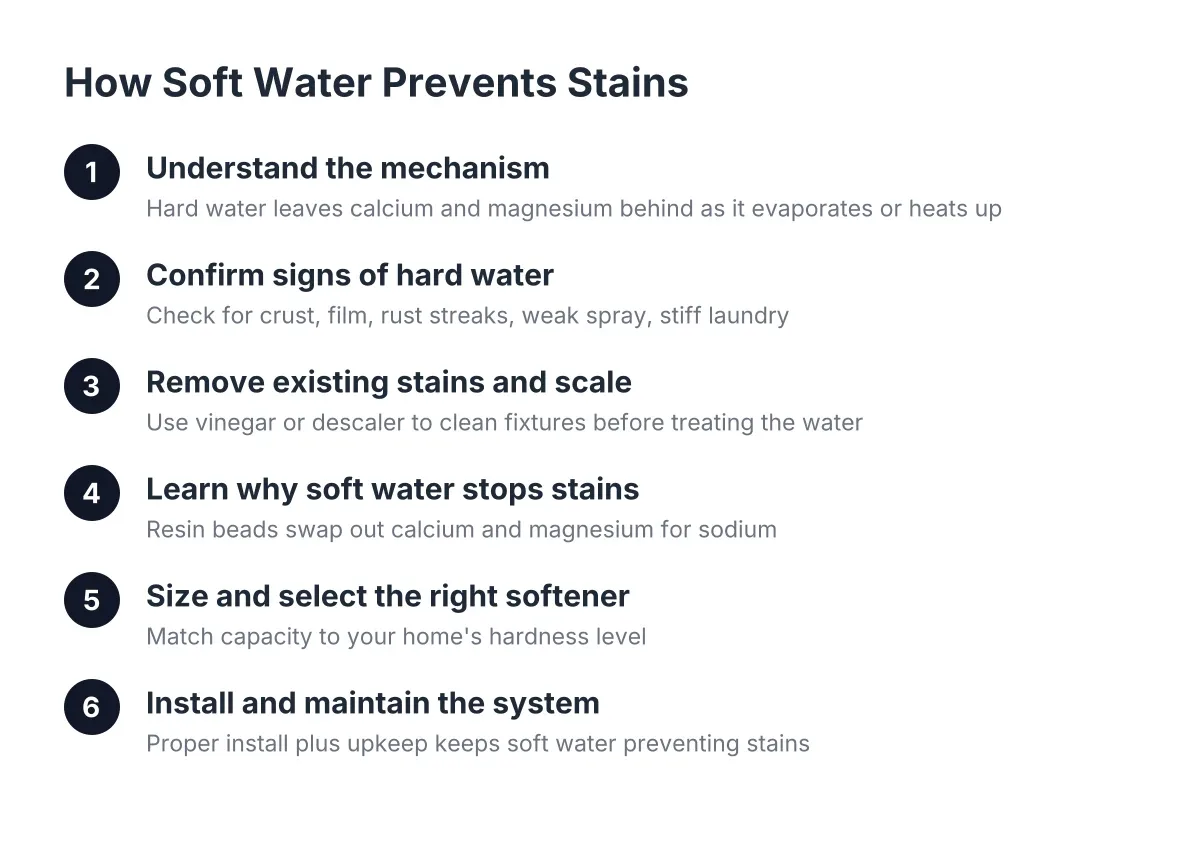
Why Soft Water Prevents Stains: The Science of Scale, Step by Step
If you keep scrubbing white crust off your faucets and it keeps coming back, the problem is not your cleaning routine. It is your water. Soft water prevents stains because it removes the minerals that cause them before they ever touch your fixtures. Hard water carries dissolved calcium and magnesium; every time a drop dries, those minerals stay behind as scale. This guide walks you through how that happens, how to confirm it in your own Minneapolis home, and how to stop it for good.
Minneapolis-area homes deal with unusually mineral-heavy water. The Twin Cities metro draws from the Mississippi River, producing hardness levels of 15 or more grains per gallon for Minneapolis-area homes, according to HomeWater 101. For context, the USGS Water Science School data across 49 measured Minnesota cities shows a median of 9.5 gpg, which already counts as hard. Your water is likely well past that line.
Follow these steps in order. Each one builds on the last.
Step 1: Understand How Hard Water Creates Stains in the First Place
Before you can fix the stains, you need to know the mechanism. Hard water holds dissolved calcium and magnesium. As long as those minerals stay dissolved, water looks clear and normal.
The trouble starts when water evaporates or gets heated. Evaporation leaves the minerals behind on glass, chrome, and porcelain as white or gray crust. That is the film on your shower door and the ring in your toilet bowl. Heat makes it worse. When hard water passes through a water heater or dishwasher, heat forces the minerals out of solution faster, so scale forms inside the equipment where you cannot see it.
In many Minneapolis suburbs, iron and manganese ride along with the hardness minerals. Iron leaves yellowish-red or rust-colored streaks in toilets and around drains. If your stains are orange rather than white, you are likely dealing with iron on top of hardness. According to Penn State Extension, ion exchange softeners can also help reduce small amounts of iron in well water, though heavy iron may need a dedicated filter.
Step 2: Confirm the Signs of Hard Water in Your Home
Walk through your house and check the trouble spots. In a pre-1980 home with original plumbing, hard water has had decades to leave evidence. Look for these signs:
- White or gray crust around faucet aerators and showerheads
- Cloudy film on shower doors and glassware that returns days after cleaning
- Rust-colored or yellowish streaks in toilets and sink drains
- Weak or uneven spray from showerheads with clogged nozzles
- Stiff, faded laundry and dry skin or hair after showering
- Appliances such as dishwashers and water heaters failing earlier than expected
If you check three or more of these boxes, hard water is the likely cause. This is not your imagination, and it is not a cleaning failure. Minnesota's average statewide hardness is 278.3 PPM, classified as very hard, based on USGS Water Quality Portal data across 87 counties. In fact, 65 of those 87 counties have very hard water above 180 mg/L. Your neighbors have the same stains.
A water test settles the question. Hardware store test strips give a rough grain-per-gallon reading. A local water treatment specialist can run a more precise test that also checks for iron, which matters when sizing a softener.
Step 3: Remove the Existing Stains and Scale
A softener stops new stains, but it will not scrub off years of buildup overnight. Clean the existing damage first so you have a fresh baseline.
For glass, a homemade hard water stain remover for glass works well: mix equal parts white vinegar and water, spray the shower door, let it sit ten minutes, then scrub with a non-scratch pad. Repeat for stubborn film. For chrome, here is how to remove limescale from a faucet without damaging the finish. Soak a rag in vinegar, wrap it around the faucet or aerator, and leave it for an hour. The acid dissolves the calcium carbonate so it wipes away.
Knowing how to remove water stains from toilets and tubs follows the same logic; acid dissolves mineral scale. Use vinegar or a commercial descaler rated for the surface, and skip abrasive powders on glass and acrylic. One caution: if scale has fused onto etched or older glass, some cloudiness may be permanent. Vinegar cannot reverse etching, only remove surface deposits.
This step matters because it proves the next point. Watch how fast the stains come back on untreated water. In most metro homes, film reappears on a shower door within a week. That speed is your before picture.
Step 4: Learn Why Soft Water Prevents Stains at the Source
Soft water prevents stains by removing calcium and magnesium before the water reaches your fixtures. A water softener passes incoming water through a tank of resin beads. The beads grab the hardness minerals and release a small amount of sodium in exchange. Water leaving the tank carries almost no scale-forming minerals, so there is nothing left behind when it dries.
According to North Dakota State University Extension, water softeners rely on salt to regenerate the resin bed, which is what removes hardness minerals from the water. The salt does not soften your water directly; it recharges the resin so it can keep trading minerals out.
This is where a softener differs from a water filter system. A filter removes particles, chlorine taste, or specific contaminants. It does not remove dissolved calcium. If stains and scale buildup are your problem, a softener is the fix. A whole-house filter can be a smart add-on for taste or sediment, but it will not stop the white crust on its own.
The payoff runs deeper than clean glass. Scale inside a water heater forces it to work harder and shortens its life. Mineral deposits clog dishwasher spray jets and wear out the seals in faucets. Softened water stops that hard water damage from accumulating, and in a home that already has scale in the pipes, soft water can gradually loosen some of the existing buildup over time.
Step 5: Size and Select the Right Softener for Metro Water
A softener only prevents stains if it is sized for your water and your household. An undersized unit runs out of capacity between regenerations, and hard water slips through on heavy-use days. That is the most common reason homeowners with a softener still see spots.
Sizing comes down to three numbers: your hardness in grains per gallon, your household's daily water use, and any iron in the water. Iron counts against capacity, so suburban homes with orange staining need extra grains built into the calculation. With Minneapolis-area hardness at 15+ gpg, a family of four typically needs more capacity than the small builder-grade units sold as one-size-fits-all.
A few selection points worth knowing in 2026:
- Look for NSF/ANSI 44 certification. According to NSF International, it means the unit underwent independent testing verifying it removes calcium and radium from water.
- Consider a high-efficiency, demand-based unit. According to Culligan, high-efficiency water softeners can be programmed to use less salt, water, and energy than standard units. Minnesota is pushing hard on chloride reduction; the Minnesota Pollution Control Agency notes that Marshall, Minnesota offered $500 to $700 rebates for replacing old timer-based softeners.
- Decide between sodium chloride and potassium chloride. According to NSF International, most units let you switch the salt type setting depending on which regenerant you use.
- For homes with heavy iron, ask about adding iron filtration ahead of the softener rather than overloading the resin.
Suppose a homeowner in a 1962 Richfield rambler finds white crust on every faucet and a dishwasher dying at year six. In that scenario, a water test showing 17 gpg plus a trace of iron points to a properly sized single-tank, demand-regenerating softener, and the whole install typically lands somewhere in the low thousands depending on capacity and plumbing access. Treat that as an illustrative range, not a quote; older homes with galvanized pipe or awkward mechanical rooms can add labor.
Step 6: Get the Water Softener Installed Correctly
Professional water softener installation matters more in pre-1980 houses. Original copper or galvanized plumbing, tight utility rooms, and outdated shutoffs all complicate the job. An installer will tie the softener into the main line after the outside spigots, so you are not softening lawn water, and will add a bypass so you can isolate the unit.
That bypass is worth understanding. According to InspectAPedia, softener units typically have dedicated inlet and outlet valves separate from the main house shutoff, so the softener can be serviced without cutting water to the whole house. Ask your installer to show you how it works before they leave.
A straightforward install usually takes a few hours. Expect the installer to set the hardness level, program regeneration, fill the brine tank with salt, and run a first regeneration cycle. This is one place where hiring a local specialist beats a DIY weekend; a bad solder joint or a mis-set bypass valve leaks quietly for months in a basement corner.
Step 7: Maintain the System So Soft Water Keeps Preventing Stains
Once softened water flows, stains stop forming, but only as long as the system stays healthy. Maintenance is light and mostly means keeping salt in the tank.
Follow this routine:
- Check the brine tank monthly and keep it at least one-third full of salt
- Break up any hardened salt bridge with a broom handle if the salt stops dropping
- Clean out the bottom of the brine tank periodically; according to Cargill, softener salt contains insoluble material that accumulates there over time
- Sanitize the system after a boil-water order, a bad taste or odor, or an extended absence, per Kinetico's guidance
- Book a service call if you notice returning spots, salty-tasting water, or a unit stuck mid-cycle
Ongoing salt cost is the objection most first-time owners raise, and it is fair. A typical household buys a few bags of salt every month or two, a modest recurring cost. Weigh that against replacing water heaters and dishwashers early because of scale, and the math favors the softener in a 15+ gpg market.
The Before-and-After You Should Expect
Give the system two to four weeks, then look at your shower door. On hard water, film returned within days. On softened water, glass stays clear with normal cleaning, soap lathers better, and the toilet stops developing rings between cleanings. Soft water prevents stains not by hiding them but by removing the cause, and that difference shows up on every surface water touches. Clean the old scale once, keep the salt topped off, and the crust does not come back.
If you need water softener installation, Twin Cities Water Softening can help.
Prefer to talk it through? Call +16512171659 — a quick call is usually the fastest way to get a straight answer for your situation.