
Hard Water Stain Remover Guide: 8 Proven Fixes for Glass, Fixtures, and Tile
If you just moved into a Minneapolis home and your shower door already looks foggy, you are not imagining it. The white crust on your faucets and the cloudy film on your glasses come from the same source: minerals in the water. A good hard water stain remover can undo most of that damage, and the right method depends on the surface. This guide walks through eight proven fixes for glass, chrome, tile, and porcelain, then explains why the stains keep coming back in this part of Minnesota.
Here is the short version of the local problem. According to HomeWater 101, the Twin Cities metro draws mineral-heavy water from the Mississippi River, and Minneapolis-area homes often see hardness of 15 or more grains per gallon. For context, anything over 10.5 grains counts as very hard. So the stains you are fighting are not a housekeeping failure. They are chemistry.
Now, the fixes.
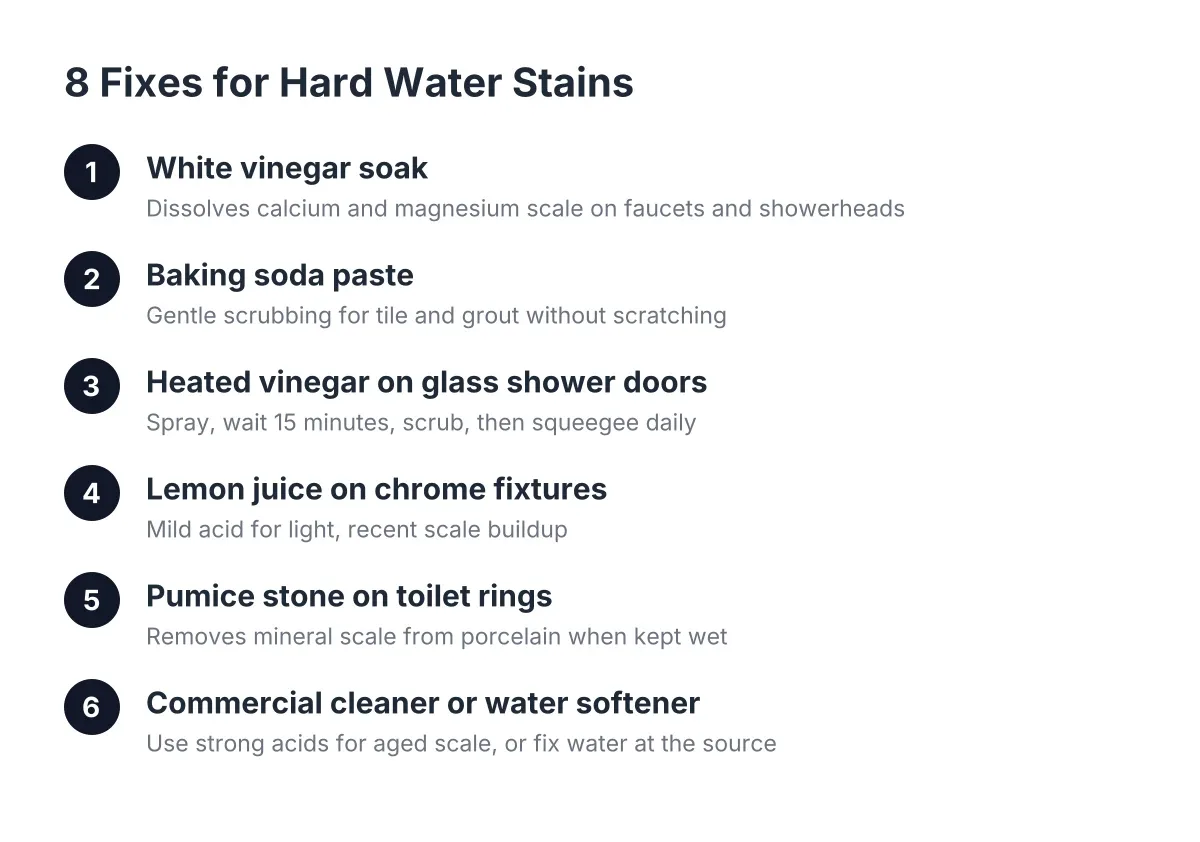
1. White Vinegar: The Everyday Hard Water Stain Remover
Plain white vinegar is the cheapest and most reliable hard water stain remover for most surfaces in your house. The stains are mostly calcium and magnesium, which are alkaline. Vinegar is a mild acid, so it dissolves them on contact.
For faucets and showerheads, soak a rag in vinegar and wrap it around the fixture for 30 to 60 minutes, then wipe and rinse. For a clogged showerhead, fill a plastic bag with vinegar, secure it around the head with a rubber band, and leave it overnight. The spray pattern usually comes back by morning.
One caution: keep vinegar off natural stone like marble or granite. The acid that eats mineral scale will also etch stone.
2. Baking Soda Paste for Tile and Grout
Baking soda works where you need gentle scrubbing power without scratching. Mix it with a little water into a thick paste, spread it over stained tile or grout lines, and let it sit for 10 to 15 minutes. Then scrub with a stiff brush and rinse.
For stubborn spots, follow the baking soda with a vinegar spray. The fizzing action helps lift scale out of grout pores. This combination handles most bathroom tile stains without harsh chemicals, which matters if you have kids or pets in the house.
3. What Removes Hard Water Stains from Glass Shower Doors
What removes hard water stains from glass shower doors best is a heated vinegar solution applied with a non-scratch scrub pad, followed by a squeegee habit that keeps the stains from returning. Warm the vinegar slightly, spray it on the glass, wait 15 minutes, and scrub in circles. Rinse with clean water and dry the glass completely.
However, if the door has been fogging for years, the minerals may have etched into the glass itself. Etching is permanent. At that point no amount of removing hard water stains from glass will restore full clarity, and replacement is the honest answer. This is the hidden cost of untreated hard water: the stain becomes the surface.
A daily squeegee after showering prevents about 90 percent of new buildup on glass. It takes 30 seconds and costs almost nothing.
4. Lemon Juice for Chrome Faucets and Fixtures
Lemon juice is another mild acid, and it works well on chrome where you want shine without residue. Cut a lemon in half and rub it directly on the faucet, or apply juice with a cloth. Let it sit for 10 minutes, then rinse and buff dry with a microfiber towel.
In addition, lemon leaves a cleaner smell than vinegar, which some homeowners prefer for kitchen fixtures. It handles light, recent scale buildup well. For thick crust that has built up over months, go back to the vinegar soak in method one.
5. Pumice Stone for Toilet Bowl Rings
That stubborn ring at the waterline in your toilet is mineral scale, often tinted yellow or rust-red by iron. Iron and manganese staining is common across the Minneapolis suburbs, especially in homes on well water. A wet pumice stone rubs the ring off porcelain without scratching, as long as you keep both the stone and the surface wet.
Work gently and rinse often. Never use pumice on fiberglass, acrylic, or plastic; it will scratch those surfaces. For weekly maintenance, a cup of vinegar poured into the bowl and left for an hour keeps rings from reforming as fast.
6. Commercial Cleaners: When to Use a Store-Bought Hard Water Stain Remover
A store-bought hard water stain remover earns its shelf space when household acids fail, which usually means thick, aged scale or iron staining. These products use stronger acids, such as sulfamic or hydrochloric acid, that cut through buildup vinegar cannot touch. They work fast on bathtub rings, toilet bowls, and heavily crusted fixtures.
Follow the label exactly. Ventilate the room, wear gloves, and never mix acid cleaners with bleach or ammonia. Test a hidden spot first, because strong acids can dull some finishes, especially brushed nickel and oil-rubbed bronze.
Use these as a reset, not a routine. If you need a heavy-duty cleaner every month, the problem is upstream in your water, not in your cleaning products.
7. How to Get Rid of Water Stains on Glass Windows
How to get rid of water stains on glass windows starts with a 50/50 vinegar and water spray, a soft scrub with a non-abrasive pad, and a thorough dry with a squeegee or lint-free cloth. Sprinkler overspray and rain runoff leave the same mineral spots outside that your shower leaves inside.
For spots that survive the vinegar, a dedicated glass polish with light abrasives, applied with a soft cloth in small circles, usually finishes the job. As with shower doors, old spots can etch permanently, so tackle window stains within a few weeks of noticing them.
8. Fix the Water, Not Just the Stains
Every method above treats the symptom. The stains come back because the water has not changed. A water softener removes the calcium and magnesium before they ever reach your faucets, glass, and appliances. According to North Dakota State University Extension, softeners use salt to regenerate a resin bed, and that resin bed is what pulls the hardness minerals out of your water.
The case for treating the water gets stronger when you list what hard water touches:
- Shower doors and glassware that fog and etch over time
- Faucets and showerheads that clog with white scale
- Water heaters that lose efficiency as scale coats the heating elements
- Dishwashers and washing machines whose spray jets clog and fail early
- Skin and hair that feel dry, and laundry that fades faster
- Soap and detergent that lather poorly, so you use more of both
Suppose a couple relocates from Seattle, where the water is soft, and closes on a house in a Minneapolis suburb in spring 2026. Within three weeks they notice cloudy dishwasher glasses, white crust on the kitchen faucet, and a film on the new shower door. In that scenario, nothing is wrong with the house or their cleaning. The home simply has no water softener, and the local water is hard enough to show damage fast. A properly sized softener install, often in the range of a few thousand dollars depending on the system and the home, stops the cycle at the source.
Softened water does not just prevent new stains. It also slows the yellowish-red staining that hard and iron-rich water leaves around drains and toilet water lines, and it protects the appliances you just bought for the new place. Left alone, hard water damage compounds: the scale you can see on the faucet is also forming inside your water heater and dishwasher, where you cannot scrub it.
How Do You Know If Your Home Needs a Softener, Not Just a Cleaner?
Your home likely needs a water softener if stains return within days of cleaning, glasses come out of the dishwasher cloudy, showerheads clog repeatedly, or appliances fail earlier than they should. In the Twin Cities, the odds are not in your favor. According to the USGS Water Quality Portal, 65 of Minnesota's 87 counties have very hard water above 180 mg/L, and the statewide average of 278.3 PPM lands in the very hard category.
Therefore, if you are new to Minneapolis, assume hardness until a test says otherwise. A water hardness test, either a home test strip or a professional test during a service call, gives you a real number in grains per gallon. That number drives everything: whether you need a softener at all, what size, and whether you also need iron filtration or a whole-house filter for other water quality issues.
A few decision points worth knowing before you talk to an installer:
- Softener vs. filter system. A water softener removes hardness minerals. A water filter system targets taste, odor, sediment, or contaminants. Many Minneapolis homes benefit from a softener alone; some well-water homes need both.
- Salt vs. salt-free. Salt-based softeners remove hardness. Salt-free conditioners alter how minerals behave but leave them in the water. For 15+ grain water, salt-based systems are the proven fix for stains and scale.
- Sizing. An oversized unit wastes salt and water; an undersized one lets hardness slip through. Sizing depends on your hardness number, household size, and water use, which is why the test matters.
- Ongoing costs. According to Culligan, typical households refill softener salt every two to four months, and high-efficiency units can be programmed to use less salt, water, and energy than standard models.
One trade-off deserves honesty: a softener is an investment plus modest ongoing salt costs, and it needs occasional maintenance like brine tank cleanout. If your stains are mild and you rent or plan to move soon, a good cleaning routine may be the practical choice. If scale is already damaging fixtures and appliances in a home you plan to keep, treatment usually pays for itself in appliance life alone. When in doubt, have a local water treatment specialist test your water and size a system before you buy anything.
The Bottom Line for Minneapolis Homeowners
Vinegar, baking soda, lemon juice, pumice, and a strong commercial hard water stain remover will handle the stains you have today. Use the gentlest method that works for each surface, and act before minerals etch into glass permanently. But in a metro where the water runs 15 or more grains per gallon, cleaning is a treadmill. A properly sized water softener installation is the only fix that stops new scale buildup from forming in the first place, on your shower door and inside the appliances you cannot see.
If you need water softener installation, Twin Cities Water Softening can help.
Prefer to talk it through? Call +16512171659 — a quick call is usually the fastest way to get a straight answer for your situation.