
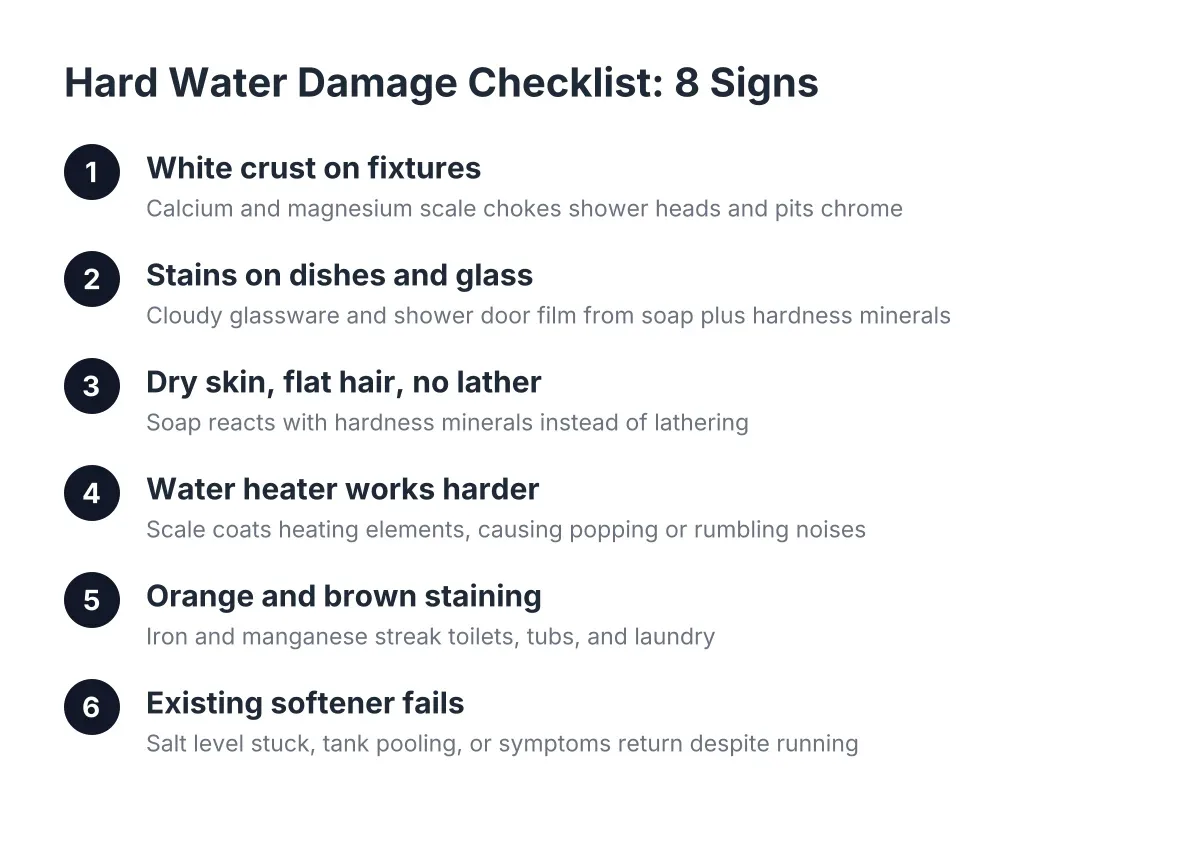
Signs You Need Water Softener Installation: A Hard Water Damage Checklist
If you just moved to Minneapolis, or your old softener finally quit, the signs you need water softener installation are probably already showing up around your house. Spotted glasses, crusty faucets, a water heater that groans, dry skin after every shower. This hard water damage checklist walks through eight signs, one by one, so you can confirm the problem and know exactly what happens next when a local installer shows up. No upsell, no scare tactics; just what a water softener specialist actually looks for in a Twin Cities home.
Minneapolis water is genuinely hard. According to the USGS Water Science School, the median hardness across 49 measured Minnesota cities is 162.0 mg/L, about 9.5 grains per gallon, and 61% of those cities fall in the hard or very hard range. If you relocated here from a soft-water region, your new house is fighting a battle your old one never had to.
1. White Crust on Faucets, Shower Heads, and Fixtures
Scale buildup on your fixtures is the most visible of all the signs you need water treatment in your home. Hard water leaves calcium and magnesium behind every time it dries, and that white or gray crust chokes off shower heads and pits chrome finishes over time.
Run your thumbnail across the faucet aerator. If it flakes white, you have hard water doing damage everywhere else too, including places you cannot see. A water softener shower head can mask the symptom in one bathroom, but it does nothing for your water heater, dishwasher, or pipes. A whole-house water softener treats every line, not one fixture.
2. Hard Water Stains on Dishes, Glass, and Shower Doors
Cloudy glasses out of the dishwasher and a film on the shower door are classic hard water stains. Soap and hardness minerals combine into scum that vinegar only removes temporarily; the stains come right back with the next wash.
For example, say a couple who just closed on a house in Golden Valley notices their glassware looks etched after three weeks, even though the same dishwasher ran spotless in their old Seattle home. That is not the dishwasher failing. That is Minneapolis-metro water at 9 or 10 grains per gallon doing what it does. In that scenario, an installer would test the water at the tap, confirm the hardness number, and size a softener to match.
3. Dry Skin, Flat Hair, and Soap That Will Not Lather
Hard water reacts with soap instead of letting it lather, so you use more shampoo and still step out feeling tight and itchy. If your skin got worse within weeks of moving here, or within days of your old softener dying, water is the likely cause. Using a hard water damage checklist like this one helps identify whether a softener is the solution.
Some homeowners try a water softener for shower use only, a filter cartridge that screws onto the shower arm. Those cartridges reduce chlorine more than hardness, and they wear out fast. If soft skin and clean-rinsing hair are the goal, treating the whole house is the fix that lasts.
4. Your Water Heater Works Harder Every Year
Scale settles inside the water heater tank and coats the heating elements. As a result, the heater runs longer to hit the same temperature, and you may hear popping or rumbling as water flashes to steam under the scale layer. In a hard-water metro like Minneapolis, an unprotected water heater loses efficiency and lifespan year after year.
To be clear, noise from the tank is a sign of hard water damage, not always a heater emergency. However, if the tank is leaking or you have no hot water at all, that is a water heater problem first; call the right trade for that repair, then deal with the hard water that caused it.
5. Orange and Brown Staining in Toilets, Tubs, and Laundry
Iron and manganese staining is common across the Minneapolis suburbs, especially on private wells and in some municipal systems. Orange streaks in the toilet bowl, brown rings in the tub, and dingy whites out of the laundry point to iron in the water on top of the hardness.
This matters for equipment selection. A standard softener handles some dissolved iron, but heavier iron loads need dedicated iron filtration ahead of the softener, or the resin bed fouls early. A local installer who tests for iron before sizing the system saves you from replacing a ruined resin tank in three years.
More Signs You Need Water Softening: When an Existing System Fails
The first five signs point to homes that never had treatment. The next three are for homeowners whose softener quit. If hard water spots came back after years of soft water, your system is telling you something, and the fix might be a repair rather than a full softener replacement. This hard water damage checklist section covers problems specific to existing systems that have started to fail.
6. Salt Sits in the Brine Tank and Never Goes Down
A healthy softener eats salt. According to North Dakota State University Extension, softeners rely on salt to regenerate the resin bed, which is what pulls hardness minerals out of your water. Culligan notes that typical households refill salt about every two to four months. If your Morton water softener salt level has not budged in months, the unit is not regenerating.
Common causes include a salt bridge, a hard crust that leaves a hollow gap under the surface, or a failed valve motor. In addition, Cargill points out that softener salt contains insoluble material that collects at the bottom of the brine tank and needs periodic cleanout. A stuck salt level is often a service call, not a death sentence for the unit.
7. Water Pooling Around the Softener or a Stuck Bypass Valve
Water on the basement floor near the resin tank demands action the same day. First, use the softener's own valves. According to InspectAPedia, softeners typically have dedicated inlet and outlet valves separate from the main house shutoff, so you can isolate the unit without cutting water to the whole house. Put the unit in bypass, mop up, and you have stopped the damage while you sort out repair versus replacement.
A bypass valve that is stuck or dripping is a repairable part on most units. Therefore, do not assume a leak means buying new. A specialist will check the valve body, the rotor seals, and the drain line before recommending anything bigger. If the tank itself is cracked, replacement is the honest answer; seals and valves usually are not.
8. Hard Water Symptoms Return Even Though the Softener Runs
The sneakiest failure is a softener that cycles on schedule but no longer softens. Old timer-based units regenerate on the clock whether you need it or not, wasting salt while the exhausted resin lets hardness through. The Minnesota Pollution Control Agency has flagged this waste directly; a rebate program in Marshall, Minnesota paid $500 to $700 to residents who replaced timer-based softeners, and the broader program cut salt use by up to 320,000 pounds per year, with some households cutting salt use by as much as 86%.
The diagnostic is simple and any competent installer starts here: test water hardness before and after the softener, on both hot and cold lines. That one test tells you whether the unit is not softening at all, only partially softening, or running out of capacity before its next cycle. It also settles the repair-versus-replace question with a number instead of a sales pitch.
What Happens After You Confirm the Signs: Your Hard Water Damage Action Plan
Once the checklist points to yes, the water softener installation process itself is straightforward. In 2026, a metered, demand-based unit sized to your household is the standard recommendation for Minneapolis homes; it regenerates based on actual water use, which saves salt and protects the groundwater that, per the Minnesota Pollution Control Agency, 75% of Minnesotans rely on for drinking water. Here is what to expect from a typical local install:
- Water test first. Hardness in grains per gallon, plus iron and manganese if staining suggests it. The numbers drive the sizing, not a catalog page.
- Sizing and selection. Household size, fixture count, and hardness determine capacity. Look for NSF/ANSI 44 certification, which NSF International describes as independent verification that a unit removes calcium and radium from water.
- Line inspection. The installer checks your plumbing near the install point; corroded old iron pipe sometimes needs a short section replaced before the unit goes in.
- Install and program. Most replacements finish in a few hours; a first-time install with new plumbing loops takes longer. The unit gets programmed to your tested hardness.
- Verification. Water gets tested again after the softener to confirm it is actually producing soft water before the installer leaves.
One trade-off worth naming: softeners add sodium to the water and discharge brine to the drain, which is why Minnesota pushes high-efficiency units. NSF International notes most units can run on potassium chloride instead of standard sodium chloride salt if that concerns you, though potassium costs more per bag. If your home is on a private well with heavy iron, or you cannot tell whether a basement leak is the softener or the plumbing, bring in a professional before spending money on equipment; misdiagnosing that one costs far more than the service call.
The signs you need water softening are not subtle in this metro. The USGS Water Quality Portal shows 65 of Minnesota's 87 counties have very hard water above 180 mg/L. Walk the checklist, get a hardness test, and you will know whether you need a repair, a replacement, or your home's first softener.
If you need water softener installation, Twin Cities Water Softening can help.
Prefer to talk it through? Call +16512171659 — a quick call is usually the fastest way to get a straight answer for your situation.