
What Whole-House Water Filtration Removes: Sediment, Chlorine, Iron, and More
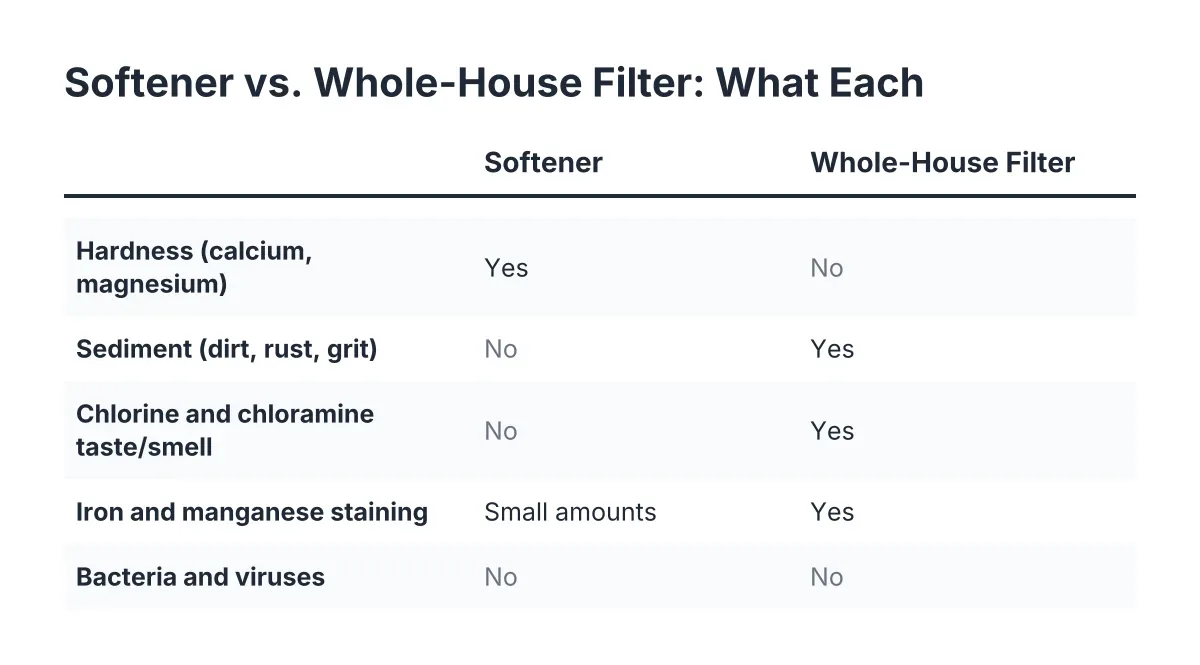
If your old water softener is on its way out, this is the right time to ask what whole-house water filtration removes and whether adding a filter alongside your new softener makes sense. The two systems solve different problems. A softener pulls out calcium and magnesium. A whole-house filter catches the stuff a softener was never built to handle: sediment, chlorine, iron, and in some cases bacteria. This guide walks through each contaminant, what removes it, and how filtration fits into a complete hard-water setup for a Minneapolis home.
We install both softeners and whole-house filter systems, so this is not a pitch to bolt more equipment onto your utility room. Plenty of Minneapolis homes do fine with a softener alone. But if you are replacing a 15-year-old unit anyway, it costs less to plan the whole setup now than to cut into the same pipe twice.
Why Minneapolis Water Needs More Than a Softener
Minneapolis water starts hard. The metro draws mineral-heavy water from the Mississippi River, and hardness runs 15 or more grains per gallon for Minneapolis-area homes, according to HomeWater 101. Across the state the picture is similar. Per the USGS Water Science School, the median hardness across 49 measured Minnesota cities is 162.0 mg/L, about 9.5 grains per gallon, and 61 percent of those cities fall in the hard or very hard range.
Hardness is only part of the story, though. City water carries chlorine from treatment. Suburban well water often carries iron, manganese, sediment, and sometimes odor. A softener addresses none of the chlorine and only a little of the iron. That gap is exactly where a whole-house filter earns its place.
Here is a mistake we see homeowners make during a softener replacement. They assume the new softener will fix the chemical taste or the faint pool smell in the shower. It will not. Soft water alone does not remove chlorine taste or smell. If that bothers you now, it will bother you after the new softener goes in. A carbon filter fixes it; a resin tank does not.
What Whole-House Water Filtration Removes, Contaminant by Contaminant
A whole-house filtration system removes sediment, chlorine and chloramine, iron and manganese, and, with the right add-on, bacteria and viruses. Each of these takes different filter media, so "whole-house filter" is not one product. It is a category, and the right build depends on what is actually in your water.
Let's take them one at a time.
Sediment: Dirt, Rust, and Grit
Sediment filters remove physical particles: dirt, sand, silt, and rust flakes. This matters more than people expect. Every particle that gets past your main line ends up somewhere, usually inside a fixture, a toilet fill valve, or the screen on your new softener's control valve.
A sediment pre-filter placed ahead of your softener protects the equipment you just paid for. Resin beds foul faster when grit gets into them. If you are replacing a softener because the old one quit early, sediment may be part of why. A basic cartridge pre-filter is cheap insurance for the new unit.
Well water homes in the western and southern suburbs see the most sediment. City water in Minneapolis proper is cleaner on this front, but older service lines can still shed rust, especially after street work stirs things up.
Chlorine and Chloramine: Taste and Smell
Carbon filtration is what removes chlorine from whole-house water. Minneapolis treats its municipal water with disinfectant, which keeps it safe on the way to your house. Once it arrives, though, many homeowners want the chlorine out. It affects taste, it dries skin, and it can shorten the life of rubber seals in fixtures and appliances.
A pitcher filter or fridge filter handles chlorine at one tap. That is what those filters are actually for: improving taste on city water at a single point of use. A whole-house carbon filter does the same job at every tap, every shower, and every appliance.
Better carbon systems layer media to widen coverage. A combination of KDF media, catalytic carbon, and coconut-shell granular activated carbon can target chlorine, chloramine, and a broader range of chemicals, including THMs and PFAS compounds. If PFAS is a concern for your household, ask for a system built for it specifically, because standard carbon cartridges vary in how well they handle it. Whole-house units marketed for lead or fluoride removal also exist, but those claims depend on the specific media and certification, so verify before you buy.
Iron and Manganese: The Staining Minerals
Iron filtration removes the dissolved and particulate iron that leaves orange stains on tubs, toilets, and laundry. Manganese does the same in black or brown. Both are common in suburban Twin Cities well water, and both are the reason a brand-new softener can still leave you scrubbing stains.
Here is the honest breakdown. An ion exchange softener can reduce small amounts of iron along with hardness minerals, according to Penn State Extension. Small amounts is the key phrase. Once iron climbs past what the resin can handle, it fouls the bed, shortens softener life, and keeps staining fixtures anyway.
Iron-heavy well water usually needs a dedicated iron filter paired with the softener. The iron filter takes the iron out first; the softener then handles hardness without getting wrecked in the process. Get your water tested before you size anything. The test tells you whether your iron level sits in softener territory or dedicated-filter territory, and guessing wrong costs you a resin tank.
Bacteria: Where Filters Stop and UV Takes Over
Standard sediment and carbon filters do not remove bacteria. This is the most important limitation to understand. If a well test comes back positive for coliform bacteria, no cartridge filter fixes that. The tool for microbes is ultraviolet disinfection, a UV unit installed after your other treatment equipment that neutralizes bacteria and viruses as water passes through.
UV works best on clear water, which is why it always goes last in the treatment chain. Sediment and iron shield microbes from the light, so the filters upstream do double duty; they clean the water and they make the UV effective. A bacteria problem in a private well is also a case where you should involve a professional and follow state well-testing guidance, not just add hardware.
What Filtration Does Not Remove: Hardness Stays
Whole-house water filtration removes particles, chemicals, and metals, but it does not remove calcium and magnesium in any meaningful amount. Carbon and sediment media are not built for dissolved hardness minerals. If you install a filter and skip the softener in a 15-grain metro home, you will still get scale buildup in the water heater, spots on dishes, and crusted showerheads.
This is why "filter or softener" is usually the wrong question here. In the Twin Cities, hardness is a given. The real question is whether your water has problems beyond hardness. If the answer is yes, chlorine smell, iron stains, gritty aerators, you pair the two. If the answer is no, a properly sized softener alone may be the whole fix.
Removing hardness is the softener's job, and it does that job through ion exchange. The resin bed trades hardness minerals for sodium, and salt regenerates the resin so it can keep working, as North Dakota State University Extension explains. Look for NSF/ANSI 44 certification on the new unit; per NSF International, that certification means independent testing verified the unit removes calcium as well as radium-226 and radium-228.
How a Combined Filter and Softener Install Goes In
A water filter and softener combo install follows a set sequence, and the order matters. Water should hit the coarse cleanup stages first and the fine or final stages last. A typical whole-house layout runs like this:
- Main water line enters the house (with a pressure tank first, on well systems).
- Sediment pre-filter catches dirt, sand, and rust.
- Iron filter, if your test shows you need one.
- Water softener removes hardness.
- Carbon filter handles chlorine, taste, and odor (on city water, this often sits before or after the softener depending on the design).
- UV disinfection, if bacteria treatment is needed, goes last.
- Treated water feeds the water heater and the rest of the house.
For a replacement project, this sequencing is good news. The installer is already cutting into the main line to swap the softener. Adding a filter housing at the same time means one shutoff, one solder-and-fit session, and one afternoon of disruption instead of two separate service calls.
On the mess question, a competent installer isolates the work area, drains the old unit before moving it, and hauls the old tank out. Softeners typically have dedicated inlet and outlet valves separate from the main house shutoff, according to InspectAPedia, so once the new bypass valve is in, future service on the unit will not require shutting water to the whole house.
A Realistic Replacement Scenario
Suppose a homeowner in Bloomington has a 16-year-old softener that regenerates loudly, eats salt, and still leaves faint orange rings in the toilets. A water test shows 18 grains of hardness and moderate iron. In that scenario, the sensible build is a sediment pre-filter, an iron filter, and a new high-efficiency softener sized for the household, installed in one visit.
The old softener was masking the iron problem badly and burning itself out doing it. The new setup splits the work: the iron filter protects the softener, the softener handles hardness, and the pre-filter protects both. Additionally, the homeowner replaces on their own schedule instead of during a Saturday flood, which was the whole point of planning ahead.
Costs vary with the equipment and the water, so treat any figure as an illustrative estimate; a basic cartridge pre-filter adds modest cost to a softener install, while an iron filter or carbon tank is a larger line item. The test results, not a sales pitch, should drive which pieces you actually need.
Sizing and Selecting Without Getting Oversold
Right-sizing starts with two numbers: your water hardness in grains per gallon and your household's daily water use. A family of four on Minneapolis city water at 15-plus grains needs a different capacity than a two-person household in a townhome. An installer who quotes a system without asking about hardness and household size is guessing, and oversized systems waste salt and water on regeneration cycles you do not need.
Modern equipment helps here. High-efficiency softeners can be programmed to use less salt, water, and energy than standard units, according to Culligan. That efficiency matters beyond your basement. Per the Minnesota Pollution Control Agency, 75 percent of Minnesotans rely on groundwater for drinking water, and softener salt discharge contributes to chloride contamination; in the Twin Cities metro, 27 percent of monitored shallow-aquifer wells exceeded EPA chloride guidelines.
Therefore, replacing a salt-hungry old unit is one of the more useful upgrades you can make, for your water bill and the watershed both. The Minnesota Pollution Control Agency documented a rebate and optimization program in Marshall where some households cut salt use by as much as 86 percent. An old builder-grade softener from 2010 was not designed with that kind of efficiency in mind.
For property managers running multiple buildings across the metro, the same logic scales. Standardizing on one softener model and one filter housing across units means one set of spare cartridges, one maintenance routine, and predictable service tickets instead of a different mystery unit in every mechanical room. Water treatment chemistry does not change building to building, but water quality can, so test each property rather than assuming one building's iron problem applies portfolio-wide.
Keeping the System Working After Install
A whole-house filter is low-maintenance, not no-maintenance. Plan for a simple routine and the system will protect your fixtures for years.
- Sediment cartridges: swap every 3 to 6 months, sooner on high-sediment wells. A pressure drop at your taps is the usual sign the cartridge is loading up.
- Carbon cartridges or tanks: replace on the schedule for your water use; carbon that is spent stops removing chlorine but gives no obvious warning, so track the date.
- Iron filters: most backwash automatically; confirm the backwash cycle is running and the drain line is clear.
- Softener brine tank: salt contains insoluble material that settles at the bottom over time and needs periodic cleanout, according to Cargill. Check salt level monthly.
- Salt type: most units can run standard sodium chloride or potassium chloride as the regenerant, per NSF International, as long as the setting matches the salt you load.
- Sanitizing: Kinetico notes a softener should be sanitized after a boil-water order, after extended non-use, or if taste or odor turns bad, which matters most on private wells.
Keep a filter removal tool, usually a plastic housing wrench, hanging next to the filter housings. Cartridge changes take ten minutes when the wrench is where you left it and half a Saturday when it is not. Shut the inlet valve, relieve pressure at the housing button, and swap the cartridge; most homeowners handle this themselves after watching the installer do it once.
The Bottom Line for Your Replacement Project
Whole-house water filtration removes the contaminants your softener cannot touch: sediment that clogs fixtures, chlorine that ruins taste, iron that stains everything, and, with UV added, bacteria in well water. The softener still owns the hardness problem, and in this metro, hardness is not optional to treat.
If your old unit is 15 years old and limping, replace it before it fails, and use the same install window to fix whatever else your water test turns up. One test, one plan, one visit. That is how you end up with a utility room that works quietly for the next 15 years instead of a new softener fighting the same old water.
If you need water softener installation, Twin Cities Water Softening can help.
Prefer to talk it through? Call +16512171659 — a quick call is usually the fastest way to get a straight answer for your situation.